

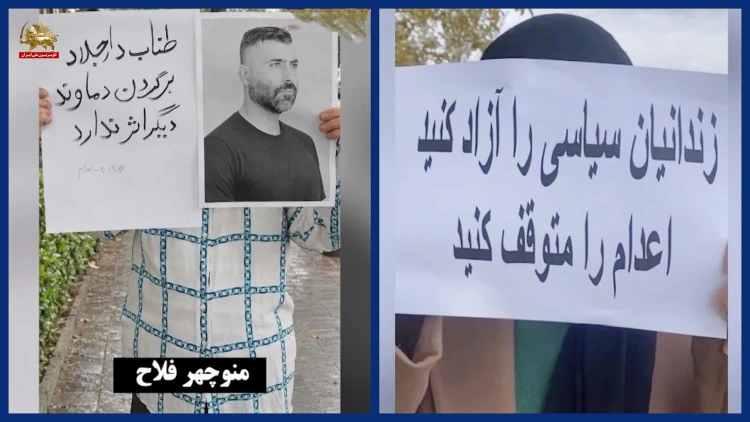

On November 3, 2026, Resistance Units affiliated with the People’s Mojahedin Organization of Iran (PMOI/MEK) carried out anti-regime activities across Iran in solidarity with the “No to Executions Tuesdays” campaign, displaying placards and photographs of political prisoners facing death sentences. The activities took place in Tehran, Isfahan, Shiraz, Rasht, Karaj, and several other cities, conveying a message of opposition to the regime’s use of executions to suppress dissent.
The activities coincided with the 145th consecutive week of the “No to Executions Tuesdays” campaign, during which prisoners across 66 prisons staged hunger strikes against capital punishment. Through their slogans, the Resistance Units demanded the abolition of executions, the immediate release of political prisoners, and an end to the regime’s policy of intimidation through death sentences.
Resistance Units demand an Iran without executions
In Isfahan, Resistance Units displayed placards declaring, “We are neither afraid of threats nor will we remain silent in the face of executions.” Other messages called for the release of political prisoners and the complete abolition of capital punishment.
November 3—Iran
PMOI/MEK Resistance Units express their support with the "No to Executions Tuesdays" campaign with anti-regime activities, holding photos of death-row political prisoners and condemning the regime's policy of ruling through terror and executions. https://t.co/WBRxG7XSa0 pic.twitter.com/LbOnZvGvvs— People's Mojahedin Organization of Iran (PMOI/MEK) (@Mojahedineng) November 4, 2026
One placard stated, “We demand the abolition of executions. Executions will not silence the voice of freedom.”
Similar messages appeared in other cities. In Karaj, Resistance Units declared, “An Iran without executions: that is the demand of all the people of Iran.” In Lahijan, activists raised the same demand, while in Kerman, Resistance Units called for the immediate release of political prisoners.
These slogans reflected a rejection of capital punishment as an instrument of political repression. By linking the abolition of executions to the release of prisoners, the Resistance Units challenged the regime’s use of its judiciary and prison system to silence opposition and intimidate society.
Solidarity with political prisoners facing execution
A prominent feature of the November 3 activities was the display of photographs of political prisoners whose lives have been threatened by death sentences.
In Shiraz, Resistance Units held photographs of Mohammad Javad Vafaei Sani, Zahra Tabari, and Arghavan Fallahi, accompanied by the slogan “No to execution.”
Vafaei Sani, a boxing champion and coach arrested in Mashhad in March 2020, has faced repeated death sentences for his alleged affiliation with the PMOI. In October 2025, the regime’s Supreme Court upheld his death sentence.
Shiraz
Photo of death-row political prisoner Zahra Tabari with the slogan "No to execution" pic.twitter.com/fLA5R7sCTo— People's Mojahedin Organization of Iran (PMOI/MEK) (@Mojahedineng) November 4, 2026
Zahra Tabari, a 68-year-old electrical engineer arrested in April 2025, was sentenced to death on charges related to PMOI membership. After her case was referred for retrial, a Revolutionary Court in Rasht issued another death sentence on April 14, 2026.
Arghavan Fallahi, a 25-year-old PMOI supporter imprisoned in Evin Prison, was sentenced to death in July 2026 on charges of baghi, or armed rebellion.
In Rasht and Tehran, Resistance Units drew attention to Manouchehr Fallah, a political prisoner detained since June 2023. On October 22, 2026, the regime’s Supreme Court upheld his death sentence on charges of PMOI membership and referred his case to the office responsible for implementing verdicts.
A placard in Tehran warned, “The life of Manouchehr Fallah is in danger. No to executions. Political prisoners must be freed.”
Defying the regime’s campaign of intimidation
In Tehran, Resistance Units directly challenged the regime’s reliance on executions to suppress opposition. One placard warned, “If you execute, there will be an uprising. No to executions.” Another declared, “Our response to executions is fiery uprisings.”
Other messages rejected the belief that imprisonment and capital punishment could extinguish resistance. In Chalus, Resistance Units declared, “Neither executions nor prison will stop us.” In Yazd, protesters stated, “We will not surrender to executions and repression.” In Ramsar, another message predicted the downfall of the regime.
Tehran
"Our response to executions is fiery uprisings" pic.twitter.com/gdPnsfs5XI— People's Mojahedin Organization of Iran (PMOI/MEK) (@Mojahedineng) November 4, 2026
In Rasht, Resistance Units also called for any negotiations with the regime to be conditioned on a halt to executions.
Bringing the prisoners’ demands beyond prison walls
The Resistance Units’ activities coincided with the 145th week of the “No to Executions Tuesdays” campaign, launched in January 2024 by prisoners protesting the increasing use of capital punishment.
Despite threats, restrictions on communications, and punitive measures by prison authorities, the weekly hunger strikes have continued and expanded to 66 prisons.
Tehran
"We swear on the blood of our comrades that we will stand till the end" pic.twitter.com/B5RVgPOSyI— People's Mojahedin Organization of Iran (PMOI/MEK) (@Mojahedineng) November 4, 2026
The campaign has also attracted growing international solidarity, including support from United Nations human rights experts and other prominent human rights figures.
The November 3 activities extended the prisoners’ demands into public spaces across Iran, linking the campaign inside the prisons with expressions of resistance outside them.
This solidarity was captured in a placard displayed in Karaj: “Political prisoners are not alone. We are their voice. No to executions.”
The November 3 activities underscored the Resistance Units’ determination to challenge the regime’s execution campaign and defend political prisoners.
In Tehran, a placard declared, “We swear on the blood of our comrades that we will stand till the end.” In Isfahan, another proclaimed, “Executions will not silence the voice of freedom.”
Across Iran, these activities reinforced the call for an Iran without executions and affirmed that the campaign against capital punishment would continue despite repression.