

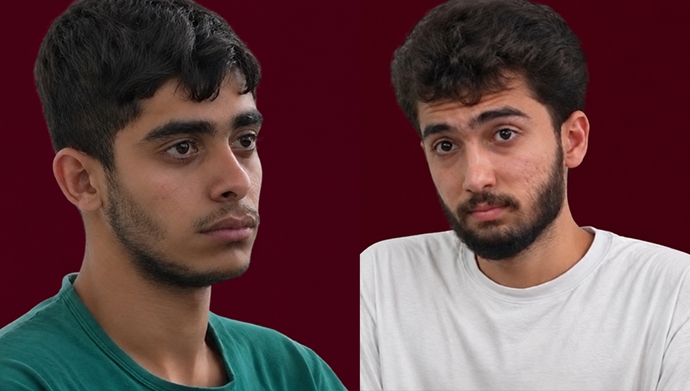

On November 3, 2026, the Iranian regime executed Amir-Hossein Maleki and Amir-Hossein Ebrahimi, two 20-year-old prisoners arrested in connection with the January uprising, at Dastgerd Prison in Isfahan. They were among 12 protesters sentenced to death in the Alikhani Square case.
Their executions bring to nine the number of defendants put to death in this single case since July. Three others remain on death row. Since the first hangings in July, the case has become emblematic of the regime’s response to the January uprising, combining deeply flawed judicial proceedings with successive executions intended to intimidate a restive society.
The regime’s judiciary charged Maleki and Ebrahimi with moharebeh (waging war against God) and “corruption on earth,” alleging that they threatened national security and created widespread insecurity by brandishing weapons.
Mizan, the judiciary’s official news agency, alleged that the defendants possessed firearms, bladed weapons, incendiary materials, and Molotov cocktails. It also claimed that they attacked security forces and set fire to a police station.
The case stems from January 2026 clashes at Alikhani Square in Isfahan, where four members of the regime’s Special Units involved in suppressing protesters were killed. The regime used the defendants’ alleged involvement in those deaths to impose capital punishment, despite serious violations of their due-process rights.
The allegations were used to justify the harshest possible punishment against young people arrested during an uprising that directly challenged the regime’s authority. Yet the judicial proceedings deprived the defendants of fundamental protections needed to contest the accusations against them.
A judicial case stripped of fundamental legal protections
The Alikhani Square proceedings were marked by serious violations of basic fair-trial safeguards. The death sentences against 12 protesters were upheld by the regime’s Supreme Court on July 5, 2026, although the defendants had been denied the right to choose independent lawyers.
Even court-appointed defense attorneys were prevented from accessing the case files, undermining their ability to challenge the charges and evidence presented against the accused.
The death sentences were issued by Morteza Barati Dorcheh and Mohammad-Reza Tavakkoli, judges of the Revolutionary Court in Isfahan. Another 23 defendants in the same case received prison terms ranging from five to ten years.
Nine protesters executed in less than four months
The executions began on July 19, when authorities hanged Erfan Esfandiari, 18, and Gol-Mohammad Mohammadi, 24, an Afghan national. On July 28, Abolfazl Sepahi, 24, and Amirhossein Safari, 27, were publicly executed at Alikhani Square itself.
On August 20, Ghaem Hosseini, a 21-year-old prisoner of Afghan origin, became the fifth defendant from the case to be executed. On October 5, Alireza Sepahi, 24, and Alireza Raisi, 21, were hanged at Dastgerd Prison, raising the total to seven.
The executions of Maleki and Ebrahimi on November 3 raise that figure to nine.
Three other young defendants—Shervin Bagherian, 18; Ali Dashti, 19; and Abolfazl Ebrahimi, 18—remain at risk of execution. The succession of hangings has left these remaining prisoners facing the prospect of the same irreversible punishment.
The regime uses executions to prevent another uprising
The continuing executions reflect the regime’s attempt to deter another uprising by making participation in anti-government protests synonymous with the threat of imprisonment and death. The message extends beyond those already sentenced to the wider population that took part in the January uprising.
The flawed trials, public hangings, and repeated executions of young defendants form part of a campaign aimed at imposing fear. Yet the public reaction in Isfahan shows that brutality can also deepen resentment and provoke defiance.
This morning, the clerical regime executed 20-year-olds Amir Hossein Maleki and Amir Hossein Ebrahimi over the “Alikhani Square” protests in Isfahan during the January 2026 uprising.
Faced with growing resistance, the regime uses violent executions of PMOI/MEK political… pic.twitter.com/xh24D20cQE
— Maryam Rajavi (@Maryam_Rajavi) November 3, 2026
Mrs. Maryam Rajavi, president-elect of the National Council of Resistance of Iran (NCRI), strongly condemned the November 3 executions, declaring:
“The regime attempts to prevent the uprising with these executions, but this brutality only strengthens the resolve of the youth in their struggle.”
Mrs. Rajavi called on the United Nations, relevant international bodies, and human rights authorities to take immediate and effective action to halt the executions of political prisoners and January uprising detainees and overturn their death sentences.
She also reiterated the need to bring the regime’s leaders and judges to justice for decades of crimes against humanity and genocide.
With nine of the 12 Alikhani Square defendants already executed and three others facing the same fate, the case underscores both the regime’s reliance on capital punishment to suppress dissent and the urgency of international action to save the remaining prisoners.