

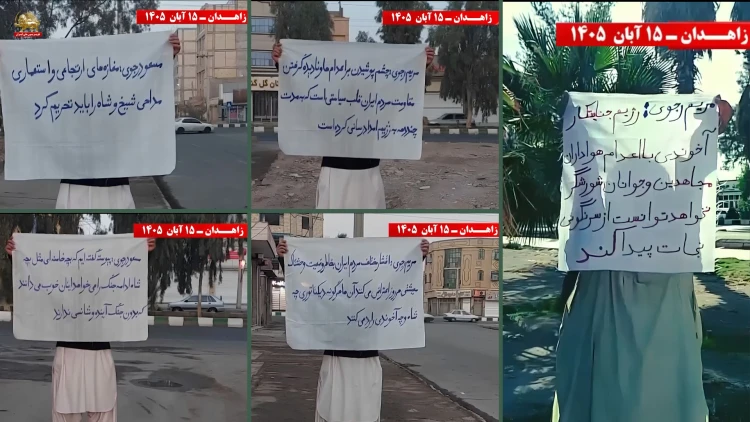

On November 6, 2026, Resistance Units affiliated with the People’s Mojahedin Organization of Iran (PMOI/MEK) resumed their weekly anti-regime activities in Zahedan, southeastern Iran, displaying placards in public locations to challenge the regime’s escalating campaign of executions and reaffirm their rejection of all forms of dictatorship.
The placards carried messages of resistance against repression, opposition to both the ruling theocracy and the former monarchy, and support for a democratic republic established through the struggle of the Iranian people.
November 6—Zahedan, southeast Iran
PMOI/MEK Resistance Units resume weekly anti-regime activities, defying the regime's growing wave of executions and reiterating the rejection of all forms of dictatorship, whether religious or monarchical. pic.twitter.com/eRNANqs2uc— People's Mojahedin Organization of Iran (PMOI/MEK) (@Mojahedineng) November 7, 2026
One of the slogans captured the central message of the campaign: “From Zahedan to Tehran, down with the oppressor, be it the shah or the supreme leader.”
The activities emphasized that neither executions nor political maneuvering can extinguish the Iranian people’s aspirations for freedom and democratic change.
Defying the regime’s campaign of executions
A central theme of the Resistance Units’ activities was the rejection of executions as a means of suppressing dissent. Against the backdrop of the regime’s growing use of capital punishment, the Resistance Units emphasized that repression would not succeed in silencing the opposition.
“The real answer to execution and repression is not compromise and fear, but uprising and steadfastness,” read one placard.
"The criminal mullahs' regime will not be able to save itself from overthrow by executing PMOI/MEK supporters and rebellious youth" pic.twitter.com/jUKeTY0mmu
— People's Mojahedin Organization of Iran (PMOI/MEK) (@Mojahedineng) November 7, 2026
Another warned: “The criminal mullahs’ regime will not be able to save itself from overthrow by executing PMOI/MEK supporters and rebellious youth.”
The slogans portrayed executions as an instrument of intimidation intended to discourage political opposition and prevent further uprisings. They also challenged the regime’s portrayal of political opponents as criminals.
“The true ‘crime’ of those executed and facing the gallows is simply their refusal to tolerate the ongoing captivity of the Iranian people under a criminal regime,” declared another placard.
Through these messages, the Resistance Units underscored their determination to continue challenging the regime despite the threat of repression.
Neither Shah nor mullahs: Rejecting all forms of dictatorship
A significant portion of the November 6 activities focused on rejecting both the clerical dictatorship and any attempt to restore the monarchy.
“The Iranian people have risen up to reject any form of dictatorship and will leave no room for either the mullahs or the Shah,” one placard declared.
Another delivered the same message more succinctly: “A dictator is a dictator, whether with a turban or a crown.”
"We have continuously said that Khamenei's son, like the Shah's son, wants the continuation of war. They know well that without war, they have no future and no chance." pic.twitter.com/BzE7gPgJwO
— People's Mojahedin Organization of Iran (PMOI/MEK) (@Mojahedineng) November 7, 2026
These slogans reflected the historical experience of Iran, where the 1979 revolution ended the Shah’s dictatorship but was followed by the establishment of another authoritarian system under clerical rule.
Their slogans emphasized that Iran’s future must be based on popular sovereignty rather than hereditary or religious rule.
One message connected this position to Iran’s democratic history: “The ‘Neither Shah nor mullahs’ doctrine is the true heritage and historical evolution of Dr. Mossadegh’s strategy of Negative Equilibrium.”
Another placard declared: “We want neither shah nor mullahs. Dictators be damned.”
Organized resistance as the path to democratic change
The Resistance Units also emphasized that Iran’s political future must be determined by the Iranian people and their organized resistance, rather than by foreign intervention, war, or accommodation with the ruling establishment.
“The overthrow of this regime and the establishment of a free Iran rest solely on the shoulders of our people and our organized resistance,” read one placard.
"True Islam is that which is at war and battle with the oppressive Shah and mullas, not that which engages in worship in the corner of a home or a monastery" pic.twitter.com/C8GEzRr89L
— People's Mojahedin Organization of Iran (PMOI/MEK) (@Mojahedineng) November 7, 2026
Another asserted that “the salvation of the Iranian people has one path; and only one path, and that is the overthrow of this evil regime through democratic revolution.”
The placards also criticized international policies that ignore human rights abuses and the Iranian people’s struggle for freedom.
“Turning a blind eye to executions and ignoring the Iranian people’s resistance is the heart of a policy that has provided aid to the Iranian regime for several decades,” one slogan stated.
Other messages rejected attempts to manufacture political alternatives through propaganda and externally backed campaigns, emphasizing instead the importance of an organized nationwide uprising.
Zahedan’s message of a democratic future
The November 6 activities concluded with a clear political message: the Iranian people’s struggle is not merely against the current rulers but against dictatorship in all its forms.
“The criminal mullahs’ regime cannot dishearten a people who are fighting for a democratic republic,” one placard declared.
Another called on the international community to recognize the Iranian people’s struggle against the regime and the fight of rebellious youth against the Islamic Revolutionary Guard Corps (IRGC).
By continuing their weekly activities in Zahedan, the PMOI Resistance Units reaffirmed their commitment to resisting executions, rejecting both monarchical and religious dictatorship, and pursuing a democratic future for Iran.