

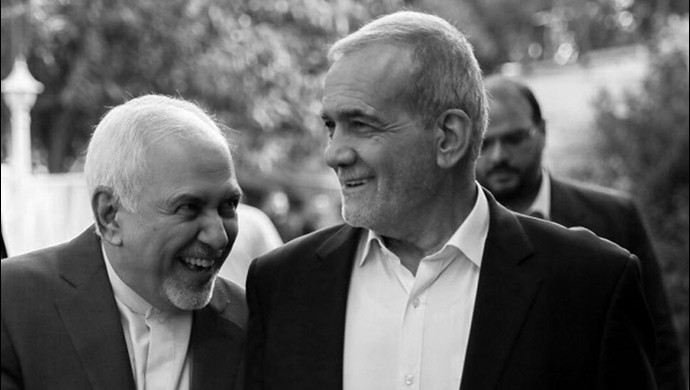

The government of Iranian regime president Masoud Pezeshkian introduced a bill to amend the “Method of Appointment of Individuals to Sensitive Positions” law as an urgent matter in the regime’s parliament. However, the proposal faced a humiliating defeat, with 207 votes rejecting its urgency.
The bill was presented urgently to secure the position former foreign minister Javad Zarif in Pezeshkian’s cabinet and prevent his resignation over having a dual-national child. However, the firm rejection of the bill further weakens Zarif’s already contentious position in the cabinet.
Members of parliament showed no leniency toward Pezeshkian’s government. In his remarks, MP Mehdi Kouchekzadeh referred to Zarif as one of the repentant, stating: “The Imam [reference to regime founder Ruhollah Khomeini] said the embrace of the country and the revolution is always open to those who wish to serve and return, but not at the expense of forsaking our principles and questioning why we chant ‘Death to America’? Why we enforce God’s decree against hypocrites and counter-revolutionaries?! The Imam said as long as I live, I will not allow liberals to rule. These individuals are using urgency as a pretext to clear the way for Zarif while claiming to support true servants.”
Challenging Majlis Speaker Mohammad Bagher Ghalibaf’s attempts to silence him, Kouchakzadeh also criticized Pezeshkian’s foreign minister, Abbas Araqchi, stating: “Today, the foreign minister, trained by none other than Mr. Zarif, said, ‘We are waiting to see what America does.’ Could there be a greater disgrace than this?”
Other members of parliament drew attention to the economic and livelihood crises, as well as rising costs, under Pezeshkian’s administration. MP Hossein-Ali Haji Deligani said, “Is the government so idle that it drafts a bill solely to address Mr. Zarif’s issue in his alleged role as deputy for strategic oversight? We expect this president to prioritize solving the people’s pressing problems.”
As a result, the proposed bill was sent to the Social Affairs Commission for future consideration, and Zarif remains a significant obstacle in Pezeshkian’s cabinet.
Comparing the November 17 parliamentary session to the August 22 session, in which Pezeshkian, according to Khamenei, managed to pass his cobbled-together cabinet through parliament, reveals a new balance within the regime, unfavorable to Pezeshkian.
In the summer, when Zarif resigned from the position of strategic deputy due to having a dual-national child, Pezeshkian reinstated him in a backroom deal, granting major cabinet shares to rivals in exchange. However, opponents did not relent. Hamid Rasaee, the third-ranking member of the regime’s parliament from Tehran, after warning Pezeshkian that “representatives will use their legal tools,” wrote on his X account, “Following a request from about 40 MPs, the National Security Commission’s report on the illegal appointment of Mr. Zarif, whose children hold U.S. citizenship, will be voted on in a public session. If the parliament votes, Mr. Pezeshkian’s violation case will be referred to the judiciary for expedited processing.”
Pezeshkian may have believed that an urgent bill could secure Zarif’s position in his cabinet amidst the crises facing the regime. This notion was supported by Hesamoddin Ashena, a regime analyst, who wrote on his X account about the government’s reliance on such figures: “Iran has activated all its diplomatic capacities for a prudent confrontation with January 20 (the inauguration of Donald Trump as the new U.S. president). The most experienced figures in formal diplomacy, secondary channels, public diplomacy, multilateral, and military diplomacy—from Ghalibaf to Larijani, Araqchi to Takht-Ravanchi, Zarif to Iravani—all pursue this objective.”
It is evident that in this “multifaceted” maneuvering, Zarif holds a special place. Newspapers with ties to the so-called “reformist” faction noted that he “knows the twists and turns of U.S. politics better than the streets of Tehran and New York.” However, with the parliament’s decisive opposition of 207 votes, Zarif’s position is now even more of a “serious obstacle,” and Pezeshkian himself has been left humiliated.