

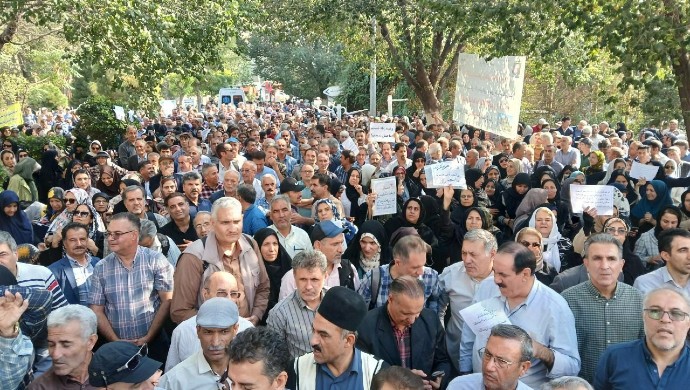

On November 16, retired teachers staged a protest in Tehran, chanting slogans such as, “Our outcry to the Pezeshkian government, shame on you,” “Government officials, have some shame and stop stealing our rights,” and “Oh lying government, where are the results of your promises?”
On the same day, IRNA, the official state news agency, reported bread price increases in Semnan Province and noted that the public was largely unaware of them. According to the report, the subsidized price of lavash bread in Semnan rose from 2,500 rials in 2021 to 6,250 rials in November 2024, while subsidized barbari bread increased from 7,500 rials to 18,750 rials during the same period. A quick calculation shows that bread prices have more than doubled in three years.
November 16—Tehran, Iran
Protest rally by retired teachers and education sector employees, demanding the implementation of pension adjustment laws and the payment of overdue wages and bonuses.#IranProtestspic.twitter.com/Ezjqy8fTfO— People's Mojahedin Organization of Iran (PMOI/MEK) (@Mojahedineng) November 16, 2024
The doubling of bread prices, one of the few staples still accessible to the impoverished, alongside a 50% increase in other food costs and soaring housing expenses, marks the 100-day record of the administration of Masoud Pezeshkian. Pezeshkian, who assumed office with promises to address livelihood issues, has surpassed the previous administration’s record by increasing executions by 80%, hiking bread prices, and enforcing widespread power outages.
Amid nationwide power outages disrupting businesses and daily life, Pezeshkian brazenly blamed the Iranian people, asking why they consume “three times more electricity than European countries.” He even advised the vulnerable and destitute enduring the cold autumn weather to simply wear “warm clothes” at home, as he claims to do himself.
Javan, a website affiliated with the Islamic Revolutionary Guard Corps (IRGC), fully supported Pezeshkian’s stance and wrote on November 16, “The President is absolutely correct in stating that to resolve imbalances, we must start with saving. … In a meeting with officials from the Ministries of Energy and Oil, Pezeshkian said: ‘It is unreasonable for electricity consumption in our country to be approximately three times higher than in European countries. All possible measures to reduce consumption must be taken.… I myself use warm clothes at home. Others can do the same.’”
In response to Pezeshkian’s audacity and contemptible blame-shifting—forcing Iranians to endure blackouts and cold despite the country’s vast oil and gas resources—protesters have taken to the streets, chanting “Pezeshkian, shame on you.”
Since the beginning of the year, many workers and the underprivileged have symbolically spread their empty tablecloths on the streets to express their protest. Yet, Pezeshkian continues to double down on the regime’s warmongering policies, increasing the budget for military organizations while resorting to rhetoric and deception.
It is no surprise that retirees, nurses, workers, and other frustrated groups are shouting slogans such as “Neither the parliament nor the government cares about the people” and “Only in the streets can we claim our rights.”
The state-affiliated newspaper Etemad referred to the explosive conditions of society and the impacts of poverty and hunger, writing on November 19, “Poverty in today’s Iran is no longer merely an economic challenge; it is a serious threat to social cohesion and political stability. Statistics show that millions of Iranians are grappling with livelihood problems and are deprived of the bare minimums of life.”
This is a small snapshot of a society whose patience has run out and that resembles a powder keg awaiting a spark.
Setare Sobh, another state-affiliated newspaper, expressed concern about protests spilling into the streets on November 12, writing, “Society does not believe this government is working for the country. This is the main flaw and obstacle for the administration. If resistance begins in the streets, the government will face difficulties because at that point, control will lie with military forces, and Pezeshkian will be irrelevant. If matters escalate to the streets, even the minimal achievements will be lost.”
Another state newspaper, Jahan-e Sanat, similarly warned Pezeshkian and Khamenei on November 18, titling its piece: “Tomorrow will be too late.”