

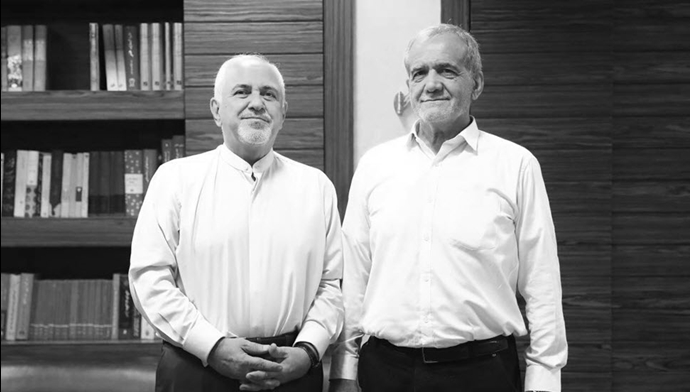

On August 1, Iranian regime president President Massoud Pezeshkian of the Iranian regime appointed Mohammad Javad Zarif as his Strategic Deputy. Zarif, a former foreign minister during the presidency of Hassan Rouhani, is a controversial figure in the regime. In his announcement, Pezeshkian asked Zarif to assume responsibility for the Center for Strategic Studies of the Presidential Office, transforming its duties and special tasks into appropriate structures for the Strategic Deputy. He also requested him to use the experience of senior managers from previous administrations to monitor the “Vision Document and General Policies approved by the Supreme Leader” and report directly to him.
Following this appointment, and within the first minutes of Zarif’s introduction as Strategic Deputy, infighting began. The IRGC-affiliated Fars News Agency quoted its visitors as saying, “We never had a Strategic Deputy until now! Zarif had promised he wouldn’t take any positions! From now on, we must be careful about everything because the spy is back.”
Zarif himself said, “I did not intend to accept any responsibility in this government. However, the concern, dissatisfaction, and insistence of my dear compatriots, especially on social media, in recent days made me inevitably change that view somewhat; but only to the extent of formalizing a consultative role, as I have repeatedly said I would serve the dear president.”
He added that he had prepared the draft of this decree himself with several objectives, “and it was formalized with the gracious signature of the honorable president.”
Zarif highlighted some of his constraints and mentioned that these were included in the draft:
- No new bureaucracy or mechanisms should be created, and it should not be a burden on the government budget and people’s livelihoods.
- There should be no interference in the work of any departments.
- No department should be weakened.
- It should serve as a link between the government, think tanks, and civil oversight institutions like KAMAND (the People’s Committee for Government Oversight).
So far, Pezeshkian has introduced his deputies, positions that do not require parliamentary approval. These appointments were not without contention, and Zarif’s rivals labeled the Strategic Deputy as a spy.
Farhikhtegan newspaper, wrote: “In Zarif’s decree, Pezeshkian implicitly dissolved the Center for Strategic Studies of the Presidential Office and transferred its structure to the Strategic Deputy of the President.”
In his continued appointments, Pezeshkian also appointed Mohammad Jafar Qaem Panah as Deputy for Executive Affairs and Head of the Presidential Office. Qaem Panah previously held positions in the Ministry of Health and was the president of the first term of the city council of Kermanshah and responsible at Tabriz University of Medical Sciences for sending students to the war fronts.
The appointment of Pezeshkian’s deputies, mostly from those who served in the administrations of former presidents Hassan Rouhani and Mohammad Khatami, including Mohammad Reza Aref as Vice President, was not without conflict and controversy among the regime’s factions. However, what happened with Zarif showed that replacing one with another of the same nature marked the beginning of extensive splits and infighting, including over the cabinet in the sham Majlis (parliament).