

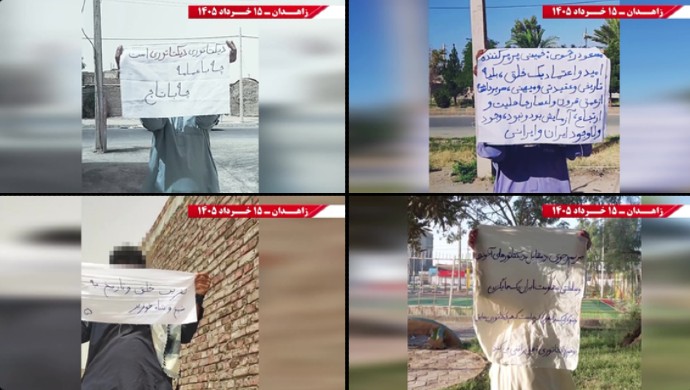

On June 5, PMOI/MEK Resistance Units in Zahedan, southeast Iran, boldly resumed their weekly activities in public spaces. The activists reiterated their unwavering commitment to regime change and their complete rejection of all forms of dictatorship.
These public displays of defiance occur at a time when the ruling regime is at its most fragile and vulnerable point in its history. Following the massive nationwide uprising in January 2026, the regime faces deep-seated popular outrage. Fearing another eruption of protests far more than foreign conflict, the clerical leadership has kept all its repressive forces deployed in the streets.
Rejecting the false choice: neither Shah nor mullahs
Activists in Zahedan took to the streets holding placards that condemned both historical and present tyrannies. They proudly highlighted the slogan, “No to monarchy, no to the supreme leader, yes to freedom and equality,” asserting that “Dictatorship is dictatorship, whether with a turban or with a crown.”
June 5—Zahedan, southeast Iran
PMOI/MEK Resistance Units resume their weekly activities reiterating their commitment to regime change and rejecting all forms of dictatorship.#No2ShahNo2Mullahs pic.twitter.com/gRKY55nvtL— People's Mojahedin Organization of Iran (PMOI/MEK) (@Mojahedineng) June 6, 2026
The Resistance Units directly challenged the parallel ambitions of the twin dictatorships, noting through their banners: “Khamenei’s son seeks to cling to power while the Shah’s son maneuvers to reclaim it; but after a century of tyranny, the era of both the Shah and the mullahs is permanently over.”
The clerical regime actively exploits the remnants of the Shah’s fallen dictatorship to promote a fabricated alternative. This theatrical display is designed to divide the anti-dictatorial movement—a tactic that paved the way for the large-scale killings of protesters last January. However, the actions in Zahedan prove that the public sees through this deception. As one placard plainly read, “Baluchestan is aware; it rejects both the Shah and the mullahs.”
Unyielding defiance in the face of brutal repression
The courageous actions of the Resistance Units are taking place against the backdrop of a severe and bloody crackdown. To hide its weakness and fear of collapse following the recent war, the regime has escalated its killings. Since the war began, the regime has executed eight members of the PMOI Resistance Units and more than 20 young people who took part in the uprisings or fought against the Revolutionary Guards. Furthermore, out of the 6,500 individuals arrested during this period, 567 were connected to the PMOI.
"Down with Khamenei, curse upon Khomeini, down with the principle of absolute clerical rule—long live the Liberation Army" pic.twitter.com/drt3k9yb2V
— People's Mojahedin Organization of Iran (PMOI/MEK) (@Mojahedineng) June 6, 2026
Despite this brutal repression, the organized resistance continues to grow. The activists in Zahedan honored the trailblazers of the historic uprising of September 27, 1981, and urged the public to say: “Curse upon Khomeini. Curse upon Khamenei!” During the recent January uprising, the Resistance Units proved their strength by carrying out 630 operations against centers of the Revolutionary Guard and the Basij to defend unarmed demonstrators. Today, they are actively preparing the groundwork for the next wave of protests.
The vision for the future: a democratic republic
The Resistance Units in Zahedan made it clear that the current system of absolute clerical rule possesses no capacity for reform or change. “This regime has no intention of changing its behavior or policies, nor does it possess the capacity or inherent nature to reform,” one of their messages read. Instead, they echoed the platform of the National Council of Resistance of Iran (NCRI), raising the banner: “The slogan of the provisional government is peace and liberty.”
"Curse upon Khomeini. Curse upon Khamenei! Down to the principle of the absolute rule of the clerics." pic.twitter.com/UJtSGBYPpX
— People's Mojahedin Organization of Iran (PMOI/MEK) (@Mojahedineng) June 6, 2026
Announced on February 28, 2026, the NCRI’s provisional government is tasked with transferring sovereignty to the Iranian people. Within a maximum of six months after the regime’s overthrow, it will organize free elections for a Constituent Assembly.
Ultimately, as the activists highlighted, Iranian society will not accept a return to the past, including the Shah’s notorious SAVAK secret police. The main battle today, waged through popular uprisings and the daily operations of the Resistance Units, is rapidly moving Iran toward a democratic republic based on the separation of religion and state, gender equality, and autonomy for oppressed nationalities.