


Iran’s economy has reached a historic breaking point, characterized by a collapsing currency, crippling fuel shortages, and a devastated population. The clerical regime is paralyzed by a fatal deadlock. While it attempts to use regional warmongering to distract from domestic crises, this very strategy is creating an explosive economic environment. State media and officials are openly expressing their terror of a looming, hybrid social eruption that could finally sweep the dictatorship from power.
The currency crash and the international financial offensive
The Iranian regime’s warmongering and systemic corruption have destroyed the national currency, erasing the purchasing power of ordinary Iranians and placing their livelihoods in a highly explosive state.
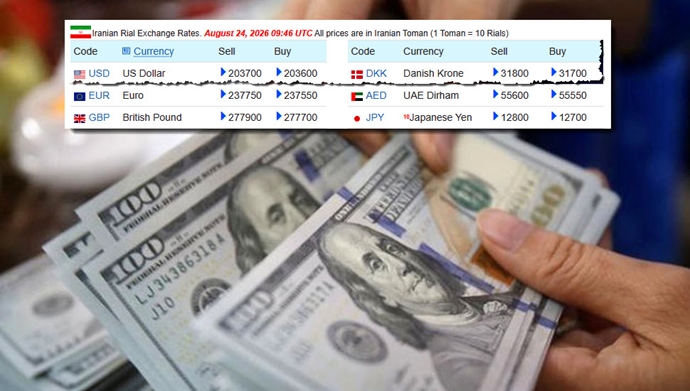
The US dollar has crossed the unprecedented 2,000,000-rial threshold, reaching 2,037,000 rials for selling and 2,036,000 rials for buying on the free market as of Monday morning. Other major foreign currencies are experiencing a similarly staggering surge, with the euro hitting 2,377,500 rials, the British pound soaring to 2,779,000 rials, and the UAE dirham reaching 556,000 rials.
Systemic plunder, the fuel crisis, and the “new map of misery”
The current economic ruin is not a natural disaster but the direct product of the Islamic Revolutionary Guard Corps (IRGC) mafia’s organized theft and the regime’s costly regional aggression. Poverty has become so severe and widespread that it is no longer just a national statistic; it has established geographical roots. The state-run Jahan-e Sanat daily recently confessed to an unprecedented exacerbation of poverty, noting that a “new map of misery” has taken shape in Iran.
An acute fuel crisis is further paralyzing the country. Citizens are enduring long, agonizing lines for gasoline and diesel, such as those seen in Ashkanan (Fars province) on August 23, 2026, and waiting hours for compressed natural gas (CNG) in Zahedan.
Amidst this crisis, Masoud Pezeshkian’s government is floating rumors of catastrophic fuel price hikes—ranging from 170,000 to 870,000 rials. Pezeshkian has justified these potential shocks by claiming the state has no money, no fuel, and that storage tanks were damaged during the war.
The ghost of November 2019 and the regime’s terror of a new uprising
The regime is absolutely terrified of the social consequences of implementing an energy price shock. State media warns the government to remember the November 2019 protests, noting that the administration at the time never imagined a fuel price hike would plunge the country into months of fiery turmoil and lead to the burning of gas stations across the nation.
State-run media acknowledge that society is now in a much more critical state, and the readiness for widespread unrest is incredibly high. Society is described as a powder keg waiting for a single spark. Jahan-e Sanat pointed out that just as a street vendor ignited the Arab Spring in Tunisia or how the death of Mahsa Amini sparked nationwide protests in Iran, a fuel price hike could provide the pretext for a massive explosion, as the country is more than ready for a “riot, revolution, or movement.”
The realization of impending doom has reached the highest echelons of the regime. Parliament Speaker Mohammad Bagher Ghalibaf recently made a desperate admission regarding the regime’s vulnerability, stating: “No matter how much military power we have, if the people are hungry, we will not survive.”
A fatal deadlock and the inevitable eruption of rebellious youth
Regime supreme leader Mojtaba Khamenei and his inner circle are fully aware that their regional warmongering leads to currency crashes, the devaluation of the national currency, and massive inflation. Yet, they deliberately attempt to maintain a state of war to justify suppressing domestic dissent, effectively forcing the Iranian people to pay the price of the regime’s survival from their empty pockets.
However, this strategy has completely backfired. Instead of silencing the population, the regime’s policies have become the primary catalyst for the next uprising. State-affiliated experts are warning the regime not to naively assume the next uprising will just be a repeat of November 2019. The state-run Jamaran website cautioned officials to expect “multi-layered and hybrid protests.”
The clerical dictatorship is trapped in a fatal, incurable deadlock. The boundaries between economic strikes and political protests have completely dissolved. Workers, teachers, retirees, and other toiling sectors of society have nothing left to lose. This impasse cannot be resolved through government maneuvering; it will only be shattered by the volcanic eruption of a starving population and the unyielding will of Iran’s rebellious youth, who will settle for nothing less than the total overthrow of the regime.