

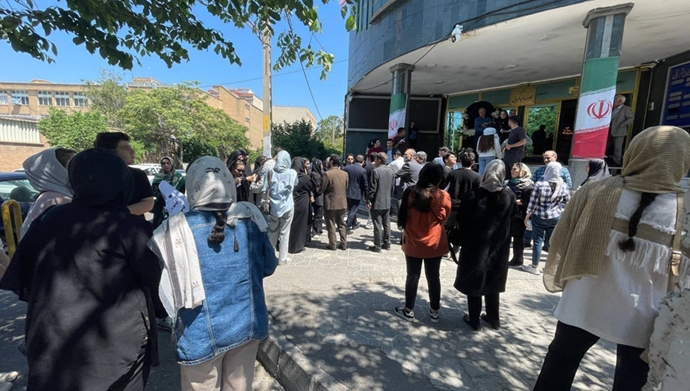

On Saturday, June 6, 2026, widespread protests erupted across 23 Iranian cities as students took to the streets to demand justice and equality in the educational system. Gatherings took place in Tehran, Mashhad, Shiraz, Isfahan, Karaj, Tabriz, Ahvaz, Rasht, Kermanshah, Sari, Arak, Qom, Dorud, Bojnourd, Birjand, Hamadan, Qazvin, Kerman, Borujerd, Yazd, Yasuj, and Ardabil.
June 6—Tehran, Iran
Students hold protest rally, chanting, "Students will die but won't accept humiliation."#IranProtests pic.twitter.com/Dh5TxVsXKT— People's Mojahedin Organization of Iran (PMOI/MEK) (@Mojahedineng) June 6, 2026
Students rallied outside Ministry of Education buildings in various provinces and the Secretariat of the Supreme Council of the Cultural Revolution in Tehran. Despite a heavy presence of state security forces and riot police, the youth bravely chanted anti-regime slogans, explicitly rejecting the mullahs’ oppressive system. Protestors chanted, “Students may die, but they do not accept humiliation,” “Do not fear, do not fear, we are all together,” “We have seen no justice, only empty promises,” and “Incompetent official, resign!”
The core grievance: Institutionalized inequality
The immediate trigger for this nationwide uprising is a controversial mandate emphasizing the “definitive impact of GPA” on the national university entrance exam (Konkur) and the removal of general subjects from the test booklet. Under these new rules, 10th, 11th, and 12th-grade final exam grades strictly dictate a student’s academic future. Protesting students and the Coordinating Council of Teachers Syndicates argue this policy deepens systemic inequality. Under the current structure, the vast majority of those who pass the Konkur attend private schools and are affiliated with the regime’s wealthy elite, while children from underprivileged sectors lack even basic educational facilities.
June 6—Mashhad, northeast Iran
Students rallied in front of the Education Ministry building to resume protests.#IranProtests pic.twitter.com/DhzZ7vwxAQ— People's Mojahedin Organization of Iran (PMOI/MEK) (@Mojahedineng) June 6, 2026
Furthermore, the regime’s incompetence during the recent 40-day war severely exacerbated the crisis. During the conflict, the government shut down schools and cut off the internet. Even after the ceasefire, education continued using the state-owned “Shad” online conference app, which proved disastrous due to technical failures and slow internet speeds. Despite this severe disruption and the resulting psychological toll on the youth, the Ministry of Education is mercilessly forcing students to take their final exams in person.
The regime’s repressive and bureaucratic response
Instead of addressing the students’ legitimate grievances, the regime resorted to its usual tactics of deception, suppression, and bureaucratic deflection. In Mashhad, authorities deceptively ushered protesting students into the Education Department courtyard, subsequently locking the exit doors to trap them. Reports indicate that several students were arrested amid a heavy presence of riot police and state security.
June 6—Isfahan, central Iran
Students resumed protests rallies, reiterating their demands and defying the regime's repressive measures.#IranProtests pic.twitter.com/JdwRnfevvJ— People's Mojahedin Organization of Iran (PMOI/MEK) (@Mojahedineng) June 6, 2026
Meanwhile, regime officials publicly washed their hands of the crisis. On June 2, Education Minister Alireza Kazemi claimed the mandate was a Supreme Council of the Cultural Revolution decision and “out of the hands of the Ministry of Education.” Two days later, on June 4, the Council issued a vague statement promising an “expert review,” offering the students nothing but empty promises.
Protesters directed their anger at the architects of these corrupt policies, chanting against Abdul-Hossein Khosropanah, the Secretary of the Supreme Council of the Cultural Revolution. Khosropanah, who was appointed to this post in 2022 by Ebrahim Raisi, the regime’s former president, was blacklisted by the European Union, the United Kingdom, and the United States in 2023 for gross human rights violations. Students chanted, “Khosropanah, have some shame, let go of the students,” and “Khosro, come out!”
A broader political awakening and call for solidarity
What began as a dispute over academic policy has quickly transformed into a stark rejection of the regime’s authority. The simultaneous expansion of these gatherings across dozens of provinces demonstrates that the regime has manufactured yet another nationwide crisis that it is fundamentally incapable of resolving.
June 6—Shiraz, southern Iran
Students rally in front of the education ministry headquarters in tandem with other cities, protesting government policies and grading rules.#IranProtests pic.twitter.com/1kxg78kSS2— People's Mojahedin Organization of Iran (PMOI/MEK) (@Mojahedineng) June 6, 2026
Mrs. Maryam Rajavi, the President-elect of the National Council of Resistance of Iran (NCRI), saluted the brave youth taking a stand against the mullahs’ systemic bias. Emphasizing that solidarity, perseverance, and expanding protests are the only ways to achieve the students’ legitimate demands, Mrs. Rajavi called on all students, teachers, and university students across the country to support the protesting high schoolers. By taking to the streets, Iran’s students are sending a clear message: they recognize the deep corruption of the clerical regime and are determined to fight for a free and equitable future.