

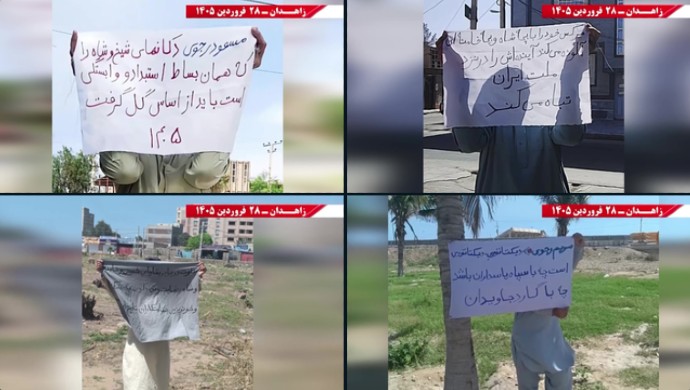

In defiance of the recent execution of political prisoners and a severe crackdown on dissidents, the People’s Mojahedin Organization of Iran (PMOI) Resistance Units resumed their anti-regime activities in Zahedan, southeast Iran, on April 17. Holding placards and displaying messages in various public locations, the activists reiterated their unwavering commitment to overthrowing the current regime and completely rejecting all forms of dictatorship. These acts of defiance occur at a pivotal moment, responding directly to the recent wave of state-sponsored killings and the ongoing ceasefire following external conflicts.
The ceasefire as a catalyst for peace and freedom
Central to the Resistance Units’ messaging in Zahedan is the ongoing 15-day ceasefire. In their public displays, activists held placards stating, “We hope the temporary ceasefire, despite the desires of the remnants of both clerical and monarchical regimes, leads to an end to the war and opens the path toward peace and freedom.” The ceasefire has also laid bare the hypocrisy of monarchist factions. One placard explicitly noted, “The ceasefire exposed the Shah’s son—his so-called humanitarian push for war has now been laid bare as a disgrace.”
"The power structures of both the Shah and the mullahs, both symbols of oppression and subservience to foreign powers, must be completely dismantled" pic.twitter.com/AXbkEso5Ob
— People's Mojahedin Organization of Iran (PMOI/MEK) (@Mojahedineng) April 18, 2026
This grassroots messaging aligns with the stance of Maryam Rajavi, the President-elect of the National Council of Resistance of Iran (NCRI). Welcoming the ceasefire—particularly the halt to attacks on civilian infrastructure—Mrs. Rajavi emphasized that the enduring slogan of the Resistance has always been “peace and freedom.” The PMOI and NCRI have long maintained that lasting peace in the Middle East cannot be achieved through foreign intervention or appeasement. Instead, as the Zahedan units highlighted, it requires the overthrow of the “terrorist and warmongering dictatorship of the absolute clerical rule” by the Iranian people and the establishment of a democratic republic.
Commemorating martyrs as the price paid for liberation
The resurgence of activities in Zahedan heavily commemorated the fallen martyrs of the PMOI and recently executed political prisoners. Holding signs that read, “The fallen martyrs of PMOI are the price paid for Iran’s freedom and independence,” the Resistance Units honored the sacrifices of those killed by the regime. Another message emphasized, “The fallen rebels are the price paid for a durable peace that will extend across Iran and the whole region.”
“The fallen martyrs of PMOI are the price paid for Iran’s freedom and independence.” pic.twitter.com/ipCx9tTeFG
— People's Mojahedin Organization of Iran (PMOI/MEK) (@Mojahedineng) April 18, 2026
Recently, the regime rushed to execute 13 individuals—including six PMOI members—to protect its crumbling power from potential post-war uprisings. By executing these political prisoners amid an external war, the regime effectively acknowledges that its true enemy, and the force driving its downfall, is the network of Resistance Units and the Liberation Army. The activists in Zahedan displayed placards demanding that a “halt to executions in Iran, as a demand of the entire Iranian population, should be incorporated into any international agreement.”
Rejecting both the Shah and the mullahs
A core theme of the Zahedan protests was the definitive rejection of all forms of dictatorship, whether religious or monarchical. The Resistance Units displayed powerful messages dismantling the legitimacy of past and present tyrannies, stating, “The power structures of both the Shah and the mullahs, both symbols of oppression and subservience to foreign powers, must be completely dismantled.”
The activists made it clear that the Iranian people have advanced to a point where there is no space left for either religious or royalist regression. Slogans displayed in public locations read, “Anyone who associates themselves with the Shah’s son or Khamenei’s son ruins their future in the eyes of the Iranian people.” They also stressed that fascist-style slogans such as “Long live the Shah” and “Khamenei is the leader” must be entirely discarded, as “a dictatorship is still a dictatorship—whether it’s enforced by the Revolutionary Guards or the Imperial Guard.”
Unlike artificial, paper-only alternatives created by monarchists who seek war, the Resistance Units emphasized that the NCRI offers a legitimate alternative, grounded in the sacrifice of 100,000 martyrs. They proudly held signs reading, “This NCRI’s Ten-Point Plan sets out a framework for a democratic republic in Iran,” showcasing a clear vision for the nation’s future.
“From the outset, the slogan of the NCRI and provisional government has been peace and freedom.” pic.twitter.com/F7IoLE77gp
— People's Mojahedin Organization of Iran (PMOI/MEK) (@Mojahedineng) April 18, 2026
The brave actions of the Zahedan Resistance Units prove that the clerical regime’s decades of mass executions, demonization campaigns, and toxic propaganda have completely failed to distance Iran’s youth from the PMOI. The organized resistance has reached the capacity to overthrow the regime. As one placard boldly declared, “Iran and the wider Middle East are currently at a pivotal turning point. The regime is teetering on the edge of collapse.” The message from the streets of Zahedan is resolute: the resolution to Iran’s crisis lies in regime change through the Iranian people and their organized resistance, ensuring that the “shameful legacy of both clerical and monarchical rule must be removed from Iran’s history.”