

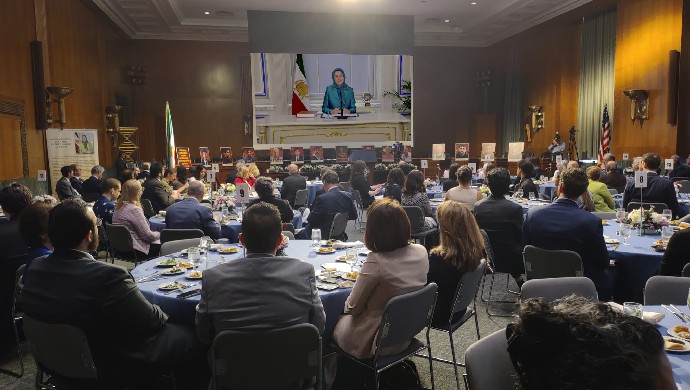

On April 16, 2026, a bipartisan coalition of US Senators and former high-ranking diplomats convened in Washington, D.C., for a critical briefing titled “Iran: Towards Peace and Freedom.”
Against a poignant backdrop of portraits depicting recently executed members of the People’s Mojahedin Organization of Iran (PMOI/MEK) and other defiant protesters, the speakers reached a resounding consensus: neither foreign wars nor decades of appeasement can resolve the Iranian crisis. Instead, lawmakers and diplomats urged the international community to recognize the Iranian people’s right to overthrow the ruling theocracy.
They firmly established the National Council of Resistance of Iran (NCRI) as the sole viable, democratic alternative to both the current clerical regime and the former monarchial dictatorship.
Mrs. Maryam Rajavi’s blueprint for a democratic Iran
In a message to the conference, NCRI President-elect Mrs. Maryam Rajavi emphasized that the ultimate solution to the Iranian crisis rests entirely with its people and their organized resistance. She noted that over the past 47 years, Western policies ranging from appeasement and “critical dialogue” to negotiations and war have fundamentally failed because the regime is inherently incapable of reform.
Although the regime is currently weaker than ever before, its aggressive nature remains unchanged, continuing its pursuit of nuclear weapons, regional terrorism, and domestic suppression.
Highlighting the regime’s brutality, Mrs. Rajavi pointed out that since March 19, at least 13 political executions have taken place in Iran, including six PMOI members and seven defiant protesters accused of working to overthrow the state. “Through these executions, the regime is intensifying an atmosphere of terror in an effort to prevent another uprising,” she stated.
US Senate Briefing, “Iran: Onward to peace and freedom”
Today, more than ever, a fundamental question is before us: What is the real solution to Iran’s crisis?
The solution to the crisis in Iran lies in its people, and in their organized resistance.#FreeIran10PointPlan pic.twitter.com/0SVcFr7xmv— Maryam Rajavi (@Maryam_Rajavi) April 16, 2026
Mrs. Rajavi specifically addressed recent claims made by Ali Khamenei’s son, who alleged that more than 17 million people are ready to sacrifice their lives for the regime. She challenged him to prove this by accepting free elections under United Nations supervision, based on popular sovereignty rather than clerical rule—a test she noted the theocracy lacks the courage to face.
She reiterated that the Iranian people unequivocally reject a return to the dictatorship of the Shah, offering instead the NCRI’s Ten-Point Plan. This platform guarantees free elections, gender equality, the separation of religion and state, and a non-nuclear Iran. “The solution to the crisis in Iran lies in its people, in their courage, and in their organized resistance,” Mrs. Rajavi declared.
Bipartisan echoes: US leaders demand a policy shift
Throughout the briefing, prominent American political figures echoed Mrs. Rajavi’s sentiments, demanding a fundamental shift in US policy toward Iran. Former US Ambassador to Morocco Marc Ginsberg and former US Ambassador to Denmark Carla Sands both delivered forceful rejections of any return to a monarchial dictatorship.
Ambassador Ginsberg stated that the Iranian people have no desire for a “pretender to the throne who has sat in Los Angeles sunning himself” while the domestic resistance makes ultimate sacrifices. Ambassador Sands reinforced this, declaring that “Iran’s future will not be shaped by relics of the past” and emphasizing that the crisis “must be resolved from within.”
Thank you to all who attended our U.S. Senate Briefing today.
Iran’s future should NOT be decided by recycled claims of destiny or nostalgia.
The future of Iran should be decided by the people and the organized resistance! pic.twitter.com/r23b8I6dFA
— OIAC: Organization of Iranian American Communities (@OrgIAC) April 16, 2026
Lawmakers stressed the need for concrete political action. Senator Thom Tillis called for a “new Iran Freedom Act” and a long-term, legally binding US commitment ratified by Congress to support a democratic Iran. He noted that such a codified agreement would transcend administrations and help replace the current “theo-fascist” rule. Former Senator Roy Blunt praised the NCRI’s Ten-Point Plan as a transparent roadmap, proving the movement is a mature governing body ready to lead an interim government and halt the state’s violence.
Framing the struggle as a global moral imperative, Senator Cory Booker rejected the notion that the desire for self-determination is exclusively Western. “The people of Iran will be free,” he declared, honoring the “quiet patriotism” of the resistance. Finally, former Ambassador Sam Brownback captured the urgency of the moment. “We are in the red zone now,” he said. “We are close to winning. We can win this.”