

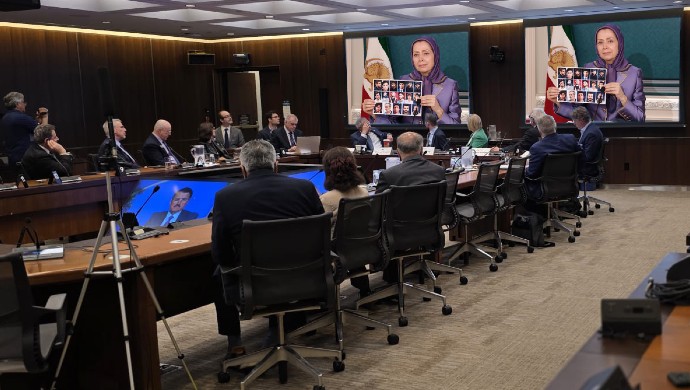

On May 27, 2026, the Canadian Parliament hosted a conference titled “Iran at Crossroads,” bringing together a distinguished coalition of Canadian and American dignitaries, international security experts, and human rights advocates. Co-chaired by the Hon. Judy Sgro and Member of Parliament Michael Cooper, the strategic session convened at a highly volatile moment in Iran’s history.
Against the backdrop of the massive December 2025–January 2026 nationwide uprisings and recent foreign military escalations, the clerical regime has intensified its domestic crackdown. The parliamentary panel meticulously examined the failure of Western appeasement, the alarming spike in political executions, and the rapidly growing operational capacity of domestic Resistance Units.
Opening the session, the Hon. Judy Sgro lauded the extraordinary bravery of the Iranian public. She noted that despite the brutal conditions on the ground, “across the country, and especially amongst its young people and women, there is a powerful and unwavering call for dignity, freedom, and democracy.” The conference served as a platform to underscore that lasting geopolitical stability in the Middle East requires recognizing the National Council of Resistance of Iran (NCRI) and its Ten-Point Plan as the definitive blueprint for a free, secular, and democratic republic.
Maryam Rajavi: The Main Force for Change in Iran
In a message to the Canadian Parliament, NCRI President-elect Maryam Rajavi articulated the fundamental connection between domestic repression in Iran and international instability, declaring that “the freedom of the Iranian people is deeply connected to global peace.” She systematically dismantled the rationale behind Western appeasement, warning that “working with dictatorships may bring short-term benefits today, but it leads to a disaster tomorrow.” Rajavi emphasized that decades of diplomatic tolerance have tragically “deprived the world of the main force for change in Iran.”
Conference at the Parliament of Canada: Unprecedented rise in political executions in Iran, the role of the international community
The freedom of the Iranian people Is deeply connected to global peace#StopExecutionsInIranhttps://t.co/eiQKe5T3sK pic.twitter.com/z1HLielpxd— Maryam Rajavi (@Maryam_Rajavi) May 28, 2026
Addressing the current landscape, she noted that the regime uses foreign conflicts to mask its domestic vulnerability. “Even though there is a major foreign war happening, the main battle for the rulers is against the Iranian people,” she stated, highlighting the brutal suppression of the recent uprisings. Pointing to the only viable path forward, Rajavi reiterated that the regime fundamentally lacks the capacity to reform. “This threat has only one answer: overthrow by the Iranian people and their organized resistance,” she proclaimed. Rejecting any regression to the Shah’s monarchic dictatorship or its notorious SAVAK secret police, she called on Canada and the international community to expel regime agents and formally recognize the Iranian people’s struggle to establish a democratic republic.
A Calculated Campaign of Executions and Human Rights Abuses
A central focus of the conference was the regime’s escalating human rights abuses, which have culminated in a horrific execution spree. Over the past month, the clerical establishment executed eight members of the People’s Mojahedin Organization of Iran (PMOI/MEK) who were active in the Resistance Units: Hamed Validi, Mohammad Massoum-Shahi (Nima), Vahid Bani Amerian, Abolhassan Montazer, Mohammad Taghavi, Ali Akbar Daneshvarkar (Akbar/Shahrokh), Pouya Ghobadi, and Babak Alipour. Furthermore, the regime executed dozens of other dissidents, including young protesters detained during the sweeping December 2025–January 2026 uprising.
MP Michael Cooper sharply condemned these atrocities, framing them not as random acts of violence, but as a systematic methodology of state survival. “Indeed, executions are a core part of a systemic state policy aimed at crushing dissent,” Cooper stated. He detailed a multi-layered campaign of repression that includes an 88-day internet blackout, the systemic targeting of women and minorities, and secret judicial proceedings driven by severe torture. Calling the regime the “epitome of evil,” Cooper urged the international community to pivot away from failed diplomatic gestures and hold the leading state sponsor of terrorism accountable.
Kyle Matthews, Executive Director of the Montreal Institute for Global Security, expanded on the human cost, reminding the audience that the regime’s current atrocities are a continuation of past, unpunished crimes. Matthews specifically invoked the 1988 massacre of 30,000 political prisoners, noting that the regime’s pattern connects domestic terror directly to global insecurity—from fueling civil war in Syria to arming extremist proxies and threatening European stability. He insisted that Western nations must proactively provide advanced communication technologies to circumvent blockades and empower internal activists.
The Illusion of Appeasement and the Rejection of False Alternatives
The strategic failure of attempting to moderate the clerical regime was rigorously critiqued by Ambassador Robert Joseph, former U.S. Under Secretary of State for Arms Control and International Security. Ambassador Joseph argued that over twenty-five years of Western diplomacy, conditional sanctions, and negotiations have been entirely fruitless. He described the regime’s diplomatic engagement as a “cat-and-mouse” game designed solely to buy time for its unyielding nuclear ambitions. Warning against the continuation of appeasement, he noted that providing sanctions relief merely throws a lifeline to a dictatorship that channels those funds into terrorist proxies and its domestic terror machinery.
Crucially, the conference addressed the political alternatives to the current regime, firmly rejecting opportunistic attempts by remnants of the former monarchic dictatorship to hijack the democratic movement.
https://twitter.com/amsafavi/status/2060282295680929798
Ali Safavi, a member of the Foreign Affairs Committee of the NCRI, joined the session to dismantle the narrative that the clerical regime is invincible. Safavi warned Western capitals against the false alternatives promoted by the Shah’s son. He observed that the recent revival of SAVAK symbolism and the normalization of intimidation by monarchist factions demonstrate that hereditary autocrats represent a dangerous return to a past of torture and political murder. The Iranian populace, Safavi noted, has definitively evolved past both forms of tyranny, permanently choosing to reject “both the turban and the crown.”
The Only Path to Overthrow: The People and the Resistance
A recurring and emphatic theme throughout the parliamentary session was the consensus on how regime change will occur in Iran. In the wake of recent international military actions and aerial bombardments of regime targets, the panelists made it unequivocally clear that a foreign war will not bring about a democratic transition.
Ali Safavi presented exhaustive evidence that structured societal crises have rendered the regime terrified of its own population. He explicitly stated that the regime cannot be overthrown through foreign intervention or actions from the air; rather, victory must come exclusively through the Iranian people and their organized resistance, spearheaded by the PMOI and internal Resistance Units. Ambassador Joseph echoed this sentiment, stating plainly, “it is left to the Iranian people to end the regime.”
The Hon. Tony Clement, former Canadian Minister of Health and Industry, reinforced this critical distinction. Expressing strong optimism for the ultimate victory of the Iranian people, Clement reminded the international audience that “it’s not the Iranian people who are our enemies.” Endorsing the NCRI’s Ten-Point Plan for a free, secular, and democratic republic that rejects nuclear ambitions, Clement concluded that the mullahs will never voluntarily relinquish power, meaning the only permanent solution is the outright overthrow of the regime by the people of Iran taking the future into their own hands.
A New Generation’s Vow to Continue the Struggle
The conference concluded with a powerful testament to the resilience of the Iranian youth and the Resistance Units operating on the ground. Representing the younger generation of the diaspora, Ali Zaei, a former Canadian national wushu champion representing the Iranian Youth Association of Canada, delivered a stirring tribute to the frontline fighters.
Honoring the recent victims of the regime’s execution spree, Zaei quoted the final vow of executed PMOI member Vahid Bani-Amerian, reminding the parliamentarians that thousands of young Iranians remain steadfast in their commitment to continue the uprising until the final overthrow of the dictatorship. Zaei argued that the regime’s escalating reliance on torture and public hangings is not a demonstration of strength, but a clear exposure of its profound terror regarding the effectiveness of the PMOI networks. Characterizing the organized resistance as the only entity with the experience, networks, and concrete transitional framework capable of delivering a permanent solution, he called on the international community to back Maryam Rajavi’s Ten-Point Plan to definitively secure a free, democratic future for Iran.
Ultimately, the “Iran at Crossroads” conference delivered a unified message to global policymakers: the era of engaging with the clerical regime has failed, foreign military intervention is not a substitute for democratic revolution, and the international community must now recognize the Iranian people and their organized Resistance as the sole legitimate force capable of bringing freedom and peace to Iran.