

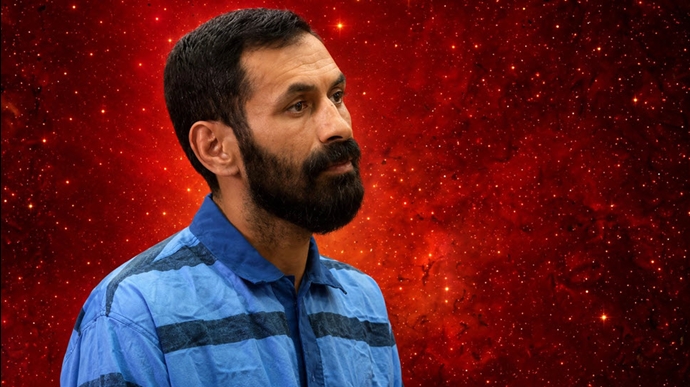

Following the massive nationwide uprisings in January 2026 that brought the ruling establishment to its knees, the Iranian regime continues to rely on its ultimate tool of survival: the execution of political prisoners and protesters.
In yet another heinous crime, the mullahs’ judiciary hanged brave protester Shahram Sadeghi in Karaj on the morning of Sunday, August 16, 2026. Sadeghi’s execution is part of a broader, systemic wave of state-sponsored killings aimed at terrorizing the public. Yet, these executions only expose the religious dictatorship’s profound fear of an increasingly restive and uncompromising society.
The case of Shahram Sadeghi: kangaroo courts and fabricated charges
Sadeghi was arrested on February 5, 2026, shortly after the peak of the uprisings. On May 30, 2026, the Revolutionary Court of Karaj swiftly sentenced him to death and ordered the confiscation of all his property. To justify the execution, the regime’s judiciary claimed that on the night of January 8, 2026, near Karaj’s Golzar Crossroads, Sadeghi drove his vehicle at high speed, injuring seven regime agents, before allegedly colluding with “rioters” to set his own car on fire.
Early this morning, Sunday, August 16, 2026, the clerical regime committed yet another heinous crime by executing the rebellious protester Shahram Sadeghi.
Strongly condemning this criminal execution and reiterating global condemnations of executions in Iran, I call on the UN… pic.twitter.com/sNS9MxyBGf— Maryam Rajavi (@Maryam_Rajavi) August 16, 2026
The judiciary also claimed he was tracked down and arrested while hiding under a fake identity in an addiction rehab center, despite not being an addict himself. The charges fabricated against him were absurd, labeling his actions as “operational action in favor of the Zionist regime, the United States, and hostile groups.”
Mrs. Maryam Rajavi, President-elect of the National Council of Resistance of Iran (NCRI), strongly condemned Sadeghi’s criminal execution. Highlighting the global condemnation of the regime’s execution wave, she demanded urgent and practical action from the United Nations Security Council to compel the Iranian regime to halt its inhumane killings.
A nationwide campaign of terror and public defiance
Sadeghi’s death follows a grim and accelerating pattern. Just weeks prior, on July 28, 2026, the regime carried out the brutal public hangings of two other young January protesters—Abolfazl Sepahi Badjani, 24, and Amirhossein Safari Hosseinabadi, 27—at Alikhani Square in Isfahan. Designed to instill terror, the regime deployed security forces on rooftops and surrounding streets. However, brave onlookers pushed back against the suppression apparatus, chanting “Dishonorable, dishonorable!” at the executioners, prompting security forces to violently disperse the crowd with tear gas.
These killings are part of the fabricated “Alikhani Square” case. The protesters were processed through sham kangaroo courts, denied independent legal counsel, and even their court-appointed lawyers were barred from accessing case files.
This same case had already claimed the lives of two other young men—Erfan Esfandiari, 18, and an Afghan national, Gol-Mohammad Mohammadi, 24—who were hanged on July 19, 2026, on bogus charges of “Moharebeh” (enmity against God) and the alleged deaths of four State Security Force officers.
The responsibility of the international community
The threat to political prisoners remains imminent. Eight other young protesters from the Alikhani Square case remain on death row.
The Iranian Resistance calls upon the United Nations, human rights bodies, and the European Union to intervene and save the lives of these political prisoners. The regime’s dossier of crimes against humanity must be referred to the UN Security Council, and its leaders must be brought to justice.
Executions as a measure of weakness, not strength
Beset by domestic and international crises, the ruling religious fascism is using executions not from a position of power, but out of sheer desperation to prevent an explosion of popular anger.
However, these anti-human crimes only belie the regime’s deep-seated fear of an increasingly restive society. Instead of pacifying the public, the machinery of repression is only strengthening the resolve of Iran’s rebellious youth, who no longer fear standing up to the regime’s apparatus of repression and remain steadfast in their determination to overthrow this bloodthirsty dictatorship.