

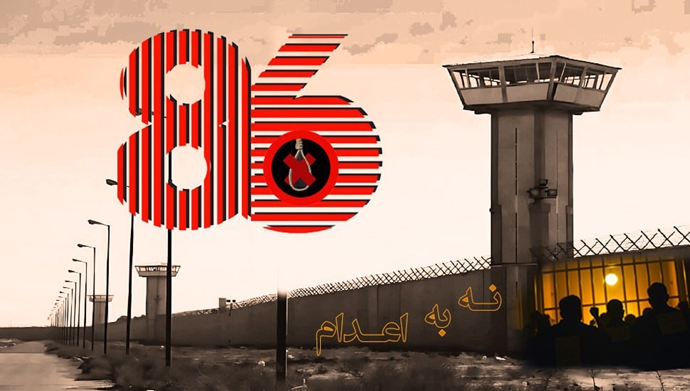

On Tuesday, September 16, 2025, coinciding with the third anniversary of the 2022 nationwide uprising that shook the foundations of the clerical regime, the “No to Executions Tuesdays” campaign marked its 86th consecutive week with coordinated hunger strikes inside 52 prisons across Iran. The sustained act of defiance by political prisoners has galvanized a parallel movement on the streets, with citizens in numerous cities holding protests in solidarity, creating a powerful, two-front challenge to the regime’s escalating use of capital punishment.
The campaign, which began in January 2024, has become a potent symbol of organized resistance against the clerical regime’s primary tool of suppression. The weekly statement from the prisoners not only coordinates the hunger strikes but also serves as a chilling indictment of the state’s killing machine. In their statement, participants honored the memory of Jina (Mahsa) Amini and all those killed during that transformative movement.
The escalating use of the gallows
The campaign’s 86th statement directly links the surge in executions to the regime’s fear following the 2022 nationwide uprising. The statement recalls how the regime “could only seemingly suppress” the movement “by opening fire on young people and women and shooting at the eyes of protesters,” adding that “resistance in the streets and alleys continues.”
“The regime was so terrified by the uprising that it had no choice but to show its inhuman nature,” the prisoners declared. They report that in the three years since the protests began, the regime “has murdered more than 3,175 people by the gallows alone,” a figure that includes 49 political and ideological prisoners and 95 women.
The pace of executions has accelerated alarmingly in recent weeks. According to the statement, at least 34 prisoners were executed in the past week, and over 126 have been hanged since August 23. “These statistics further reveal the daily human tragedy and human rights violations in Iran,” the statement reads, “and they increase the responsibility of the international community and all freedom-lovers to support the fight against these ruthless executions.”
Echoes of defiance: From prison cells to city streets
As prisoners inside Evin, Ghezel Hesar, and 50 other detention centers began their hunger strike, their call for justice was answered by citizens on the outside. Despite heavy security presence, protests erupted in cities across the country, including Tehran, Isfahan, Tabriz, Shiraz, Rasht, Kermanshah, and Bojnourd.
September 16—Iran
Families of political prisoners on death row return to the streets to mark the 86th week of the "No to Executions Tuesdays" campaign, calling for an end to the death penalty and the release of their loved ones.#StopExecutionsInIran pic.twitter.com/3VtHrcNFzz— People's Mojahedin Organization of Iran (PMOI/MEK) (@Mojahedineng) September 16, 2025
Demonstrators held images of prisoners on death row and chanted slogans that directly challenged the regime’s authority. Chants of “Political prisoners must be freed,” “Immediate abolition of the death penalty,” and the particularly defiant “Execution and exile no longer work” reverberated through the cities. Protesters also specifically condemned the recent death sentence handed down to Pejman Toubrehrizi on the charge of “corruption on Earth,” a charge frequently used against dissidents. This public mobilization demonstrates that the campaign has successfully transformed the issue of executions from a judicial matter into a nationwide political referendum on the regime’s legitimacy.
Saqqez: A flashpoint of brutality and resistance
The campaign’s latest statement explicitly declared its solidarity with the people of Saqqez, where the regime’s violence was on full display. On September 15, repressive forces opened fire on residents of the village of Pir Omran who were protesting the destructive activities of a local gold mine. Mohammad Rashidi, 22, was shot and killed.
The regime’s brutality did not end with his death. Authorities refused to hand over his body to his family and blocked the wounded from reaching hospitals. They then coerced the family into a secret burial in the middle of the night, with the local governor and Revolutionary Guards (IRGC) commander personally intervening to ensure no public mourning could take place. This act, designed to prevent a funeral from becoming a protest, reveals the depth of the regime’s fear of its own people.
The “No to Executions Tuesdays” campaign continues to draw strength from the legacy of past uprisings and martyrs like Navid Afkari, who was executed on September 12, 2020, and the hundreds killed during the 2022 protests. The campaign statement noted that the sacrifices made in the protests of 2017, 2019, and 2022 have shown “that the people of Iran will never surrender to oppression and tyranny.”
As this organized resistance inside and outside prison walls gains momentum, its participants have vowed to continue their struggle. “We will not rest until the complete abolition of the death penalty and the establishment of true justice in Iran,” their statement concludes. “And we will shout this resounding voice for justice and the defense of human rights and dignity with greater strength every week.”