

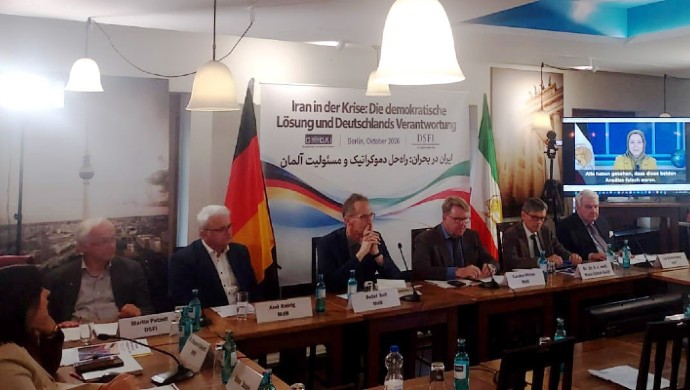

A conference held in Berlin on October 14, 2026, brought together German parliamentarians, former diplomats, political analysts, and Iranian activists to discuss the deepening crisis in Iran and the need for a fundamental change in German and European policy toward Tehran. The conference highlighted the Iranian regime’s escalating human rights violations, the growing wave of executions, and the role of the Iranian people and their organized Resistance in bringing about democratic change.
Throughout the discussions, speakers rejected both foreign military intervention and continued appeasement of the clerical regime. They stressed that a sustainable solution must come from within Iran, through the Iranian people’s struggle and the organized Resistance represented by the People’s Mojahedin Organization of Iran (PMOI/MEK) and the National Council of Resistance of Iran (NCRI).
The participants also expressed support for Maryam Rajavi’s Ten-Point Plan for a democratic Iran, criticized attempts to promote the restoration of the former monarchy, and urged Germany and the European Union to take concrete measures against Tehran’s repression and its activities abroad.
Maryam Rajavi: The decisive struggle is between the Iranian people and religious fascism
In a video message to the conference, Maryam Rajavi, President-elect of the NCRI, emphasized that Iran’s central conflict is not between Tehran and foreign governments, but between the Iranian people and the ruling dictatorship.
Mrs. Rajavi traced the current crisis to the regime’s decision after the 1979 anti-monarchic revolution to suppress demands for democracy and pursue regional intervention and warmongering. She described the struggle for freedom as “the fundamental war between the Iranian people and religious fascism.”
She warned that the regime was exploiting the ongoing conflict to prevent another nationwide uprising while intensifying domestic repression. She cited the execution of at least 46 political prisoners, including nine PMOI members, since the latest war began, alongside new death sentences against political detainees.
Nevertheless, Mrs. Rajavi emphasized that repression had failed to contain public defiance, particularly among younger Iranians and the expanding network of Resistance Units.
Message to Conference in Berlin: Iran crisis & democratic solution
Germany is among the nations fully empowered under the principle of universal jurisdiction to prosecute regime leaders in its own courts for crimes against humanity.
Furthermore, closing the regime’s embassy and… pic.twitter.com/DArK5LuuPp
— Maryam Rajavi (@Maryam_Rajavi) October 14, 2026
Turning to Western policy, she criticized the longstanding assumption that the clerical regime could be moderated through engagement while ignoring the Iranian people and their organized Resistance.
“Appeasement produced war,” she declared, describing the refusal to recognize the Iranian people’s Resistance as “the core failure of Western policy.”
Mrs. Rajavi also rejected attempts to promote the remnants of the Shah’s dictatorship as a “false alternative” and reaffirmed the NCRI’s commitment to a democratic republic based on free elections and separation of religion and state.
She concluded by urging Germany to pursue accountability for crimes against humanity, condition relations with Tehran on ending executions, and recognize the Iranian people’s struggle for democratic change.
Escalating executions and human rights violations expose the regime’s crisis
A major theme of the conference was the Iranian regime’s increasing reliance on executions, imprisonment, and repression to contain growing public discontent.
Bundestag member Carsten Müller described Iran as being at a critical political turning point. He argued that the regime’s intensified crackdown on political opponents revealed its vulnerability rather than demonstrating strength. Despite attempting to portray its survival through military confrontation as a political victory, Tehran remained unable to resolve its profound domestic crisis.
The speakers’ concerns came amid a dramatic escalation in executions across Iran. Between September 30 and October 13 alone, the regime executed at least 43 prisoners, including 19 on September 30.
The wider campaign has increasingly targeted political prisoners, protesters, and individuals accused of supporting the organized opposition. Among recent cases is 23-year-old student Amirhassan Akbari Monfared, whose death sentence over alleged links to PMOI was upheld by the regime’s Supreme Court.
The mounting execution toll was presented at the conference as part of a systematic strategy intended to intimidate society and prevent another uprising.
For Müller, the persistence of the PMOI despite decades of persecution was particularly significant. He challenged assertions that the organization had little influence inside Iran, arguing that the regime’s determination to suppress it demonstrated the seriousness with which Tehran regarded the movement.
The conference underscored that the international community must view the executions not as isolated judicial abuses but in the broader context of the regime’s efforts to preserve its rule.
Resistance continues inside Iran’s prisons
Dr. Masumeh Bolourchi, the NCRI’s representative in Germany, highlighted the continuing struggle of political prisoners as evidence that the regime’s repression had failed to extinguish resistance.
She drew attention to the No to Executions Tuesdays campaign, which reached its 142nd consecutive week on October 13, with prisoners participating in hunger strikes across 66 prisons.
The campaign has developed into a nationwide movement opposing capital punishment and demanding international action against the regime’s execution apparatus.
Dr. Bolourchi emphasized that its significance extended beyond opposition to the death penalty. Even inside prisons, where detainees face extreme pressure and the constant threat of execution, she observed that “resistance continues and expands.”
The latest statement by participating prisoners described intimidation, communication restrictions, and punitive measures intended to silence their campaign.
Their continued defiance reinforced one of the conference’s central arguments: the regime’s ability to imprison or execute its opponents has not eliminated their determination to resist.
Dr. Bolourchi situated these protests within the Iranian Resistance’s decades-long history of sacrifice, arguing that the persistence of organized resistance under such conditions was itself evidence of the movement’s political and social strength.
Organized Resistance is essential to democratic change
Beyond condemning Tehran’s repression, the conference focused on how democratic change could be achieved.
Dr. Hans-Ulrich Seidt, a former German ambassador, presented a broad critique of European policy, arguing that Germany and the European Union had concentrated excessively on individual issues such as the nuclear program, missiles, and regional conflicts without adequately addressing the nature of Iran’s ruling system.
He maintained that neither negotiations nor foreign military intervention had succeeded in transforming the regime’s behavior.
Instead, Seidt emphasized the importance of organized political forces with established networks inside Iran, long-term leadership, and a credible democratic program. Without those elements, he argued, meaningful political change was “hardly conceivable.”
He specifically identified the NCRI and PMOI as organizations possessing continuity, political structures, and a proposed framework for transition. Ignoring them, he warned, meant overlooking an important factor in Iran’s political future.
Former Bundestag member Leo Dautzenberg echoed this assessment, drawing on nearly three decades of engagement with the Iranian Resistance.
He described meeting individuals who had endured imprisonment, lost family members, or experienced exile, yet maintained their commitment to political change.
Dautzenberg argued that public dissatisfaction alone, however widespread, could not overthrow an entrenched dictatorship. A successful transition also required organization, coordination, sustained leadership, and a clear vision for “the day after.”
Sociologist Reza Mousavi examined this argument from the perspective of social movements and the activities of the Resistance Units.
He explained that economic hardship and widespread anger could create revolutionary conditions, but unorganized protest lacked the “strategic coherence” necessary to confront a deeply entrenched repressive apparatus.
Mousavi presented the PMOI Resistance Units as the connecting force between spontaneous public defiance and organized political struggle.
The discussion reflected developments inside Iran, where Resistance Units continued activities despite intensified security measures. In early October, the Units carried out coordinated operations against symbols and facilities associated with the regime’s apparatus of repression following the execution of protesters arrested during the January 2026 uprising.
For the conference participants, these developments illustrated why the Iranian people’s struggle, rather than foreign military action, must remain central to any realistic strategy for democratic change.
The NCRI’s Ten-Point Plan provides a framework for Iran’s democratic future
Speakers repeatedly emphasized that ending the present dictatorship must be accompanied by a credible plan for establishing democratic institutions.
Müller highlighted Mrs. Rajavi’s Ten-Point Plan as a political framework addressing fundamental questions about Iran’s future, including secular government, human rights, women’s equality, abolition of the death penalty, and an end to political persecution.
Bundestag member Detlef Seif also expressed support for the principles of the plan, noting their compatibility with Germany’s constitutional commitment to a “free democratic basic order.”
He highlighted its emphasis on the rule of law, freedom of religion, minority rights, gender equality, and democratic government.
The Ten-Point Plan envisions a republic founded on universal suffrage, political pluralism, separation of religion and state, equal rights for women, respect for Iran’s diverse nationalities, and a non-nuclear Iran committed to peaceful international relations.
These principles were presented not merely as aspirations but as foundations for a post-regime political system.
Speakers emphasized the importance of a structured transitional process that would transfer sovereignty to the Iranian people through free elections, rather than replacing one form of authoritarian rule with another.
The discussions underscored a distinction between overthrowing a dictatorship and establishing a lasting democratic order: the latter requires a political program, institutions, and commitment to popular sovereignty.
Rejecting both clerical dictatorship and restoration of the monarchy
Another prominent theme was opposition to attempts to present Reza Pahlavi, the son of Iran’s former Shah, as a democratic alternative.
Former Bundestag member Martin Patzelt criticized the Friedrich Naumann Foundation’s decision to involve Pahlavi in receiving its 2026 Freedom Prize dedicated to the Iranian people.
Patzelt argued that public recognition did not confer democratic legitimacy. He warned that elevating a representative of the former monarchy risked undermining republican opposition forces and offering a political “gift to today’s dictatorship.”
He referred to an open letter signed by German public figures criticizing the foundation’s decision and calling for it to be reconsidered.
Former Bundestag member Thomas Lutze similarly challenged the assumption that media prominence or online visibility demonstrated genuine political representation.
Lutze argued that the credibility of an alternative must be judged by its political program, accountability, organizational capacity, and actual support inside Iran.
He stressed that foreign governments had no mandate to “select a leader for Iran.”
Mohammad Ali Elahi, a former political prisoner under the Shah, provided a personal perspective on this debate. He recounted his arrest by the Shah’s SAVAK intelligence service in 1972 for distributing PMOI literature, the torture he endured, and his years of imprisonment.
Elahi argued that the experiences of victims of the Shah’s dictatorship must not be disregarded in discussions about Iran’s future.
Conference co-moderator Sahar Sanaei also warned that portraying Pahlavi as the principal alternative marginalized other opposition currents and distorted the political debate.
Together, these interventions reinforced the conference’s rejection of a false choice between the present theocracy and the restoration of monarchical rule.
The participants stressed that legitimacy must come from the Iranian people through democratic processes, not hereditary claims, publicity campaigns, or decisions made by foreign institutions.
Germany and Europe’s responsibility to confront Tehran’s repression
The conference also examined the responsibilities of Germany and other European governments in responding to the Iranian regime’s activities beyond its borders.
Seif addressed the problem of transnational repression, including attempts to intimidate Iranian dissidents abroad through threats against their relatives inside Iran.
He emphasized the importance of strengthening Germany’s legal and political response and developing coordinated European measures against such activities.
The discussion also included testimony concerning alleged intimidation by supporters of the former monarchy.
Vida Niktalean, an Iranian activist, reported complaints involving more than 100 Iranians in Germany who had allegedly experienced threats, harassment, exposure of personal information, cyberattacks, or physical intimidation associated with some monarchist activists.
Behnam Vafa, a former political prisoner, described threats and harassment he said he had experienced and reported to German police.
Both called for the German authorities to investigate such allegations and protect the democratic rights of Iranian activists, regardless of their political affiliations.
The testimonies emphasized that freedom of expression, political pluralism, and the rejection of intimidation must apply to all those participating in debates about Iran’s future.
More broadly, the conference called on Germany and the European Union to reject attempts by Tehran to discredit the organized Resistance and to establish direct engagement with democratic opposition forces.
From condemnation to action: A new international policy toward Iran
A central message emerging from the conference was that statements of concern were insufficient to address the regime’s escalating human rights violations.
Mrs. Rajavi’s seven-point initiative against executions, submitted to the United Nations ahead of World Day Against the Death Penalty, provided a framework for concrete international measures.
The proposals include making an end to executions a condition for political, diplomatic, and economic relations with Tehran, creating an international mechanism to investigate serious crimes, and ending the impunity enjoyed by officials responsible for repression.
They also call for unrestricted access to Iranian prisons by international investigators and the prosecution of perpetrators of crimes against humanity through competent courts, including national jurisdictions where applicable.
Mrs. Rajavi specifically urged Germany to use the principle of universal jurisdiction to pursue accountability for the regime’s crimes.
She also called for closing the Iranian regime’s embassy and expelling operatives of the Islamic Revolutionary Guard Corps and Ministry of Intelligence from German territory.
Former ambassador Seidt and former parliamentarian Dautzenberg argued that a new European policy must go beyond maintaining relations with Tehran while excluding the organized democratic opposition from political consideration.
The speakers’ broader argument was that meaningful diplomatic engagement with the Iranian Resistance would recognize an existing political force rather than attempt to manufacture an alternative from outside the country.
The conference therefore presented a policy approach combining pressure over human rights violations, accountability for regime officials, engagement with the organized Resistance, and recognition of the Iranian people’s right to determine their political future.