

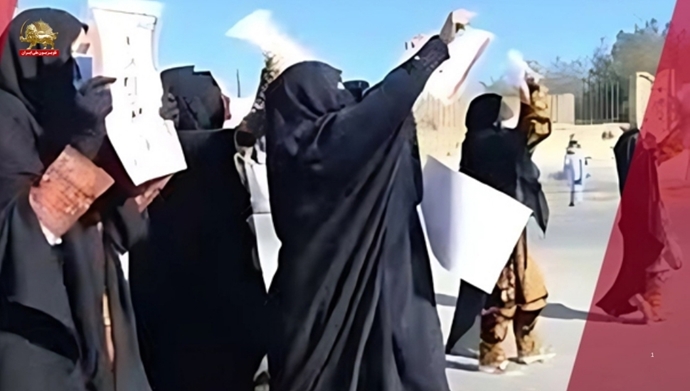

On Friday, July 4, the streets of Khash in Sistan and Baluchestan province witnessed a powerful display of defiance led by Baluch women. Marching toward the local governor’s office, they held placards that posed a stark question to the world: “Lali was killed, Khan Bibi too; why is the world silent?” Their chants of “Death to the child-killing regime” and the message they wrote on the wall of the government building—”We neither forgive nor forget”—reverberated with an unwavering resolve against the clerical regime’s escalating brutality. These women were not just mourning; they were demanding justice for the victims of the regime’s structural violence and sending a clear message that its crimes will not be forgotten.
The Gunich massacre: the spark of the protests
⚠️ Another tragedy in Baluchistan.
According to local news agency Hal Vash, 40-year-old Lali Bamari has died after three days in the hospital. She was shot by regime forces during their violent raid on Guneich village, Khash, on July 1.#Iran #HumanRights pic.twitter.com/k4OoZNXv6c— SIMAY AZADI TV (@en_simayazadi) July 4, 2025
The women’s outrage was sparked by a brutal, pre-dawn military raid on the village of Gunich on Tuesday, July 1. In a coordinated attack, the Islamic Revolutionary Guard Corps (IRGC) and law enforcement descended on the village. With the men away, the women of Gunich mounted a courageous resistance, blocking village entrances and burning tires to halt the advance of armed forces. Despite their lack of weapons, they used stones and makeshift barriers to defend their homes against live ammunition. The five-hour assault, conducted without a court order, left 40-year-old Khan Bibi Bameri dead, eleven others wounded—including four girls under 18—and over 50 arrested. This attack was a clear act of state-sponsored terror designed to intimidate a restive population.
A province under siege: a pattern of regime violence
The raid on Gunich is not an isolated incident but part of a broader, systematic campaign of repression by the regime across Sistan and Baluchestan. This pattern of violence is reminiscent of the infamous “Bloody Friday” massacre of 2022 and reveals the regime’s deep-seated hostility toward the Baluch people.
In the past week alone, this crackdown has intensified. On Friday, July 4, in Rudan, regime forces opened fire on local residents who rose up to defend a Baluch fuel carrier, wounding at least three people. A day earlier, on Thursday, July 3, in Iranshahr, municipal agents carried out a nighttime raid, confiscating the meager fruit stalls of poor street vendors, demonstrating the regime’s economic war on its own citizens.
A desperate regime faces a resilient nation
The escalating brutality in Baluchestan is a clear sign of the Khamenei regime’s desperation. Faced with a population that refuses to be silenced, it resorts to indiscriminate violence against women and children. However, the women of Khash and Gunich have shown that repression only fuels resistance. Their courage has become a powerful symbol of the Iranian people’s struggle for freedom. Their question—”Why is the world silent?”—is a direct challenge to the international community to abandon its silence and stand with the people of Iran against a tyrannical regime on its last legs.