

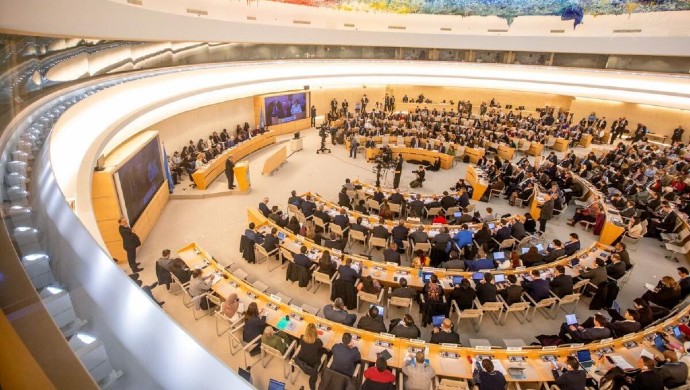

On Friday, April 4, the UN Human Rights Council approved a resolution to extend the mandate of the Special Rapporteur on the situation of human rights in Iran and the mandate of the Independent Fact-Finding Mission, both outcomes of the 2022 uprising.
This decision was made despite efforts by the clerical regime to prevent the extension of these mandates through various conspiracies, threats, and coercions, mobilizing its agents and allies in the region and worldwide.
A few weeks ago, in an attempt to block the extension of the reporter’s mandate and the fact-finding committee, Gholamhossein Mohseni Ejei, the head of the regime’s judiciary, slandered the Iranian Resistance, stating: “The same demons who sought to overthrow the Iranian government in the fall of 2022 and threatened our security and failed, later returned with lies and claims of assassinations. They tried to provide primary materials for the so-called international fact-finding mission on Iran and the use of exaggerated words to create a scandal.” (Mizan News Agency, affiliated with the regime’s judiciary – March 11).
The appointment of a special rapporteur for Iran has been the focus of Iranian Resistance campaigns at the United Nations headquarters in Geneva and New York for several years. Iran’s great human rights martyr, Dr. Kazem Rajavi – who declared, “We write human rights with our blood” – played a crucial role in organizing these activities. He brought many torture victims from Iranian prisons to the United Nations headquarters in Geneva and New York to testify on the regime’s crimes, and his efforts to pass numerous resolutions condemning the regime in the United Nations Commission on Human Rights (which was later replaced with the United Nations Human Rights Council) and the first resolution condemning the regime in the United Nations General Assembly are unforgettable.
Regarding the current session of the Human Rights Council and efforts to extend the mandates, the Iranian Resistance and its supporters are active in Geneva, Switzerland, and other European countries, as well as in the United States and the United Nations headquarters in New York. They are engaged in extensive activities, including providing documents and evidence, protests, hosting exhibitions, and holding press conferences.
The legacy of the 30,000 martyrs in the 1988 massacre of Iranian political prisoners, the martyrs who laid down their lives across Iran, and PMOI members and supporters who survived the enemy’s inhuman torture chambers and testified to the regime’s crimes, played a significant role in the success of these efforts.
In this regard, 77 current and former UN rapporteurs, experts, and commissioners penned a letter to the current President of the Human Rights Council and Member States, stating: “Impunity and the absence of accountability for serious human rights violations remain a significant and recurrent feature of Iran’s political landscape. We believe this impunity stems in part from the failure to hold Iranian officials accountable for their involvement in the 1988 massacre of political prisoners.”
The 77 rapporteurs, experts, and commissioners, supporting the Special Rapporteur’s call for an investigation into the regime’s crimes in the 1980s and the massacre of Iranian youth in the November 2019 uprising, wrote: “We support the call by the Special Rapporteur on Iran for the establishment of international accountability mechanisms with respect to long-standing emblematic events that have been met with persistent impunity, including the enforced disappearances and summary and arbitrary executions which took place in 1981 and 1988 and the protests of November 2019.”
In conclusion, the statement addressed to the head of the Human Rights Council by the rapporteurs and experts reads: “It is time to challenge the ongoing atrocities in Iran. Owing to the critical work of both the Special Rapporteur on Iran and the FFMI, we urge Member States of the Human Rights Council to vote in favour of resolution A/HRC/55/L.6, extending both mandates for a period of one year.”
At the outset of the Iranian New Year, the simultaneous presentation of the report of the Fact-Finding Mission and the final report of Special Rapporteur Javaid Rehman took place at the fifty-fifth session of the Human Rights Council, emphasizing “crimes against humanity” and the necessity to reject immunity from investigation and punishment of the perpetrators of the massacre and their accomplices, thereby disrupting the regime’s balance of bloodshed. Now, approving the decision to extend the mandate of the Special Rapporteur and the fact-finding missions constitutes two heavy legal and political blows to the regime of executions and massacres.