

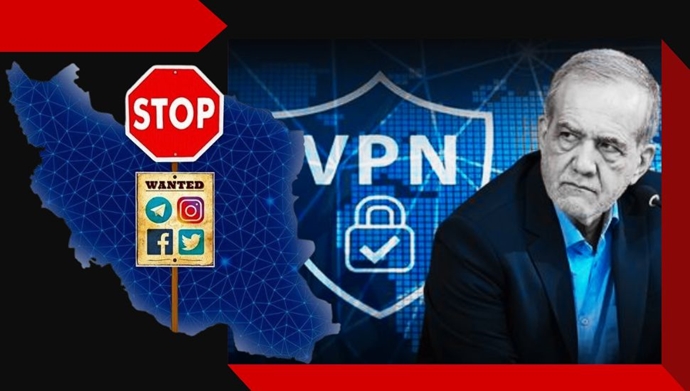

One of the promises of Iranian regime president Massoud Pezeshkian during the presidential election was “lifting internet censorship.” Meanwhile, the outcomes of various sessions of the oppressive body called the “Supreme Council of Cyberspace” remain contradictory, with no significant developments in this area. The back-and-forth surrounding this issue is an exposed story in the mullah’s regime, to the extent that even they write: “They deceive everyone with news about lifting censorship” (Source: Hamshahri news website, November 15).
Despite the narratives surrounding Pezeshkian’s to lift censorship, Qasem Ravanbakhsh, the First Vice Chairman of the Parliamentary Commission for Internal Affairs and Councils, said, “The lifting of censorship falls under the jurisdiction of the Supreme Council of Cyberspace and must be approved there. It is not something the president can simply order to be done.” (ibid)
One of the regime’s media outlets dashed the hopes of those looking for an end to censorship under the oppressive regime.
On November 15, the state-run Donya-ye Eghtesad newspaper wrote, “Even the president has emphasized that the government’s plan to lift censorship does not mean abandoning control of cyberspace. Experts and activists also believe that one should not expect widespread removal of censorship.
Why? Because the internet and free flow of information are like scorching sunlight on the dark swamp of Iran’s medieval dictatorship. For over four decades, this regime has tried to turn society into a vast prison.
Censorship is the regime’s tool to combat Resistance Units, the dynamic movement for regime change, and the connections between protest organizers.
It has often been revealed that the censorship circumvention tools market is controlled by the regime and its privileged elites, generating enormous profits for them.
Regime analyst Abbas Abdi once highlighted this lucrative business to his rival, though he used the generic term “operators” instead of exposing those behind the scenes.
On August 5, 2020, the state-run Etemad newspaper quoted him as saying, “Censorship is not the correct term for what they intend to do or have done in the past. The accurate term is the distribution, supply, and sale of VPNs, increasing traffic volume, and earning greater revenue for operators. This is an economic plan, not a political or cultural one. While it is presented as a cultural and media initiative, its true nature is an economic scheme aimed at generating more income.”
As far as this regime is concerned, it will not cease its oppression and suppression for even an hour until the day of its overthrow. What is celebrated as “lifting censorship” by so-called reformists is merely a new form of deception and fraud. Titles such as “governance of cyberspace” are just other names for censorship and its continuation. If the day ever comes when censorship, distortion, terrorism, executions, and repression are abandoned, that day will mark the regime’s end.
It must be emphasized that the overthrow of this regime is not contingent upon the lifting of internet censorship. The necessity for its overthrow is not a sentiment instilled from outside Iran’s borders that can be suppressed through censorship. Whether with internet censorship or without it, the regime must and will be overthrown.