

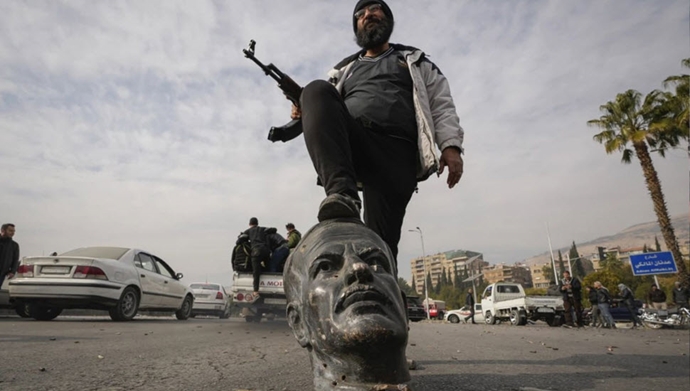

Two weeks have passed since the victory of the Syrian revolution and the overthrow of Bashar al-Assad’s dictatorship. News agencies and media outlets in their daily reports from Damascus and other Syrian cities present a completely different image compared to the frightening dictatorship era. People across Syria continue to celebrate breathing in a free atmosphere. Following the celebrations, what has astonished observers and foreign media is the calm and security prevailing in Syria. Despite the country having been reduced to ruins steeped in poverty, bloodshed, and misery over the past 14 years, there is no sign of chaos. Conditions are improving, and people are optimistic and hopeful about the future.
Economically, bread is available at a lower price for the people. The markets are thriving, and shops are open and active. The value of the Syrian lira against the dollar has increased. A significant point is that during the same period (less than two weeks), the Iranian rial has lost an additional 16% of its value.
Over the years, the Iranian regime, through extensive and misleading propaganda, has tried to frighten its people about “Iran becoming like Syria,” referring to the very disaster that it and its security and military forces, such as Qasem Soleimani and Hossein Hamedani, had inflicted upon Syria.
The marginalized factions of the regime also perpetuated the myth of “Iran becoming like Syria,” claiming that no reforms beyond the current regime should be pursued because if the situation spirals out of control, “Iran will turn into Syria!” However, for the past two weeks, this myth has collapsed on the regime, its officials, and the supporters of regime supreme leader Ali Khamenei. Anyone can now clearly observe the reality of the political and social environment in Syria after the revolution and the fall of the dictator.
Scaring people away from revolution and revolutionary solutions to overthrow dictatorships while inviting them to compromise with the status quo has always been a tactic of declining regimes. The Shah used to say that without him, Iran would become “Iranistan” and head toward disintegration. Similarly, the clerical regime adopted this tactic through its lobbyists and agents, promoting “passive” and “cost-free” approaches while fueling the myth of “Iran becoming like Syria.” Yet, the current situation in Syria is such that the people mock Khamenei and his failed propaganda, joking and writing on social media that now it is Khamenei and his regime who should fear “becoming like Syria” and the downfall of Iran’s corrupt and ineffective government.
How meaningful it is that Syrian television reported on December 25 that the people of Deir ez-Zor, in eastern Syria, held a celebration not only for the fall of Assad’s dictatorship but also for the expulsion of Iranian regime forces. They have bid farewell forever to the dark and criminal days of the Iranian regime’s destructive presence.
The Iranian Resistance has long exposed the myth of Iran becoming like Syria. Following the reverberation of slogans such as “Reformist, hardliner, the game is over” during the December 2017 uprising—proving the futility of the “reform from within” theory and dispelling the fear and illusion of “civil war,” “Iran’s disintegration,” and “Iran becoming like Syria”—the strategy of Resistance Units blossomed during the uprisings of November and December 2019. The slogans “Death to the oppressor, be it the Shah or the Supreme Leader,” the authenticity of a democratic alternative, the distinction of “Neither Shah, nor mullahs,” and the revolutionary orientation of Iran’s rebellious society demonstrated to everyone the path to achieving freedom and social justice. Today, it is clear that the only path forward for Iran is the overthrow of the mullahs’ regime and the establishment of a free and democratic republic.