

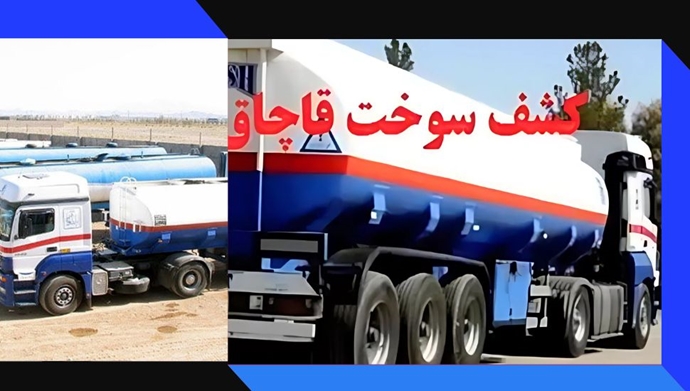

For several days, two news stories about fuel smuggling have unveiled a fraction of one of the largest systematic corruption cases in Iran.
The first report quoted regime president Masoud Pezeshkian as saying: “How is it that 20 million liters of fuel disappear daily while we are the producers and suppliers ourselves? They should hang me for this theft. The same applies to water, electricity, gas, and everything else.” (Source: the state-run Tabnak newspaper, December 17).
Earlier in December, Majlis (Parliament) Speaker Mohammad Bagher Ghalibaf revealed other figures, stating: “Between 25 to 30 million liters of fuel products are smuggled out of the country daily; rest assured, this smuggling is organized, and the main producers and consumers are the primary facilitators of this smuggling” (Source: Tasnim News Agency, November 26).
These two individuals admitting to massive smuggling of energy products are not ordinary people or lower-tier officials but two heads of the country’s three branches of power. They are deeply involved and aware of the theft and smuggling mechanisms in the country, fully understanding that gasoline and energy product smuggling is conducted by the Islamic Revolutionary Guard Corps (IRGC) yet choose to remain silent.
To conclude, we must also consider another earlier report revealing significantly different numbers about smuggling within the regime.
On October 15, Arman-e Melli newspaper wrote, “We consume 120 million liters of gasoline daily, of which only 70 million liters are actual consumption, and the rest is smuggled!” According to this claim, the amount of gasoline smuggled in this looted country is 50 million liters daily.
A Blow to Khamenei
When Ghalibaf himself declares, “This smuggling is organized,” and Pezeshkian admits, “It’s us,” it represents two significant blows to regime Supreme Leader Ali Khamenei, who has repeatedly claimed, including in June 2017, that “systemic corruption existed during the Pahlavi era, and the system naturally bred corruption, but today… corruption is sporadic, not systemic!” At the time, as the uproar and revelations about systemic corruption escalated, in March he repeated his denial and rebuke critics, asserting, “Corruption in the country has not become systemic. Anyone who says it’s systemic is wrong. Systemic corruption is something else. Systemic corruption was during the Pahlavi era!”
Additionally, discrepancies in figures like 20, 30, or 50 million liters and the general dismissiveness of specific amounts, such as 25 or 30 million, highlight the massive scale of this organized smuggling. The figures are so enormous that several million liters are now considered trivial or negligible.
Even the largest disclosed figures are likely manipulated and understated.
The Largest Smuggler in Iran
Both Ghalibaf and Pezeshkian acknowledge that the root of this corruption lies within the “producers” and “suppliers” of fuel. Thus, the main smuggler is the entity controlling the largest oil and gas holdings and profitable petrochemical companies. This same plundering institution manages about 70% of the country’s economy through various mafias. It is the multi-headed monster that, on behalf of Khamenei, operates the largest fuel smuggling network via its transportation and shipping companies.
On December 18, 2024, Reuters reported about this entity, stating: “Iran’s Revolutionary Guards have tightened their grip on the country’s oil industry and control up to half the exports that generate most of Tehran’s revenue and fund its proxies across the Middle East.”
This vast plundering, draining the lifeblood of the nation’s economy, occurs amid crises stemming from shortages of gas, electricity, and other energy products that have left the country semi-paralyzed:
– Many businesses and production centers face shutdowns or reduced output due to repeated power outages.
– Gas shortages have made heating homes a challenge for people.
– Power and internet outages have closed schools and offices and disrupted online education.
– Hospitals and healthcare centers that rely on electricity for medical equipment are struggling with severe issues.
– The use of alternative fuels like mazut in power plants and industries has increased air pollution, and so on.
Yet, Pezeshkian and Ghalibaf, both high-ranking officials of this corrupt regime, whose hands are deeply stained with its evils and crimes, never address the root of these problems or mention the “IRGC” or “Khamenei’s Office.”
One publication from the so-called “reformist” faction, which has suffered setbacks, told Pezeshkian, “You are in the position of the president. When dialogue fails, you must speak transparently.” However, seeking to maintain and prolong the regime, Pezeshkian resorts to playing the part of the victim, offering himself as a scapegoat for Khamenei, suggesting: “Hang me for this level of corruption and smuggling!”
Pezeshkian doesn’t realize that such theatrics are no longer effective. Soon, the people of Iran will settle scores not only with him but with all the officials and leaders of this malevolent regime. A fate like the associates of Assad’s regime awaits them all.