

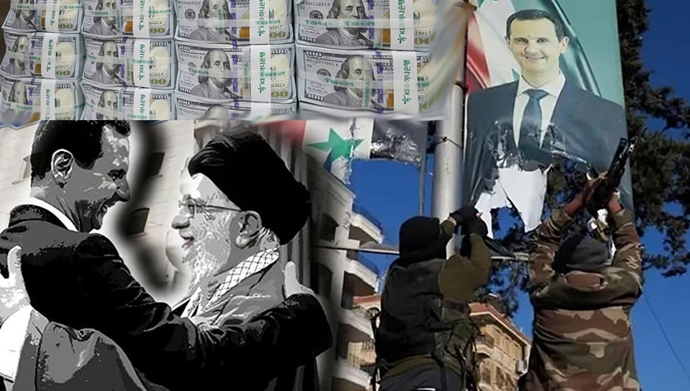

The Iranian regime’s terrorist meddling in Syria, exemplifying a costly policy to further its ambitions through military force, has profoundly affected the country’s economy and its citizens. This report highlights the financial cost of these policies in Syria, illustrating the burden borne by Iranian households and the broader implications of these expenditures.
The Iranian regime has turned Syria into a hub for distributing weapons, ammunition, and troops to affiliated groups in Gaza, Lebanon, Yemen, and Iraq. This strategy has resulted in ongoing conflicts and bloodshed, aimed at maintaining the regime’s survival. This policy can be summarized in one sentence: “a policy of crime.”
But what is the cost to the Iranian people? The economic burdens have been enormous, with vast resources diverted from vital sectors such as education, healthcare, industry, and agriculture to cover these policies.
To understand the scale of spending by the Iranian regime in Syria, refer to the documented evidence:
- Unauthorized Loans and Financial Support:
Bahram Parsaei, a former member of parliament, said: “During my time in parliament, Bashar al-Assad’s debt to the Iranian regime amounted to $30 billion, and it was not approved by parliament, in violation of Article 80 of the constitution.” When calculating the exchange rate of 700,000 rials to the dollar, this is equivalent to 21 quadrillion rials. - Cash Stipends for Syrian Fighters:
According to a 2019 report by the Washington Institute for Near East Policy, the IRGC pays Syrian fighters $100 a month, and those on the front lines $150. - Oil Shipments to Syria:
In his memoirs, former regime president Ali Akbar Hashemi Rafsanjani said that on March 14, 1982, the regime granted one million tons of crude oil free of charge to Syria under the pretext of “participating in jihad against Israel.” - Annual Financial and Oil Aid:
According to a December 8, 2024 report by Euronews, on May 23, 1984, the discussion of the draft law on the sale of oil to Syria began in a public session of the Majlis. During the debate, Ali Akbar Moin Far, a member of parliament at the time and former oil minister in the interim government of the Islamic Republic, revealed a shocking fact: “The regime was providing about seven million barrels of oil a year for free and without parliamentary approval to the government of Hafez al-Assad (Bashar al-Assad’s father).” - Billions of Dollars in Financial Aid:
Euronews, on the same date, reported that according to Bloomberg, Staffan de Mistura, spokesman for the UN special envoy to Syria, has said that the Iranian regime annually provides $6 billion in financial assistance to the government of Bashar al-Assad. Simultaneously, Nadim Shahadi, director of the Fares Center for Eastern Mediterranean Studies, told Bloomberg that between 2012 and 2013, the Iranian regime provided military and economic aid to the Syrian regime ranging from $14 billion to $15 billion. - Broader Financial Impact:
Euronews, on the same date, cited the Christian Science Monitor, which quoted a think tank affiliated with de Mistura, reporting that the Iranian regime annually provides $35 billion in financial aid to the government of Bashar al-Assad, equivalent to three times the official military budget of the Iranian regime. - Parliamentary Certificates:
On March 7, 2020, Heshmatollah Falahatpisheh, a member of the Majlis National Security and Foreign Policy Committee, was quoted by Etimad Online as saying: “We have given Syria between $20 and $30 billion, and we have to recover this money. This money belongs to the Iranian people, and it was spent there.” - Trade Deficit:
The fact-checking website Dorosti Sanji wrote December 16, 2024: According to a report published by the Tehran Chamber of Commerce website based on Iranian customs data, the value of foreign trade between Tehran and Damascus in the years 2023-2024 amounted to about $175 million, of which approximately $140 million represents Iran’s exports to Syria. - Industrial Projects:
In the same report, Dorosti Sanji quoted a 2006 IRNA report that placed the total value of various industrial projects carried out by companies affiliated with the Iranian regime in Syria amounted to $900 million. These projects included the construction of a cement plant, concrete silos for storing grain, the development and modernization of the Banias power plant, the rehabilitation of the Banias refinery, power transmission projects, and the Samand car production line.
Using the conservative figure of $6 billion annually in direct aid to Syria between 2012 and 2022, the Iranian regime would have spent at least $60 billion over a decade. With an average of 24 million households during this period, each household accounts for $2,500. When calculating the exchange rate of 700,000 rials to the dollar, the share of each household is 1.75 billion rials.
This does not include additional costs, such as free oil shipments and unequal trade agreements.
Redirecting resources to maintain the Assad regime has had catastrophic effects on Iran’s domestic economy. Investments that could have been directed to schools, universities, factories, agriculture, and environmental initiatives were instead spent on a foreign war. This trend has exacerbated inflation, poverty, unemployment, and social inequality.
Statistics underscore the high price of this policy: the growing number of child laborers, student dropouts, brain drain, and the expansion of slums.
These expenditures represent a betrayal of the Iranian people, whose economic stability has been sacrificed to fund foreign military adventures. In addition to Syria’s political and strategic failure, these figures demonstrate the urgent need for justice and accountability. As internal crises escalate, popular demands for transparency and accountability are increasing, presenting the Iranian regime with unprecedented challenges.
The staggering cost of the Iranian regime’s policies in Syria reflects a regime that prioritizes its survival over the well-being of its citizens. As domestic difficulties worsen, popular demands for accountability are likely to intensify, potentially representing a pivotal moment in the quest for justice for the Iranian people.