

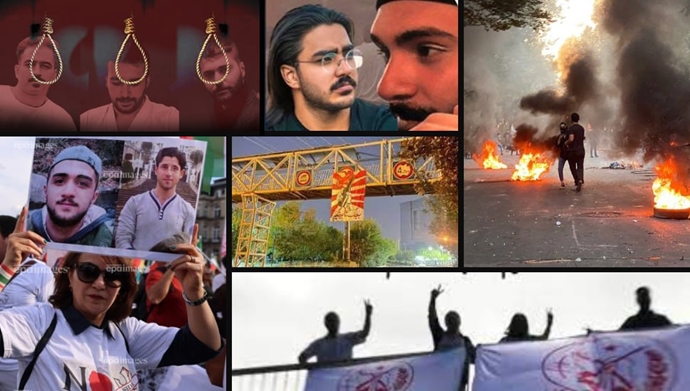

Iran’s regime holds the highest execution rate per capita in the world.
The persistence of executions owes itself to its utility as a tool for both political and religious power. The clerics who seized power in 1979 soon realized that execution could not only instill a continuous state of fear in society but also physically eliminate their political opponents.
Execution is not merely a judicial method; it is the lifeblood of the death-driven regime, a means of survival and sustenance.
When it comes to dealing with political opponents and overthrow movements, the ruling system unleashes itself. As the regime Supreme Leader Ali Khamenei has stated, the clerical regime deals with everything regarding supporters and members of the People’s Mojahedin Organization of Iran (PMOI) through executions justified by its repressive fatwas and inhumane courts.
Shocking Execution Figures on the World Day
This year, the regime is setting new records under the Massoud Pezeshkian’s government.
On October 7, HRANA news website wrote, “Between October 10, 2023, and October 8, 2024, at least 811 people were executed by hanging across various parts of Iran. This represents an increase of approximately 23.06% compared to the same period last year.
“Of those identified, 23 of the executed were women, and four were under 18 at the time of their crime.”
“No to Execution” Tuesdays
Organized resistance to dismantle the infernal machine of executions has launched and advanced various campaigns. One of its great achievements is the expansion of the justice-seeking movement and the documentation of extrajudicial executions and the massacre of political prisoners in the summer of 1988 as crimes against humanity and genocide, as detailed in the historic report by Professor Javaid Rehman, the former UN Special Rapporteur on the Human Rights Situation in Iran.
The Iranian Resistance’s campaigns and activities against the regime’s brutal repression on the streets and torture and execution in prisons have given rise to a powerful movement, spreading the message that the world must stand against executions—even from within the regime’s darkest prisons.
This year, on the eve of the World Day Against the Death Penalty, the courageous “No to Execution Tuesdays” campaign spread to 22 prisons across Iran. The leadership of women prisoners in advancing this campaign is notable. The regime is faced with a movement rooted in the sacrifice of 120,000 freedom-loving souls.
Global Activities of the Resistance on the Eve of World Day Against the Death Penalty
The Iranian Resistance has now extended its “No to Execution” movement beyond Iran’s borders, calling on all conscious minds to support this cause. In an online conference titled “No to Execution, Call for Justice” at the Parliamentary Assembly of the Council of Europe, Maryam Rajavi, the President-elect of the National Council of resistance of Iran (NCRI( said:”The ‘No to Execution’ campaign, which is advancing inside and outside Iran by the Iranian Resistance, is part of the Iranian people’s movement to overthrow the clerical regime.
“Therefore, we call on governments to condition their diplomatic and trade relations with the clerical regime on the cessation of executions and torture.
“We also call on governments to prosecute Khamenei, other regime leaders, and those responsible for crimes against humanity and genocide under universal jurisdiction and issue international arrest warrants for them.”
Mrs. Rajavi also stated on October 6: “As long as the clerical regime remains in power, neither torture and executions in Iran nor war and terrorism in the region will cease. The Middle East will not see peace or tranquility.”
Executions of prisoners have continued relentlessly. Thirty #executions were carried out on October 1 and 2 alone. Since August, when Pezeshkian took office, at least 255 prisoners have been executed.
As long as the clerical regime remains in power, neither torture and executions…— Maryam Rajavi (@Maryam_Rajavi) October 6, 2024
She called on the international community to support the “No to Execution” campaign and to condition diplomatic and trade relations with the regime on ending torture and executions, once again emphasizing that “The regime’s leaders must face justice for four decades of crimes against humanity and genocide.”
Coinciding with the 57th session of the Human Rights Council in Geneva, a conference titled “Human Rights Violations in Iran” was held at the European headquarters of the United Nations in Geneva. Political, legal, and human rights figures called for accountability for those responsible for genocide and crimes against humanity, as well as an end to the impunity of the clerical regime’s leaders.
The message and outcome of this widespread movement inside and outside Iran, in connection with the movement for the regime’s overthrow, is that a day will come when the people of Iran will celebrate freedom over the ruins of the regime’s dungeons. A day when barbed wires will no longer stop the breeze, and the key will no longer turn in the lock to lead prisoners to the firing squad or the gallows.
Article 3 of Maryam Rajavi’s 10-point plan heralds this day.