

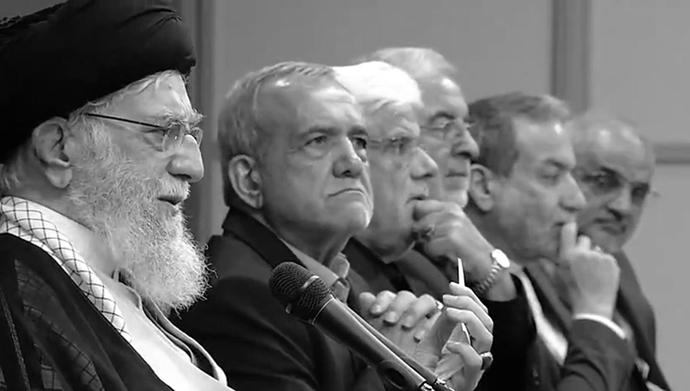

The new president of the Iranian regime, Massoud Pezeshkian, and his associates have been chanting the mantra of “national unity” and in every meeting they talk about a government of national unity, which refers to factional partnerships and quotas. The new president of the regime claims that he has included all viewpoints in the government. In practice, the introduced cabinet is a mixture of ministers from previous governments and elements from different factions of the regime. Pezeshkian himself constantly emphasizes the “Seventh Development Plan” and states that he has no other program except this one, which was drafted by the now deceased regime president Ebrahim Raisi, and approved by the regime Supreme Leader Ali Khamenei.
Nevertheless, after this cabinet was approved in the Majlis (parliament), what everyone has witnessed in these few days is not unity, but rather a fragmented government on the brink of various crises. Unity is out of the question; no faction is satisfied with its share, and each wants more. A notable example is the warnings and admonitions in recent Friday sermons directed at Pezeshkian.
Ahmad Alamolhoda, the Friday Prayer leader in Mashhad, reminded Pezeshkian that he should take Raisi as his model and, by learning from the fate of previous presidents, be careful not to “stray from the leadership.”
Hosseini Hamadani, the Friday prayer leader in Karaj, reminded Pezeshkian that after Khamenei’s endorsement, he can no longer use excuses like “they don’t let us work, it’s not possible, we can’t do it; these excuses will no longer be accepted.”
Khamenei’s intervention and his endorsement of Pezeshkian’s statements and the approval of all the ministers did not stop the attacks from those who were eager to seize the entire cabinet. On the contrary, after former foreign minister Mohammad Javad Zarif’s return to the Strategic Deputy position, they feel that Pezeshkian has deceived them. They claim that Pezeshkian apparently sidelined Zarif before the vote, but now that he has crossed the parliament’s bridge, he has brought Zarif back and placed him beside him as the Strategic Deputy.
After the announcement of Zarif’s return, Kayhan newspaper wrote: “After the introduction of Pezeshkian’s proposed cabinet, Zarif engaged in trickery, pretending that he was dissatisfied with the proposed cabinet and took a stance of resigning from the Strategic Deputy position (although the main reason for his discontent was the legal prohibition due to his children’s dual citizenship) … However, today he wrote: ‘After the wise consultations of the honorable President and with his written order, I will continue to serve in the Strategic Deputy position.'”
Kayhan sees trickery and “dishonesty” not on Zarif’s part, but rather on Pezeshkian’s, implying it indirectly.
MP Hamid Rasaee issued a condemnation of Pezeshkian. Rasaee wrote on his X account: “If Mr. Zarif’s claim is true and he is retained in his position as Deputy, according to the law, firstly, this appointment as Strategic Deputy is null and void, and secondly, the perpetrator (Mr. Pezeshkian) will be sentenced to deprivation of social rights (for 5 to 15 years) under Article 19 of the Islamic Penal Code.”
Meanwhile, many of Pezeshkian’s reformist allies, from the very day the cabinet was introduced, called it a quota-based cabinet and Raisi’s second cabinet.
Thus, what Pezeshkian calls a “cabinet of unity” resembles more of a crumbling structure hastily put together with the decayed remnants of previous governments and various factions, teetering on the edge of a fiery abyss. A structure that on one side is besieged by the regime’s internal crises and infighting, and on the other, faces the storm of public anger and protests, which, according to regime experts, it is unlikely to survive intact.