

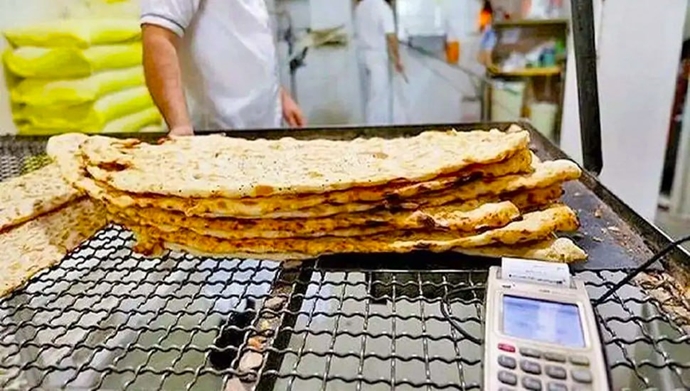

One of the known methods of Iran’s regime to increase the prices of essential goods is to first raise prices in a few regions, ignore the ensuing news for a while, then claim it was a rumor. After a few rounds of confirmation and denial, they proceed to increase prices in other regions as well. The regime’s goal is to prevent public shock and to avoid uprisings by gradually raising prices and managing the flow of information.
Similarly, the regime has recently increased the price of bread in certain provinces. The 25 percent price hike for bread started in the Qazvin province and gradually spread to other provinces. On August 7, regime media reported that “bread prices have increased in 10 provinces.”
On August 28, Mizan the judiciary’s news agency reported an increase in bread prices in the capital, stating: “The price of bread has been rising in Tehran for some time, with increases of over 50 percent in some cases. Sangak bread, which was recently sold for 50,000 rials in private bakeries, has now reached 100,000 rials. Similarly, the price of Barbari bread has gone from 30,000 rials to 50,000 rials, and Taftoon bread has increased from 10,000 rials to 20,000 rials”. On the same day, bread price increases were also reported in Tabriz and South Khorasan—some of Iran’s poorest provinces.
In the same report, there is a subtle deception. The article initially mentions a price increase of “over 50 percent” but a few sentences later, the reader realizes that Sangak bread has gone from 50,000 rials to 100,000 rials and Taftoon bread from 10,000 rials to 20,000 rials, which is a “100 percent” increase.
Price Hikes Accompanied by Claims of Victimhood
In this latest round of bread price hikes, the regime has adopted a defensive stance, claiming that the government bears most of the bread’s cost, subsidized by the state. “In traditional bakeries, 80 percent of the final price of bread is covered by government subsidies, and people pay only 20 percent of the actual cost. According to current calculations, the actual price of bread is four to five times higher than the current price” (Source: the state-run Etemad newspaper, August 7).
But what exactly is this subsidy, and what is it supposed to cover?
One of the regime’s commitments, having control over vast oil reserves and the wealth of the Iranian people, is to purchase wheat from farmers at a price supposedly higher than the harvest season price and then sell it to bakeries at a lower cost.
According to the regime’s own statistics, “The government has estimated the bread subsidy in the 2024 budget bill at 1.43 quadrillion rials… still 160 trillion rials less than the subsidy allocated for bread in 2023. The Majlis Research Center estimates that the required budget for bread subsidies in the 2024 budget bill will be around 1.92 quadrillion rials in the first [pessimistic] scenario and 1.78 quadrillion rials in the second [optimistic] scenario” (Source: The state-run Khabar Online news website, August 7).
A brief comparison of the numbers in this report leads to two conclusions:
First, the budget allocated for bread subsidies for the Iranian people has decreased compared to last year, even though factors like population growth should lead to an increase in the bread subsidy budget.
Second, according to these statistics, “the bread subsidy for this year has a shortfall of about 280 trillion rials, and in the most pessimistic scenario, 420 trillion rials” (Source: Khabar Online, August 7). This means that all these subsidy calculations are unreliable, and even if the full budget is allocated, the state will still face a budget shortfall.
However, beyond all this, the situation of the wheat farmers—the ones supposedly receiving these subsidies—is tragic.
In June, the regime widely publicized its claim of self-sufficiency in wheat, with IRNA, the official government news agency, headlining: “A major step towards wheat self-sufficiency in the 13th administration; we do not need imports this year,” and touted this as a “leap” in production and one of the achievements of the now-deceased president Ebrahim Raisi.
According to this claim, the regime will not spend even a dollar on importing wheat. However, since the beginning of the year until this month of September, the farmers have been left hanging without payment for the wheat they supplied, a significant portion of which has already been turned into flour. This is why one of the ongoing protests involves wheat farmers, with daily protests and outcries heard in provinces like Ilam and Khuzestan. They say that the government has not paid them for their wheat, yet they are forced to pay the installments and debts they incurred for wheat cultivation.
In tandem with increasing repression, executions, and imprisonments, the regime has decided to empty the tables of the Iranian people.
While increasing the budgets of repressive institutions such as the State Security Forces, the Islamic Republic Guard Corps (IRGC), and propaganda bodies like the “Al-Mustafa International University,” the “Foundation for the Preservation of Sacred Defense Works,” and others, he has cut the budget for bread, which constitutes 40% of the primary food for the Iranian people.
There is also no news of payment to the struggling wheat farmers.
This is why Iran’s people are becoming more determined every day that the only way they will achieve their rights and deserved prosperity is to overthrow the regime.