

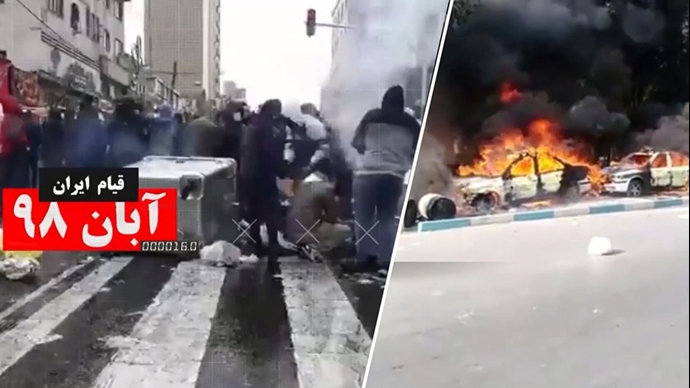

Iran’s November 2019 uprising can be reviewed from various perspectives to analyze its dimensions and achievements. The most significant achievement of this glorious movement was strengthening the belief in an imminent overthrow of the mullahs’ regime.
The so-called reformists, fake opposition groups created by the regime, its lobbyists, and foreign appeasers propagated that regime change was not the preference of the Iranian people, that one must focus on reforming this regime, and that the only solution lay within its structure. The November uprising disrupted all their calculations and demonstrated that since June 20, 1981, the Iranian people, hand in hand with the revolutionary resistance, seek freedom not under the regime, but in a structural overthrow of the system built upon absolute clerical rule.
This article examines the fearful reactions of regime leaders to the scope and impact of the November uprising. Observing these reactions in their own timeframe enables us to understand the November uprising and the power of the streets more deeply from the regime’s perspective and recognize it as the sole decisive force for Iran’s present and future. A common theme in the regime leaders’ statements regarding the scope and depth of the November uprising was the strategy of Resistance Units and the specific role of the People’s Mojahedin Organization of Iran (PMOI/MEK) in shaping it.
On January 8, 2020, regime supreme leader Ali Khamenei admitted: “A few days before the November events, those related to gasoline and the like, in a small but truly wicked European country, an American agent gathered with a group of mercenary Iranians, traitors, planning and plotting against the Islamic Republic. Their plan was exactly what we saw a few days later in the gasoline-related events.”
A Full-Scale World War
Deputy commander of the IRGC Basij forces, Salar Abnoosh likened the November 2019 uprising to “a full-scale world war” that “suddenly engulfed the entire country.” He said, “Only God saved us.”
Also, Deputy Commander of the Islamic Revolution Guards Corps (IRGC) Ali Fadavi admitted that 28 provinces and 100 neighborhoods participated in the uprising on its first day. He added, “When I spoke with IRGC commanders in some cities, at times these riots reminded one of Karbala-4 (An Iranian Operation in the Iran–Iraq War) … We truly fought for 48 hours.”
“Eternal Light Operation 2“
About the November uprising, Hesamodin Ashna, political advisor to former regime president Hassan Rouhani and former deputy minister of intelligence, wrote: “They thought they had launched Eternal Light Operation 2 (The 1988 offensive operation by PMOI).”
The head of the political bureau of IRGC, Yadollah Javani, described the scope of the November uprising as such: “These events, in terms of their scale and dimensions, were unprecedented in the forty-year life of the Islamic Revolution. Although we saw instances of attacks on Basij bases, burning them, and setting fire to banks and government centers during the protests of 2009 and 2017, those incidents were on a much smaller scale than the recent events.”
On November 22, 2019, Ahmad Khatami, the regime’s Friday prayer leader in Tehran, called for protesters to be pursued from house to house, said, “They should be dealt with as they were in the early days of the revolution!” He also advocated for continuing internet restrictions, saying, “I request that you do not open the internet. You saw that they taught people how to commit crimes. In regard to foreign networks, I ask that you do not open them.”
On November 19, 2019, Rasoul Fallahati, the regime’s Friday Prayer leader in Rasht, addressed protesters, saying, “We know you are the children of the executed hypocrites [PMOI]. You are the children of the exiled hypocrites… We know you… Don’t return to the ill-fated ways of your predecessors; come back to the nation’s embrace and repent!”
Repeating June 20, 1981
In its analysis of the November protests, the Ministry of Intelligence wrote, “Recently, the country has once again been caught up in unrest… According to security forces, the PMOI played a major role in this unrest. This fact becomes more evident when we know that, over the past forty years, the PMOI have used every opportunity to create instability and chaos in the country. This tactic is the primary strategy of this group. From 1979 to 2019, the PMOI have consistently tried to prevent political stability in the system… In 2002, they launched a propaganda campaign against Iran’s nuclear program, a case that we are still dealing with… In December 2017, the PMOI exploited economic dissatisfaction and coordinated with the new tenant of the White House to set the stage for Trump’s exit from the JCPOA through street unrest… They still hope to repeat the events of June 20, 1981, with even a small upheaval.”
On June 20, 1981, hundreds of thousands of PMOI supporters across Iran held peaceful protest rallies to call for the regime to respect the freedoms the Iranian people had obtained in the 1979 revolution. In response, the regime opened fire on the protests and began a massive and brutal campaign of cracking down on dissidents. That event became a turning point, proving that freedom can only be restored in Iran through resistance against the regime
On November 21, 2019, the IRGC-affiliated Javan newspaper wrote, “Hostilities of an unprecedented intensity that we had not seen in 1999, 2009, or any other sensitive period! What kind of tribe were we facing? Where were they trained? Through what gaps did they infiltrate? And how did they emerge from our own streets in new attire and guise?”
Admission of PMOI’s Role in the November Uprising
In a speech before the Friday prayer sermons in Qom, the IRGC commander of Qom, Mohammad Taghi Shahcheraghi spoke about the role of the PMOI in the November protests: “The role of the PMOI in the recent incidents was very prominent, to the extent that through their management and influence in certain cities, they caused widespread destruction.”
In a press conference related to the nationwide November protests, Secretary of the Supreme National Security Council, Ali Shamkhani, said, “These individuals were connected to governments and the PMOI… I believe that 34 PMOI members have been arrested so far, and a vast network of channels operating not under the name of the PMOI but with their agenda has also been identified.”
Saffar Harandi, a member of the Expediency Discernment Council, said, “The rioters were an organized group that carried out similar actions across the country.”
The spokesperson for the Parliamentary Security Commission, Hossein Naqavi Hosseini explained how the November protests were formed and led, stating, “The PMOI has been training various groups and circles and guiding them in the protests over the past two years.”
Ali Akbari, in the Tehran Friday sermon, said, “The result of what they themselves call two years of extensive organizational work, reconnaissance, training, equipping, and arming… is a very dangerous and planned conspiracy… The verdict of ‘Moharebeh’ (enmity against God) and rebellion, prescribed for such individuals, is at the peak of Islamic punishments… The judiciary should apprehend these people and act swiftly.”
The Basij commander announced that Saturday evening’s unrest was caused by “centers of mischief” and that the PMOI have cells within the country.
Hassan Rouhani, then-president, in a meeting thanked the security forces for handling protesters and suppressing dissenters, saying, “I thank the Ministry of Intelligence, the Law Enforcement Force, the IRGC, the Basij, and all armed and security forces. They made every effort to identify the leaders of those attempting to destroy public property. Some were arrested, and others will be detained, and they will be dealt with according to the law.”
The Protesters’ Intention to Seize State Television
About the recent protests, in a television interview, Rouhani’s Interior Minister, Abdolreza Rahmani Fazli, said, “During the recent unrest, around 731 banks and 140 government buildings were set on fire by protesters, and over 50 security force bases were attacked. In addition, during the protests, 731 banks, 140 public places, 9 seminaries, 70 gas stations, 183 military vehicles, and 1,076 motorcycles were set ablaze by protesters. About 500 people were moving towards state television, but we did not allow them to get within three kilometers.”