

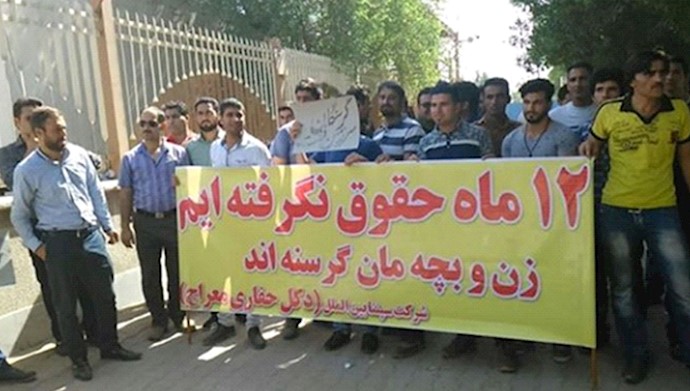

In the past century, Iran, with its significant oil and gas reserves and valuable natural resources, has experienced a trajectory of intensifying poverty and misery. Workers and other wage earners in Iran, who number over 60 million with their families, can be said to face conditions similar to their counterparts in 18th and 19th century England.
Lack of suitable employment, exhausting work in workshops and factories with minimal safety and hygiene standards, wages that don’t even cover ten days of a month’s expenses, rental costs that consume over 80% of their income, and skyrocketing inflation, especially in food prices, have depleted the energy and stamina of workers who toil for long hours each day. They are forced to choose backbreaking labor with meager wages in government, quasi-governmental, and state-affiliated institutions rather than working in low-paying jobs in the public sector. When a carton of eggs costs 50,000 rials and a kilogram of tomatoes reaches 700,000 rials, it is evident that an omelet is a luxury for the working class. Proteins, fruits, vegetables, and meat are no longer part of their daily diet, despite being mentioned in stories from the past.
The intensity of exploitation and the meager wages of workers, even insufficient for their own survival and that of their families, have caused a portion of the workforce to refuse to work in factories.
To the extent that the government of Iranian regime president Ebrahim Raisi and its members claim that there are jobs, but workers cannot be found. The regime talks about the readiness of the workplace but says nothing about wages that do not even cover the minimum costs of living.
On December 8, Tejarat newspaper wrote, “Inflation is so high that people cannot meet their basic living expenses with their wages. False occupations have emerged that minimize the motivation for work and production. The combination of these factors has led to severe labor shortages in many industrial units.”
On December 8, Rouydad 24 news website wrote that all people familiar with the labor market say, “Long working hours throughout the day and the hardship of work in exchange for low wages have caused employed workers in production units to seek other jobs after a year, prioritizing false occupations. As a result, most individuals who are forced to leave their jobs in production units say that even street vending provides significantly higher income than working in factories and production units.”
Under such very circumstances, Raisi claims to have achieved a reduction in the unemployment rate. In presenting the budget bill for 2024 to the parliament, Raisi said, “Currently, in some provinces, the unemployment rate is 5-6 percent, and even some provinces are in need of labor.” (Source: IRNA news agency, December 8)
On December 8, Tasnim news agency, affiliated with the terrorist IRGC Quds Force, quoted the secretary of the Supreme Council of Trade Unions of Workers as saying, “Unfortunately, due to reasons such as low wages, the workforce has no inclination to work. By better work, we do not mean that the worker should have more rest and a higher job position, but rather the central issue for workers is income. It means that the worker’s income should be sufficient to sustain their life.”
The workers, who are unsupported and have no future prospects, know well that a job that does not provide for their livelihood is not suitable. When the cost of living for a worker is at least 150 million rials, it is evident that a job that does not even provide half of that amount is not acceptable. The pain and suffering of workers and other hardworking people in the 40-year reign of religious fascism have not only not decreased but have increased day by day. The army of the unemployed and the hungry will not reconcile with a system of exploitation and plunder. For a better tomorrow, the oppressors must be brought down.