

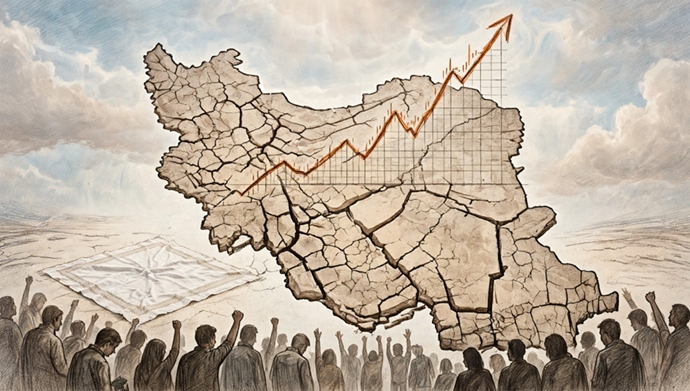

In totalitarian and authoritarian regimes, corruption is neither an incidental anomaly nor a localized administrative malfunction. Rather, it constitutes the foundational logic and primary mechanism for the reproduction of political power. In economies subjugated by closed autocratic structures, capital accumulation does not emerge from productive innovation, competitive markets, or entrepreneurial enterprise.
Instead, it operates through clientelism, systemic dispossession, and the redistribution of massive state rents to networks loyal to the regime’s core. In Iran, national assets, strategic resources, judicial oversight, and armed forces are consolidated under the unchecked authority of the supreme leader and his allied security-military apparatus. As a result, corruption becomes the very adhesive that binds the ruling oligarchy and sustains the machinery of repression.
From this structural perspective, recurring economic scandals are not isolated grievances. They are everyday clinical manifestations of an extractive state apparatus that offloads the cost of its survival and elite rent-seeking onto ordinary citizens through runaway inflation, healthcare collapse, mass unemployment, and infrastructural decay.
Everyday Symptoms of Systemic Plunder: Three Diagnostic Cases
To understand how this macro-logic translates into concrete devastation, three recent developments illustrate how public wealth is extracted and shifted away from society:
- Rents in the Assembly Sector: The $6 Billion Automotive Windfall
The allocation of $6 billion in preferential and semi-subsidized foreign exchange to Modiran Vehicle Manufacturing (MVM) between 2021 and 2026—primarily under the administration of former regime president Ebrahim Raisi—for importing knockdown kits from China’s Chery Automobile demonstrates the regime’s currency priorities.
This sum represents more than one-third of Chery’s entire market valuation (approximately $17 billion). Yet, this astronomical outlay yielded only 430,000 assembled consumer vehicles. By comparison, that same capital could have rebuilt the massive Mobarakeh Steel complex four times over, financed the country’s entire gasoline import bill for two consecutive years, or established six industrial-scale automotive plants with a capacity of one million vehicles each.
Under authoritarian rule, foreign trade functions primarily as a conduit to siphon state reserves into the coffers of politically connected commercial cartels.
- Dismantling Health Subsidies: Profiteering off Public Health
While billions in hard currency flow toward high-margin vehicle assembly, the state has eliminated preferential exchange rates for the pharmaceutical sector under the pretext of “currency shortages.” According to industry officials, this abrupt policy shift drove a fivefold increase in the cost of raw pharmaceutical materials within months, triggering price surges across at least 400 essential and over-the-counter medications.
This contradiction reveals the underlying dynamic of the regime’s political economy: the fiscal drains created by elite corruption are offset through forced austerity, depriving vulnerable households of vital medical care and driving lower-income families deeper into poverty.
- Industrial Atrophy and the Assault on Labor
Starving productive sectors of capital while favoring import monopolies inevitably paralyzes domestic industry, resulting in waves of workforce “downsizing.” Deprived border regions, such as Kermanshah province—which leads national rankings with an official unemployment rate of 11.9%—bear the heaviest burden.
Contradictory official statistics reflect the administration’s inability to conceal the depth of the contraction. Independent manufacturing units, crushed by liquidity crunches and unfair competition from state-backed importers, are forced to shutter, passing the ultimate cost to the working class in the form of layoffs, wage suppression, and economic destitution.
Institutional Deadlock: The Impossibility of Internal Reform
Institutional political economy demonstrates why systemic corruption within an autocratic regime cannot be remedied through technocratic fixes or internal administrative reforms:
- Monopoly of Extractive Institutions: Strategic economic drivers—including petrochemicals, mining, customs, and currency channels—are controlled by parastatal foundations and security conglomerates answering directly to the core of power, precluding any equitable redistribution of resources.
- Absence of Judicial Independence and Rule of Law: The judiciary and regulatory agencies operate as instruments of regime preservation rather than independent watchdogs. Selective anti-corruption campaigns serve merely as factional score-settling over the division of state rents.
- Suppression of Civil Society and Free Press: By criminalizing investigative journalism, outlawing independent labor syndicates, and suppressing civic oversight, the regime deliberately eliminates transparency, allowing structural looting to continue unchallenged.
The Imperative of Confrontation and Democratic Transition
Systemic plunder, systemic inflation, and deepening poverty are structural requisites for the regime’s survival. Historical precedent confirms that an entrenched, predatory ruling apparatus never relinquishes power voluntarily, nor can it be dismantled through incremental appeals or reformist illusions. Genuine transparency and institutional accountability would require the regime to dismantle the very economic and political foundations upon which its power rests.
Ending the continuous cycle of impoverishment, halting the pillage of national wealth, and restoring the rights of workers and citizens requires popular organization, broad-based social solidarity, and decisive confrontation to overthrow this dictatorship. Only the establishment of a democratic, secular republic anchored in the rule of law and public accountability can reclaim national resources from predatory cartels and direct them toward sustainable development, universal social security, and economic justice.