


On the eve of the World Day Against the Death Penalty, political prisoners across Iran issued a series of statements condemning the Iranian regime’s escalating execution campaign, warning against international inaction, and reaffirming their determination to continue resisting the ruling dictatorship.
Published on October 9, 2026, the messages came from PMOI/MEK supporters in eight prisons, five women political prisoners in Evin Prison, and individual prisoners in Evin, Ghezel Hesar, and Bandar Abbas.
The prisoners repeatedly insisted that their statements be broadcast through Simay-e Azadi, the Iranian Resistance’s television network, so their voices could reach Iranian youth and the public regardless of the consequences they might face.
Their messages reflect a shared conviction: the regime is using executions to suppress dissent and prevent another uprising, but neither imprisonment nor the threat of death will extinguish the struggle for freedom.
Prisoners across eight prisons: Executions cannot silence resistance
In a joint statement, PMOI supporters held in Evin, Karaj Central, Vakilabad, Ghezel Hesar, Urmia, Khorramabad, Iranshahr, and Gonbad-e Kavus prisons described executions as an instrument of political survival for the clerical regime.
They opened their message with a warning that executions reflect the authorities’ growing fear of the Iranian people:
“Although the execution machine of the religious fascism ruling Iran continues to kill relentlessly in fear of an explosion of the people’s anger, the global movement to abolish the death penalty has gained considerable momentum in recent years.”
The prisoners contrasted the regime’s increasing reliance on capital punishment with the worldwide movement toward abolition. They pointed to Iran’s disproportionate share of recorded executions worldwide as evidence of the scale of repression.
They also emphasized that their opposition extends beyond the death penalty to the dictatorship responsible for imposing it. Rejecting both monarchical and clerical rule under the principle of “Neither Shah nor mullahs,” they pledged to continue their struggle alongside Resistance Units and the Iranian people.
They declared their determination to establish a democratic republic based on Maryam Rajavi’s Ten-Point Plan, which includes the abolition of the death penalty, and vowed not to relent until oppression is uprooted and freedom is established in Iran.
Five women in Evin demand action beyond international condemnation
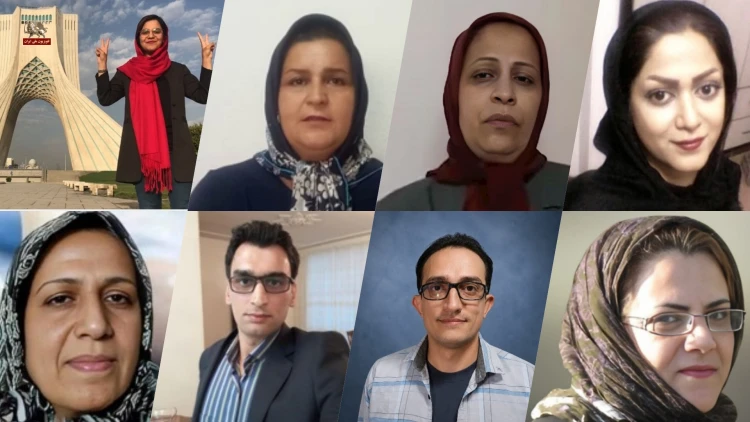
Five women political prisoners in Evin—Zahra Safaei, Marzieh Farsi, Shiva Esmaeili, Elaheh Fouladi, and Forough Taghipour—issued a joint statement dated October 7, warning that successive dictatorships in Iran have used executions to preserve their power.
“For 120 years, our grief-stricken country has witnessed the execution of women and men under the tyranny of the Shah and the mullahs,” they wrote, describing a history of state violence that they argued could neither be adequately expressed in writing nor comprehended by ordinary human conscience.
They stressed that execution is a permanent instrument of repression under the clerical regime, intended to prevent an uprising that would bring an end to its rule.
Their most important message was directed at international institutions. The five women demanded that the international community move beyond statements of condemnation:
“We ask international institutions not to merely condemn human rights violations in Iran. They must not appease this bloodthirsty regime, and must recognize the organized Resistance and the Iranian people’s right to struggle to overthrow the regime of executions.”
Their appeal carries considerable personal risk. Safaei, 63, is serving a five-year prison sentence, while Esmaeili, Farsi, and Taghipour received sentences of ten and a half, six, and six years respectively. Fouladi was sentenced to five years.
Authorities have previously punished the women for participating in anti-execution protests, restricting family visits and telephone contact. Esmaeili and Fouladi also received additional six-month sentences after protesting the death of fellow prisoner Somayyeh Rashidi.
Their statement thus represents a continuation of resistance from inside prison despite punishment for earlier protests.
Parisa Kamali warns against silence in the face of executions
From Bandar Abbas Prison, 40-year-old political prisoner Parisa Kamali delivered an urgent appeal to Iranian society, warning that the authorities were using executions to silence demands for freedom and accountability.
She warned that the ruling authorities responds to people’s legitimate questions and aspirations with death sentences instead of accepting responsibility for the country’s conditions.
“Be the voice of the children of our homeland,” Kamali urged, referring to young Iranians who, she said, face execution even for sharing videos or social media stories expressing their aspirations for freedom and a prosperous homeland.
Her most pointed warning concerned the consequences of remaining silent while others face the gallows:
“Those who remain silent should know that tomorrow the bloodthirsty mullahs and judges in this sham judicial system may turn their pens toward issuing death sentences for their loved ones—and how quickly it becomes too late.”
Kamali’s statement came after repeated punitive measures. Arrested in 2024, she was sentenced to six years in prison and two years of internal exile. She was denied necessary medical treatment in Yazd Prison and abruptly transferred to Bandar Abbas on September 8, 2026.
Despite these pressures, she has continued speaking out against executions, insisting that living in a free and prosperous country is the right of every Iranian.
Bijan Kazemi: Poverty and executions as instruments of repression
In a statement from Evin Prison, political prisoner Bijan Kazemi connected the death penalty to the regime’s wider system of economic deprivation and political repression.
Invoking the Persian legend of Zahhak, the mythical tyrant who sacrificed young people to sustain his power, Kazemi drew a parallel with Iran’s ruling dictatorship.
“The dictator needs the minds and blood of the people to survive, because the thirst for power and tyranny is quenched only by drinking the blood of the innocent,” he wrote.
Kazemi stressed that regime authorities perpetuate economic hardship and then using the resulting social problems to justify repression.
“They place some people in poverty and hardship, then arrest them as criminals and execute them,” he warned.
He criticized the authorities for failing to build factories, create employment, and provide opportunities for young people, particularly in Lorestan Province, while continuing to rely on the gallows to spread fear.
Kazemi himself faces exceptionally harsh punishment. Arrested in January 2025, he endured prolonged interrogation and torture before receiving sentences totaling 37 years and six months in May 2026.
Sepehr Emamjomeh: Testimony from the shadow of the gallows
From Ghezel Hesar Prison, Sepehr Emamjomeh offered one of the most personal accounts of the execution campaign, recalling the fellow prisoners he had lost to the gallows.
Speaking as a participant in the No to Executions Tuesdays campaign, which has organized weekly hunger strikes across prisons nationwide, he described the human toll of the regime’s executions.
“As a political prisoner, eleven of my dearest and most honorable brothers have been taken from beside us and sent to the gallows, and I still carry their grief in my heart,” he wrote.
Emamjomeh explained that his assessment of executions comes not only from political convictions but from personal encounters with prisoners facing death sentences in Ghezel Hesar.
He declared:
“I testify that every execution in Iran has been and is carried out solely to intimidate and suppress society.”
Emamjomeh explained that the regime’s reliance on capital punishment is an effort to escape the consequences of popular anger and the prospect of another uprising.
Emamjomeh has experienced years of repression. Arrested during the 2020 crackdown on PMOI supporters, he was wounded during the October 2022 assault on Evin Prison.
His message also highlighted the No to Executions Tuesdays campaign, which reached its 141st consecutive week on October 6, with participating prisoners conducting hunger strikes across 66 prisons.
He concluded with a pledge linking the abolition of executions to the future of Iran:
“As the smallest child of this land, I swear and believe that on the day the gallows are dismantled in Iran, freedom will arrive.”
An urgent call for international action
The prisoners’ warnings come amid an unprecedented execution crisis. Amnesty International documented at least 2,159 executions in Iran during 2025, accounting for approximately 80% of the worldwide executions it recorded, excluding countries where reliable figures were unavailable.
The prisoners’ demands echo Maryam Rajavi’s October 6 letter to the UN Secretary-General, which called for an immediate halt to executions, international investigations, access to prisons, accountability for perpetrators, and conditioning diplomatic and economic relations on ending executions.
As the prisoners warned, executions are being used to preserve a dictatorship, public silence enables repression, and international condemnation must be translated into concrete measures that protect lives.
At the same time, their statements demonstrate that the threat of further punishment has not silenced political prisoners who continue to call for an Iran free of executions and dictatorship.