

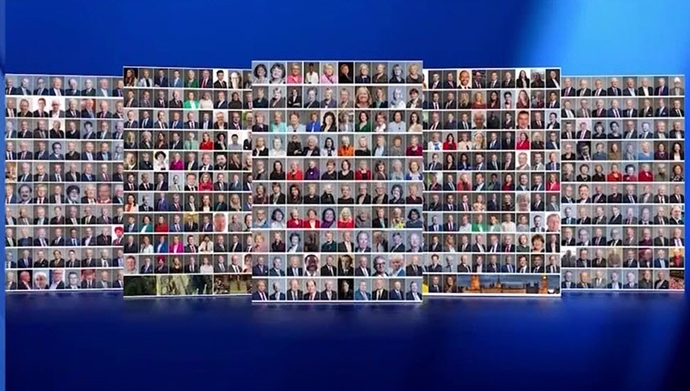

The Iranian regime has reacted with predictable fury and thinly veiled panic to a powerful statement from over 550 British lawmakers calling for the terrorist designation of the Islamic Revolutionary Guard Corps (IRGC) and recognizing the legitimacy of the Iranian people’s struggle for change, including the role of PMOI Resistance Units.
The regime’s Majlis (parliament) issued its own desperate condemnation, tellingly blaming the People’s Mojahedin Organization of Iran (PMOI/MEK) for this significant international pressure. This panic reaction from Tehran inadvertently reveals not strength, but a deep-seated fear of the PMOI’s expanding influence both within Iran and on the global stage.
The regime’s Majlis, in a session on Tuesday, May 20, 2025, read out a statement drenched in agitation. This official outcry from the clerical regime’s parliament branded the unified call from 230 members of the UK House of Commons and 330 members of the House of Lords as a threat to the “sovereignty, security, and authority of the armed forces” of the regime. The Majlis statement condemned what it called the “unwise and malicious action” of the British parliamentarians, who had formally requested the blacklisting of the IRGC.
Crucially, the Majlis, in its distressed statement, directly attributed the British parliamentary initiative to the influence of the Iranian opposition. It lamented that the UK lawmakers’ action was undertaken “under the instigation of the PMOI,” whom the regime invariably attempts to discredit with derogatory labels.
This admission is highly significant, as it openly acknowledges the PMOI as the driving force behind mounting international pressure and the primary focus of the regime’s fear when its repressive machinery faces global scrutiny. The regime’s default reaction to any organized opposition or international condemnation is to point the finger at the PMOI and NCRI, thereby inadvertently confirming the Iranian Resistance’s central role in challenging its tyranny.
This panic was not confined to the Majlis. The IRGC’s extraterritorial Quds Force, the regime’s primary tool for exporting terrorism and regional interference, echoed these “howls of terror.” Its affiliated Tasnim news agency ran a piece tellingly titled, “UK Parliament’s support for PMOI’s actions.” While attempting to downplay their effectiveness, the article explicitly acknowledged the effectiveness of the activities of PMOI Resistance Units.
The significance of the UK lawmakers’ statement cannot be overstated, and it clearly explains Tehran’s agitated response. The letter, signed by a formidable cross-party group of over 550 MPs and Peers, not only called for the IRGC to be proscribed as a terrorist organization but also crucially stated: “the international community must recognise the Iranian people’s right to regime change.” Furthermore, it explicitly acknowledged that “The right of MEK resistance units, who play a key role in this popular push for change, to fight the IRGC must also be acknowledged.” This direct validation of the Resistance Units’ struggle against the IRGC is a significant blow to the regime’s attempts to delegitimize the organized opposition.
The regime’s fear is rooted in the undeniable reality of the PMOI’s organized and resilient Resistance Units operating deep within Iran, coupled with the Iranian Resistance’s expanding legitimacy on the world stage. By openly identifying the MEK as the source of its woes, the clerical regime inadvertently amplifies the very message it seeks to suppress: that a viable, organized democratic alternative exists and is gaining traction, recognized by influential voices in the international community.