

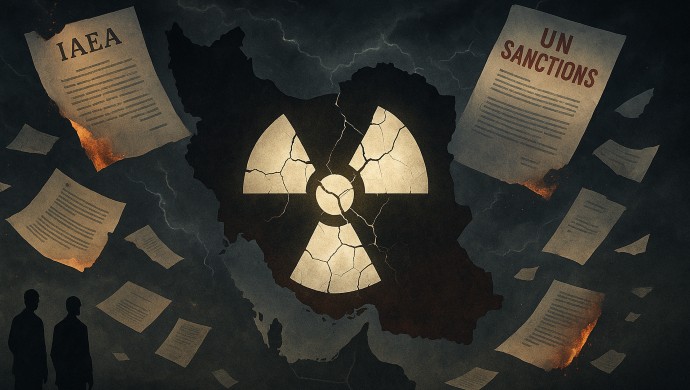

The Iranian regime’s long-running strategy of deception and delay over its nuclear program has finally hit a wall. With European powers poised to trigger the “snapback” mechanism to reimpose all UN sanctions, the clerical regime is facing its most significant diplomatic crisis in years. The failure of last-ditch talks in Geneva has not just confirmed Tehran’s international isolation; it has ignited vicious infighting within the ruling factions and exposed a leadership that is paralyzed, cornered, and left with nothing but empty threats. This crisis reveals a regime caught in a self-made trap, where any move—either retreat or defiance—hastens its own internal collapse.
The end of the line: diplomatic isolation and a failed strategy
For years, the regime has played a game of buying time, using endless negotiations to advance its illicit nuclear ambitions while offering no real concessions. That game is now over. A final meeting in Geneva on Tuesday between representatives of the regime and the E3 countries (France, Germany, and the UK) ended without any result, as the Iranian delegation failed to present any credible proposals.
The Europeans had laid down a clear ultimatum: resume negotiations with the United States over a new nuclear deal and grant UN inspectors full access to its facilities and its stockpile of 60% enriched uranium by August 31. The regime’s refusal to comply left the E3 with no choice but to proceed with reimposing crippling UN sanctions, a move expected as early as Thursday. This diplomatic dead end is the direct result of a strategy that has completely failed.
Chaos at home: the sanction threat ignites vicious infighting
The looming threat of sanctions has thrown the regime’s internal power structure into chaos, revealing deep cracks and a total lack of a coherent response. In Tehran, a bitter feud has erupted in the Majlis (parliament) over the decision to allow IAEA inspectors back into the country. MPs are openly accusing the Foreign Ministry of treason for defying a parliamentary law that explicitly suspended all cooperation with the agency.
One MP, Morteza Mahmoudi, accused the foreign ministry of having “trampled on the official law of the parliament regarding the suspension of cooperation with the agency and is officially engaged in comings and goings and cooperation with inspectors.” Another MP, Amirhossein Sabeti, called a potential agreement with the IAEA a “disaster,” warning, “If this is true, we must cry woe… Our national security is not a joke.” This public squabbling, with Parliament Speaker Mohammad Bagher Ghalibaf trying and failing to shut down the debate, showcases a regime in disarray, incapable of forming a unified front even in the face of an existential crisis.
Hollow threats and desperation: the regime’s only remaining cards
Cornered and without a viable strategy, the regime has fallen back on its only remaining tactics: making hollow threats while simultaneously pleading for more time. Deputy Foreign Minister Kazem Gharibabadi made a desperate plea for the Europeans to “make the right choice and give diplomacy, time, and space,” the regime’s classic line for stalling. In the same breath, other officials threatened that triggering snapback sanctions would force Tehran to withdraw from the Nuclear Non-Proliferation Treaty (NPT) and suspend all cooperation with the IAEA.
These threats, however, ring hollow. IAEA Director-General Rafael Grossi has publicly dismantled them. In an interview with Fox News Grossi reminded Tehran that as a signatory to the NPT, it must accept the inspections. He stressed that the work of his inspectors is essential, as without their presence and verification of what is going on, no serious negotiation can be entered into.
The picture could not be clearer. With the European ultimatum expiring and the clock ticking on snapback sanctions, the regime finds itself completely trapped. It has no path to retreat, as any concession would accelerate its internal collapse, yet it lacks the strength to withstand a new wave of sanctions. The deep divisions on display in its parliament are merely a symptom of a regime that has run out of options and is sinking deeper into a swamp of its own making, with no way forward and no way back.