

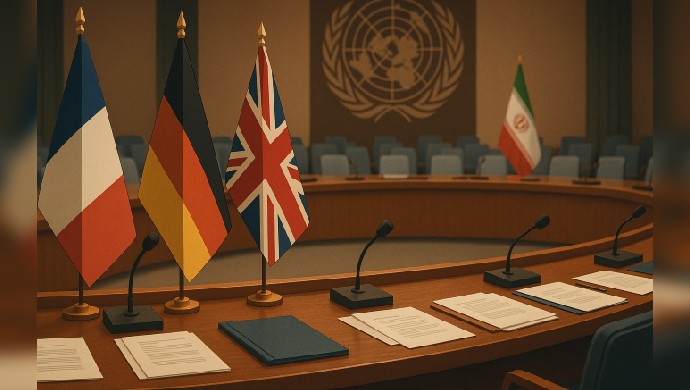

On Thursday, August 28, after years of failed diplomacy and the clerical regime’s relentless nuclear brinkmanship, Britain, France, and Germany finally initiated the snapback mechanism, setting in motion a 30-day process to reimpose all United Nations sanctions on Iran. This decisive step is not a surprise but the inevitable consequence of a failed policy of appeasement. It serves as a powerful vindication of the National Council of Resistance of Iran (NCRI), which has warned for over a decade that the mullahs’ regime will never abandon its quest for a nuclear bomb and cannot be trusted on the world stage.
The international community’s belated realization
In a joint statement, the three European powers (E3) made it clear that the regime’s violations of the 2015 nuclear deal (JCPOA) were “clear and deliberate.” They noted that Tehran has no civilian justification for its massive stockpile of highly enriched uranium and that its nuclear program remains a “clear threat to international peace and security.”
While French Foreign Minister Jean-Noel Barrot stated that the decision did not signal the end of diplomacy, his German counterpart Johann Wadephul urged the regime to cooperate fully with the UN nuclear watchdog. U.S. Secretary of State Marco Rubio welcomed the move, affirming that Washington remained available for direct engagement toward “a peaceful, enduring resolution to the Iran nuclear issue.” This belated consensus among Western powers highlights a dawning realization of the truths the Iranian Resistance has long exposed.
Panic and defiance in Tehran: A regime cornered
The regime’s reaction has been a mixture of hollow defiance and palpable fear. In comments to Reuters, a senior Iranian official called the decision “illegal and regrettable” and vowed that “Iran will not concede under pressure.” However, behind this facade, the regime’s own experts are sounding the alarm.
On August 27, a state-affiliated expert admitted on television, “Snapback is not a joke; it is a serious threat to the social and political structure of Iran.” A day earlier, on August 26, a member of the Expediency Council gave an even more stark warning, stating that with the return of international sanctions, “the country becomes plagued… no one will come near us.” This contrast reveals a regime that is cornered, lashing out publicly while privately terrified of the consequences.
Economic meltdown: The true cost of the mullahs’ nuclear ambitions
The Iranian people are already paying the price for the regime’s belligerence. On August 27, as news of the failed talks with European countries spread, the U.S. dollar surged to 1,027,000 rials on the open market, a new five-month high. The regime’s own Chamber of Commerce issued a dire forecast on August 28, warning that the snapback would trigger catastrophic economic consequences, including inflation soaring to 90%, the exchange rate hitting 1,650,000 rials per dollar, negative 3% economic growth, and unemployment rising to 14%. This economic collapse is a direct result of the regime prioritizing its illicit nuclear program over the welfare of its people.
The Iranian Resistance: A consistent voice of warning and a clear solution
In response to the news, NCRI President-elect Mrs. Maryam Rajavi described the activation of the snapback mechanism as “belated but urgent and necessary.” Her statement reaffirms a position the Iranian Resistance has held consistently for years, exposing the fundamental flaws of the JCPOA from its inception.
The mullahs’ regime will never abandon its pursuit of the nuclear bomb.
The activation of the snapback mechanism and the enforcement of the UN Security Council resolutions are long overdue, and their implementation has become more urgent than ever.
The failed talks in Geneva on… pic.twitter.com/0l1o4GIviX— Maryam Rajavi (@Maryam_Rajavi) August 28, 2025
On the very day the deal was signed, July 14, 2015, Mrs. Rajavi warned that circumventing six UN Security Council resolutions would “not close the mullahs’ path to deception and access to a nuclear bomb.” She cautioned that any money released to the regime must be placed under strict UN monitoring, otherwise Supreme Leader Ali Khamenei would “use these funds to further the regime’s policy of export of terrorism and fundamentalism… as well as to fill the coffers of the Islamic Revolutionary Guards Corps.” Today, that warning has become an undeniable reality.
The Resistance has always maintained that the only path forward is to reject both war and appeasement, and instead support the true solution: “regime change by the people of Iran and their Resistance.”
The world must now stand with the Iranian people
The triggering of the snapback mechanism proves that the policy of engaging with the clerical regime has failed. The problem was never a specific clause in the nuclear deal, but the criminal nature of the regime itself.
As Mrs. Rajavi said, “The mullahs’ regime will never abandon its pursuit of the nuclear bomb… The failed talks in Geneva on August 26, and the fruitless discussions with European foreign ministers once again underscore the undeniable fact: This regime has no intention of halting its nuclear weapons project.”
The international community must now abandon the illusion that this regime can be reformed or contained. The only way to ensure a non-nuclear Iran and a peaceful Middle East is to stand with the Iranian people and their organized Resistance in their quest to establish a free, democratic, and non-nuclear republic.