


During his presidential elections campaign, Ebrahim Raisi made promises that were clearly unworkable, from building a few million homes to creating a million jobs a year. A few months ago, his minister of labor claimed to have created more than 1.97 million jobs in the last two years.
The Iranian regime’s baselessness and fabricated statistics are no secret. At the time that the labor minister made such claims, ILNA news agency called the statistics provided by the minister “unrealistic” and wrote that experts have repeatedly emphasized that the government manipulates indicators or shifts the basis of time for its benefit.
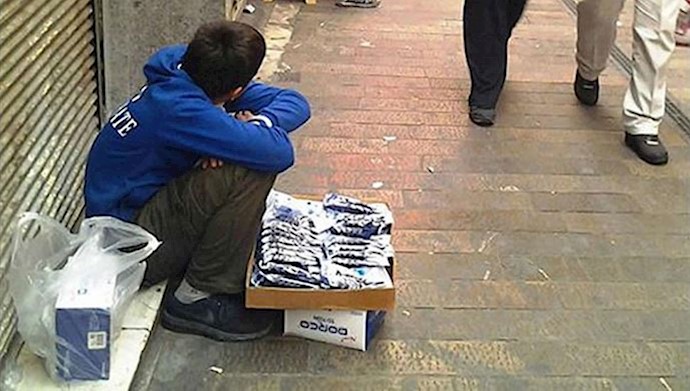
According to Tasnim News Agency on January 1, 2024, the October report of the Statistical Center of Iran, the country’s unemployed population was announced to be 2.043 million people, of which 875,000 are graduates of the country’s universities and constitute 42.8% of the total unemployed population.
How and why do graduates become unemployed?
A look at the unemployment problem of graduates, even according to the regime’s officials, highlights the regime’s utter failure. But Labor Minister Sowlat Mortazavi laid the blame on the graduates. According to Mehr news agency on September 29, he said about the unemployed in Khuzestan province: “The highest unemployment rate in this province is among university graduates because they lack the skills to work.”
Meanwhile, the head of the Chamber of Commerce of Isfahan went further, saying that “the unemployment rate of graduates of Isfahan province is 27%, which is higher than the national average” (Mehr News Agency, August 14, 2023).
A Ministry of Science study on graduate employment has provided shocking statistics. The survey on the employment of graduates in the 2017-2018 school year writes: “Of the 688,678 graduates, only 293,208 were employed, or more accurately 42.58% were employed and 57.42% were unemployed. The share of men was 48.60% and women’s share of employment was 34.71%. The University of Applied Sciences (whose job is to improve student proficiency) found 48.69% of its graduates failed to make it to the job market. At the university, 55% had no job. In universities affiliated with the executive branch, 59.71% unemployment is recorded. In non-profit universities, 65.39% are defined as unemployed populations. More than 66% of public school graduates are unemployed… At Payame Noor University, 33.45% of graduates went to the job market.
“The technical and vocational university, whose main mission is to train the skills necessary to enter the job market, is ranked ninth and bottom of the table in this sector, and only 21.67% of graduates were able to find a job for themselves.
“The probability of remaining unemployed in arts graduates is 76% and agriculture and veterinary medicine with a share of employment is 35.21%, basic sciences with 34.77%. The share of employment in engineering and engineering is 41.74%. 59% of social sciences are among the unemployed. Only 35% of management and services graduates are employed.”
What is the impact of these statistics on the economic and social fabric? On November 13, 2023, Farhikhtegan newspaper wrote: “From the 2% share of employment ratio among the first decile to 50% share of the last two deciles conveys the message that if you were born into a wealthy family, you should not worry too much about your future career, but if you fall into the lowest income category, your chances of earning a salary are less than 3%. It is a notable event that also greatly questions the question of educational justice and social justice.”
Fact-checking of unemployment rate decline
But Ebrahim Raisi still insists that his government has reduced unemployment. The deputy labor minister says the unemployment rate has reached 7.6% and the net job creation is equivalent to 907,000 jobs, but many economic experts believe that, assuming the correct statistics, “this improvement is due to the use of the country’s empty capacities and major changes in areas such as the creation of fixed capital and sustainable economic growth has not occurred” (Online Economy, December 26, 2023)
What has really happened is the frustration of young people at finding decent jobs and thus deactivating millions of young people. DW reported on January 3, 2024: “The Iranian Statistical Center has reported a fall in the country’s unemployment rate to 7.6% this fall, the main cause of which is not the growth of employment, but due to 3.5 million people in the country becoming inactive over the past four years. The reason for the drop in unemployment is that hundreds of thousands of people have despaired from seeking jobs and become inactive. If those 3.5 million people had not been disappointed in job searches and remained active, the real unemployment rate would be above 18% this fall.”
Since the fall of 2019, the working-age population has increased by 3 million, but the number of employed has increased by just 300,000, which indicates the low capacity to attract employment in Iran’s economic structure, which is characterized by continuous recession.
An impoverished society on the verge of explosion
Even the regime’s statistics show that 30 million people are below the poverty line and 10 million are in absolute poverty. According to ILNA News Agency on June 18, 2023:
“According to the parliamentary research center, nearly 30 million people live below the poverty line, and a population of more than 9.9 million people in the country are in absolute poverty. In simple words, nearly 10 million people are unable to meet the simplest needs of food and housing, and cannot obtain the calories needed for daily living.”