

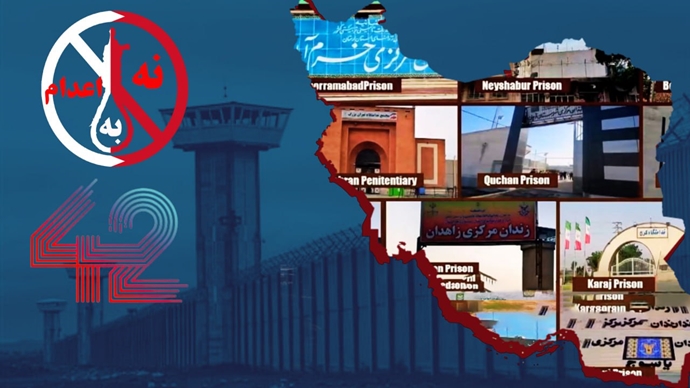

Inmates in 25 prisons across Iran held the 42nd week of the “No to Execution Tuesdays” campaign on November 12. This week, Isfahan’s Dastgerd Prison joined the campaign. The “No to Executions Tuesdays” campaign is a coordinated protest movement initiated by political prisoners across Iran to oppose the regime’s extensive use of the death penalty. Since its inception in early 2024, the campaign has involved weekly hunger strikes and statements condemning executions, aiming to raise awareness and mobilize both national and international support against capital punishment in Iran.
The prisons participating in the 42nd week of the campaign included Evin (women’s ward, wards 4 and 8), Ghezel Hesar (units 3 and 4), Karaj Central Prison, Greater Tehran Prison, Arak Prison, Khorramabad Prison, Asadabad Prison in Isfahan, Sheiban Prison in Ahvaz, Nezam Prison in Shiraz, Bam Prison, Kahnuj Prison, Mashhad Prison, Qaemshahr Prison, Lakan Prison in Rasht Prison (men’s and women’s wards), Ardabil Prison, Tabriz Prison, Urmia Prison, Salmas Prison, Khoy Prison, Naqadeh Prison, Saqqez Prison, Baneh Prison, Marivan Prison, Kamyaran Prison, and Dastgerd Prison in Isfahan.
The prisoners’ statement for the “No to Execution Tuesdays Campaign” reads: “On the eve of the fifth anniversary of the Bloody November 2019 uprising, we honor the memory of over 1,500 women, men, youth, and children who lost their lives in the protests of that uprising, and we salute the resilience of those who continue their pursuit of justice in the face of the oppressive regime’s repression.
“The ruling plundering minority in Iran has executed more than 103 people, including two women, since the beginning of Aban (beginning on October 22). This amounts to an average of five executions per day. Since the beginning of Pezeshkian’s administration, over 450 people have been executed, which stands as the only concrete yet grim achievement of this new government.”
The prisoners’ statement for the “No to Execution Tuesdays Campaign” adds: “In recent days, we have witnessed the issuance of inhumane death sentences for two prisoners accused of political charges and espionage in Evin and Urmia prisons.
“Political prisoner Varisheh Moradi, a woman held in Evin Prison, has been sentenced to death on fabricated charges of ‘rebellion.’ In Urmia Prison, Nasser Bekrzadeh has been sentenced to death on espionage charges by Branch 3 of the Urmia Revolutionary Court. Previously, this same branch sentenced three other prisoners—Edris Ali, Azad Shojaei, and Rasul Ahmad Mohammad—to death.
“In Sheiban Prison in Ahvaz, Arab political prisoners Ali Mojadam, Moein Khanfari, Mohammadreza Moghadam, and Adnan Gheybishavi were transferred to quarantine two weeks ago in preparation for execution. They are in deplorable conditions, and in protest against this inhumane treatment, three of them are on a hunger strike, placing their lives in serious danger.”
The striking prisoners stated in their declaration: “The ‘No to Execution Tuesdays Campaign,’ in an effort to inform our fellow citizens, reveals for the first time that in the case of four Baluchi citizens (Eido Shahbakhsh, Abdolghani Shahbakhsh, Abdolrahim Ghanbarzehi, and Soleiman Shahbakhsh), at one point these prisoners were told, ‘There is nothing in your case, and you will soon be released.’ Eido Shahbakhsh was even briefly released but was later re-arrested and sentenced to death alongside the other defendants in this case.”
The “No to Execution Tuesdays Campaign” once again called on all conscientious people, political activists, labor leaders, civil society members, and human rights advocates who consider the issue of executions vital to join the efforts to save the lives of condemned prisoners and to end and abolish executions in Iran.
The campaign held its 42nd week while Iran’s regime continues to ramp up executions across the country. On November 5-6 alone, the regime carried out 27 executions. On November 6, the regime executed 16 people in Karaj, Khorramabad, and Zanjan.
On November 5, the regime hanged 11 prisoners, six of whom were executed in Mashhad, one in Zahedan, three in Yazd, and one in Yazd. The number of recorded executions since July, when the regime’s current president, Massoud Pezeshkian, took office, has increased by at least 85% compared to the same period last year. Ironically, Pezeshkian is regularly presented as a moderate figure in the West.
The international community’s inaction against the regime—the godfather of executions and terrorism—has encouraged further crimes and warmongering. The aggravating conditions in Iran’s prisons underscores the necessity of holding the regime to account and bringing its leaders to justice for four decades of crimes against humanity and genocide.