

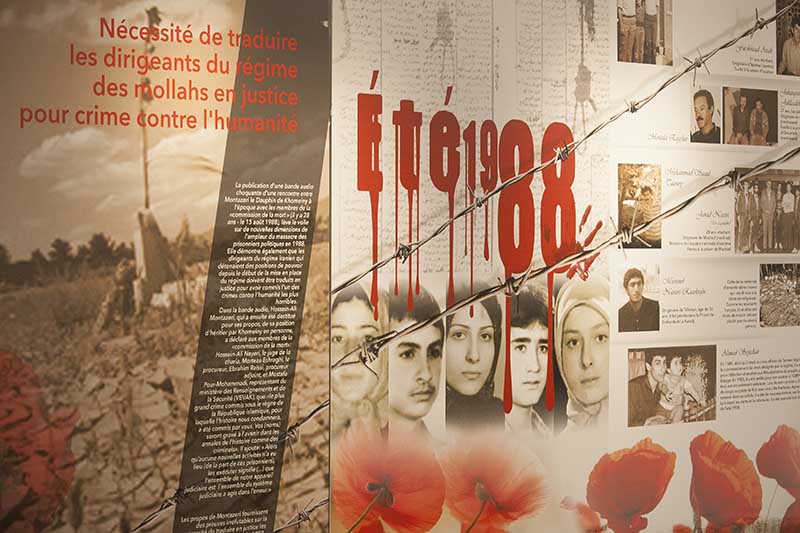

On Monday, April 14, 2025, a second audio file of Ayatollah Hossein Ali Montazeri, concerning his meeting in January 1989 with members of the “Death Committee,” was released. At the time, Montazeri was apparent successor to Iranian regime founder Ruhollah Khomeini. The Death Committee was a group of regime officials tasked with the mass execution of political prisoners in the summer of 1988.
The new audio tape, which is only a portion of Ayatollah Montazeri’s second meeting with the Death Committee and has parts deleted, reveals further dimensions of the genocide targeting the People’s Mojahedin Organization of Iran (PMOI/MEK) and executions of members of other political groups, ordered by the regime’s founder Ruhollah Khomeini. It serves as clear testimony to the historical steadfastness of the PMOI members in their principles and the righteousness of the just revolutionary resistance against the mullahs’ regime.
In this recording, Montazeri acknowledges the widespread popular resentment towards Khomeini and the Velayat-e Faqih system, saying: “Velayat-e Faqih has become repulsive to the people; people are fed up with them… The very families whose members we have now killed are all saying that the Monafeqin [regime’s derogatory term for PMOI/MEK] were right… If we had attracted them through kindness, tolerance, and affection, their numbers would have decreased, but we keep increasing them.”
In the first audio file of Montazeri, released in 2016, he, speaking on August 15, 1988, in his capacity as Khomeini’s designated successor, addressed members of the Death Committee who were conducting the killings in prisons, including Ebrahim Raisi and Hossein Ali Nayyeri. He told them, “the greatest crime has been committed by your hands” and “this kind of massacre without trial, especially concerning prisoners and captives—they were your captives—will certainly benefit them in the long run, and the world will condemn us.”
In another segment of the second audio file, Montazeri refers to the swift execution of 300 female PMOI members captured during Operation Forough Javidan (Eternal Light) in Kermanshah province. He said: “They brought 300 girls who were supposedly involved in Mersad [the regime’s name for the counter-operation]—Mersad in Bakhtaran [Kermanshah]—and two of them were French. Incidentally, [Sadegh] Khalkhali said he was there… I said, ‘Alright, execute them all, but don’t execute these two girls; they are French, out of all of them…’ They said, ‘No, execute.’”
In another instance from the second audio file, Montazeri refers to the will of a heroic female PMOI member from Tehran who had courageously maintained her position before the executioners during the massacre. He says: “Light radiated from the beginning to the end of the will… This girl who believes in God, believes in the Prophet, believes in the Quran, believes in everything, she just says, ‘This Islamic Republic is not to my liking.’ Can she be executed for this? Is this jurisprudence [fiqh]?”
Last year, in July 2024, Professor Javaid Rehman, the then-UN Special Rapporteur on the situation of human rights in Iran, in his final report addressing heinous crimes and gross violations of human rights, described the 1988 massacre as instances of “crimes against humanity” and “genocide,” writing: “The specific requirements of the Genocide Convention and the challenges related to establishing genocide have already been considered. Khomeini’s fatwa, a key document of the 1988 massacre, lays bare the genocidal intent in physically destroying the PMOI, which was treated as a religious group by the perpetrators. The fatwa explicitly characterizes the PMOI’s alleged religious transgressions as ‘waging war against God’ that must be punished by execution.”
The report also notes that the scale and number of individuals involved in these crimes are extensive, ranging from the leadership, Sharia judges, prosecutors, representatives of the Ministry of Intelligence, members of the Death Commission and their facilitators, prison guards, members of the Islamic Revolutionary Guard Corps (IRGC) and all those who facilitated the commission of these international law crimes and their subsequent ongoing concealment.
In his recommendations, the Special Rapporteur calls on all UN member states to use universal jurisdiction to conduct immediate, impartial, complete, and transparent investigations into crimes under international law and to collect, integrate, and preserve evidence for future criminal prosecution of all perpetrators.