

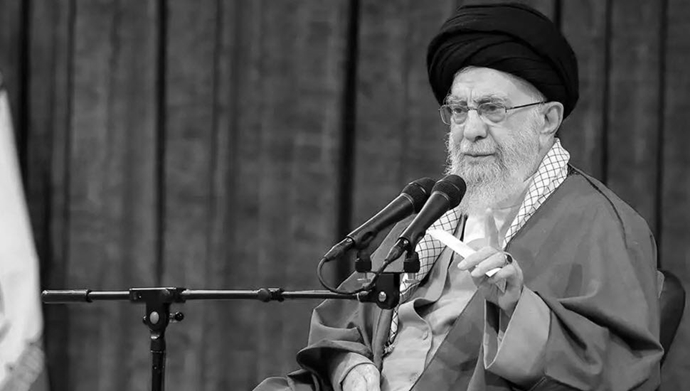

On Friday, Iranian regime supreme leader Ali Khamenei categorically dismissed any prospects of negotiations with the U.S., making his stance clear to those advocating for talks as a means of addressing Iran’s crises. He sought to underscore his message to those seeking dialogue to resolve the nation’s “problems” and the ruling system’s ongoing turmoil, stating: “Negotiating with the United States has no effect on solving the country’s problems. We must understand this correctly. Do not make it seem like if we sit at the negotiation table with that government, one problem or another will be solved. No, absolutely not; negotiations with the U.S. do not solve any problems… Negotiating with such a government is neither rational, nor wise, nor honorable.”
Khamenei then shifted the responsibility for resolving the country’s “economic hardships” onto regime president Masoud Pezeshkian, who has been advocating negotiations, and the current administration, stating: “Of course, we do have domestic problems; no one denies the existence of these difficulties. There are many hardships in people’s livelihoods. Almost all segments of society are struggling with various issues, but the key factor in solving these problems is internal.”
He defined this internal factor as the “efforts of committed officials and the unity of the nation” and added: “Officials are working, thank God. They are engaged in various efforts, and I am very hopeful that this very government will at least be able to reduce the economic hardships of the people and alleviate their difficulties.”
However, the “efforts” being undertaken include increasing taxes, raising the prices of essential goods, and hiking energy prices. On February 7, the same day as Khamenei’s speech, Abdolreza Rahmani Fazli, who served as the interior minister under Hassan Rouhani and was heavily involved in suppressing the bloody November 2019 protests, issued a warning:
“If the government intends to take such actions, it must fully learn from and apply the experiences of 2019. Right now, fuel prices are not just an economic issue; they have turned into a political and social issue. After the events of 2019, for our enemies, it has also become a security matter. The current situation is not comparable to 2019. Back then, our currency exchange rate was not at this level, inflation was not this high, enemy threats were not as intense, and we had not yet faced the events of [protests in] 2022. So if someone asks me how the conditions for implementing such measures now compare to 2019, I would say today’s situation is far, far more concerning, and public dissatisfaction has accumulated significantly.”
“The accumulation of dissatisfaction” refers to an explosive social situation in which unresolved economic and basic livelihood problems have turned society into a powder keg. In such conditions, any spark can ignite a fire and trigger an eruption.
On February 5, Pezeshkian claimed that the regime is not dependent on oil revenues and that economic problems could be resolved through public austerity— a statement that translates into further pressure on a population where 80% have fallen below the poverty line.
Just four days ago, on Tuesday, February 4, food vendors and merchants in Tehran shut down their shops and went on strike in protest of the surge in the dollar’s exchange rate, rising prices, and oppressive taxes.
Subsequently, Iran’s rebellious youth, in solidarity with the merchants, shopkeepers, and the oppressed people of Tehran, and with the resounding chants of “Death to Khamenei” and “Death to the dictator,” carried out 27 operations targeting the regime’s centers of repression and plunder.
- Setting fire to two Basij bases under the Tehran IRGC command
- Setting fire to a regime-affiliated foundation for corruption and plunder in Tehran
- Setting fire to a regime building in District 12 of Mashhad
- Torching a statue of Qasem Soleimani, the notorious former commander of the IRGC Quds Force, in Kerman
- Setting fire to an IRGC Basij base in Aligudarz
- Setting fire to six IRGC Basij bases in Tehran, Mashhad, Kerman, Saravan, and Nikshahr
- Burning down the looting headquarters of the Khomeini Committee in Isfahan
- Setting fire to the effigy of Ebrahim Raisi, the “Butcher of 1988,” in Mashhad
- Burning down banners of Khomeini and Khamenei in Mashhad and Lordegan
- Torching billboards and banners of Soleimani in Urmia and Jiroft
- Burning banners of regime judges Ali Razini and Mohammad Moghiseh in Mashhad
Setting fire to billboards promoting the intelligence ministry in Tehran, Isfahan, Saravan, and Khash
Burning banners of Soleimani and the regime’s proxy forces on Khayyam Boulevard bridge in Mashhad - Burning a propaganda banner of the regime’s proxy militias in Mashhad
- Setting fire to a missile-themed propaganda banner featuring the image of Khomeini in Mashhad
- Burning banners of the regime’s propaganda-preaching clerics in Mashhad