

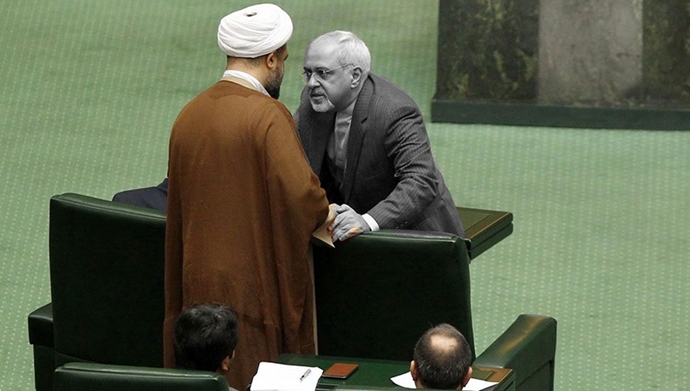

Negotiations with the U.S. have become a hot topic in Iran’s regime-affiliated media. At the same time, confusion, infighting, and power struggles among the ruling factions have intensified. Some, like journalist Mohammad Ali Vakili, have already determined that negotiations will take place. On February 2, he wrote in Shargh newspaper, “The heads of the three branches have a unified stance on this issue. Overall, the ruling establishment has reached a consensus on negotiations. As long as national interests and security are at stake, the state’s unified position will be to proceed with negotiations.”
When confronted with the question of why, despite this “consensus,” there are deafening slogans in the regime’s Majlis (parliament) and protests by extremist street demonstrators in shrouds, he dismisses them as “scattered voices” and says: “These scattered voices opposing negotiations or confronting figures like former foreign minister Mohammad Javad Zarif and President Masoud Pezeshkian are merely remnants of entrenched radicalism in the country. As such, these occasional objections will no longer have much impact. They are not even worth addressing or analyzing.”
However, when it comes to Friday sermons, the representatives of regime president Ali Khamenei tell a different story. Mohammad Mehdi Hosseini Hamedani, Friday Prayer leader in Karaj, reacted to pro-negotiation voices by saying: “Some are distorting the leader’s statements!” He emphasized that Khamenei has not given any authorization for negotiations with the U.S. He also added that Khamenei has stressed the need to be mindful of whom the regime is dealing with.
Ahmad Reza Shahrokhi, the regime’s Friday Prayer leader in Khorramabad, said: “An individual who does not yet have legal authorization for his position repeatedly makes statements that are inconsistent with the slogan of national unity under the 14th government. At the annual World Economic Forum in Davos, he made unusual remarks… Such individuals harm national interests. Just as we are sensitive to energy imbalances, we must also be sensitive to the imbalances among some managers and officials.”
Also, Friday Prayer of Ilam, Allahnour Karimi Tabar said: “Today, the enemy’s strategy is that having failed in war and sanctions, it now seeks to alter the course of the revolution through diplomatic smiles at the negotiation table. Testing what has already been tested is a mistake. We once trusted their smiles, their signatures, and their promises—no believer should be stung twice from the same hole.”
Ahmad Mahmoudi, Khamenei’s representative in Isfahan, said: “These hostilities and resentments are always hidden behind their diplomatic smiles. We must all be vigilant, especially our respected officials, particularly those working in our Foreign Ministry—who have a responsibility to heed these warnings. They need to borrow extra eyes and ears to see and hear better.”
Begging for Negotiations!
Ahmad Alamolhoda, the Friday prayer leader of Mashhad, also likened negotiations with the U.S. to “begging.” He sarcastically criticized those eager for talks, saying that those who go to the enemy’s doorstep to gain power have been “born too late” and have distanced themselves from the so-called “values of the revolution “or, more accurately, religious fascism.
“Is this the Russian October Revolution that you think you can reverse it against the Americans with some kind of ‘Gorbachev maneuver’? Should that treacherous American declare that Iran has reached the point where it is now begging for negotiations? Should the enemy be the one saying this? Should they go begging at the enemy’s doorstep just to gain power in this country? Just to become somebody in this country?”
Khamenei and the ‘Policy of Ambiguity’!
This is just a small glimpse of the larger chaos engulfing the regime, but it clearly illustrates the confusion and infighting throughout its ranks. Not to mention that Khamenei, in his effort to maintain control, speaks from both sides of his mouth. He is a master of deception and misdirection. In this case, he prefers to follow a “policy of ambiguity” so that every faction within the regime believes his words align with their stance.
What is certain is that negotiations with the U.S. have become more than just a political debate; they have turned into a full-fledged power struggle between the regime’s competing factions
“Dead Negotiations”!
This precarious situation is reflected in the state-run Jahan-e Sanat newspaper, which wrote on February 2, “The Iranian and possibly American negotiating parties still do not clearly and precisely know what they are negotiating over, with what approach, or what they hope to achieve from these talks.”
The newspaper goes further, warning: “The even bigger problem is that, especially on the Iranian side, there is so much emphasis on misunderstanding, distrust, and negative perceptions that the child of these negotiations may be stillborn in the end.”