

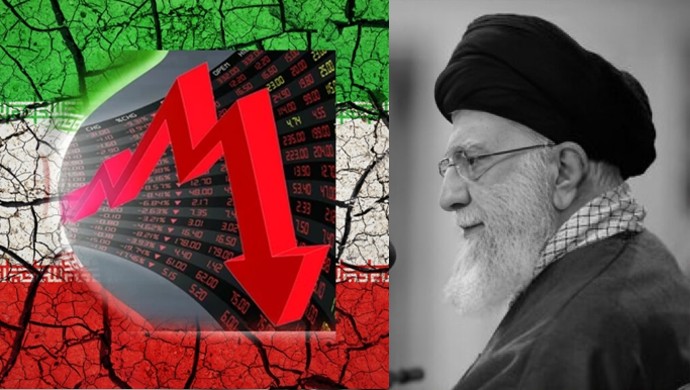

At the beginning of the new Persian year (March 20, 2025), amidst escalating social tensions and a deepening livelihood crisis, Iranian regime supreme leader Ali Khamenei shamelessly deflected responsibility, stating, “The leadership does not interfere in economic planning; meaning, it doesn’t even have the right to interfere. This is part of the government’s duties; the government must do this.”
In the few weeks that have passed since the new year began, not a day has gone by without the regime’s media, officials, and experts warning about the consequences of the people’s economic hardships and the danger of social protest eruptions for the crisis-ridden clerical regime.
Referring to the consequences of “chronic and prolonged inflation” for the regime, the state-affiliated Ham-Mihan newspaper wrote on April 9, 2025, “The country’s situation is not good at all, and sanctions are not just pieces of paper. People are dissatisfied, the ruling system is worried, and chronic, long-term inflation persists. We have fallen behind in competition with regional countries, we are constantly living in critical conditions, there is no stability or peace. The state of the country’s administration is indefensible from any perspective, and significant changes do not happen even with changes in government.”
On April 3, 2025, a regime-affiliated expert, in an article titled “Taxes and Inflation: Two Blades of a Scissor on the Body of Society” on Eghtesadran acknowledges the reality that the bankrupt clerical regime considers increasing taxes and extorting money from the people necessary for the continuation of its “rule,” while soaring inflation has also stolen bread and basic sustenance from the tables of workers and the deprived.
This regime publication specifies, “From the perspective of the ruling system, taxation is a means for the continuation and survival of governance, as its feedback in society is faint and it does not meet national needs and interests. In reality, inflation and taxes act like two blades of a scissor, cutting off the purchasing power and financial capacity of society; therefore, as tools for financing the government, they are mainly perceived to be aimed at achieving ideological goals and place society under financial and economic pressure from both sides.”
Regime experts also admit that the staggering increase in the price of the dollar and the collapse of the rial’s value, which have caused price hikes and a sharp decline in people’s purchasing power, are the product of organized governmental looting of the country’s resources.
Regarding this, economic expert Mahmood Jamsaz wrote on April 3, 2025, in Eghtesadran, that the value of one unit of the national currency in 1979 is equivalent to a 10,675th of its value in March 2025. “By this calculation, the national currency has lost 99.99 percent of its value, becoming worthless, and the general price level has increased by more than 10,600 times,” he said.
It is perfectly clear how the corruption and plundering of the clerical regime, on the one hand, push millions of the country’s population below the poverty line and towards starvation through staggering price increases, and on the other hand, through the governmental mechanisms of increasing foreign currency exchange rates and printing unsupported domestic money, devalue the rial held by the people and empty their pockets for the benefit of the government’s treasury.
The state-affiliated Etemad newspaper, on April 7, 2025, in an article titled “The Rial Under the Blade…” referring to the government’s hidden hands – though not so hidden, as the role of the IRGC, the Central Bank, and Khamenei’s office is evident – writes: “In Iran, this invisible hand is intertwined with the hidden hands of corruption and rent-seeking. Hands that, instead of boosting production and creating employment, are busy plundering and looting national resources. These hands, through wrong policies, monopolism, and dependence on oil, have taken the rial hostage. With each passing day, the value of the national currency decreases, and people’s purchasing power declines. It no longer matters if you are an employee or a worker, a shopkeeper or a retiree; we are all victims of this mismanagement.”
Regarding the consequences of this anti-people corruption and plundering for the predatory rule of the clerics, Ali Jannati, the Minister of Culture in former president Hassan Rouhani’s government, expressing fear that the regime faces a “difficult year ahead,” says: “With the continuation of the current economic situation and high inflation, we should perhaps also expect street demonstrations” (Didar News, April 7, 2025).