


On February 19, the Iranian regime’s Majlis (Parliament) was the scene of an open battle between different factions. The announcement of the impeachment request for the Minister of Economy, Abdolnasser Hemmati, by 91 members of Parliament was a sign of deep divisions within the ruling structure. Ahmad Nadiri, a member of the Parliament’s presiding board, confirmed on February 19 that the impeachment, after being reviewed by the Economic Commission, had been referred to the presiding board for final decision. At the same time, Hamid-Reza Haji Babaee, the session’s chair, announced that the impeachment would take place on the March 2.
This event reflects widespread dissatisfaction with the government’s handling of the economic crisis. The economic and livelihood crisis, which has burdened people for years, has now reached a breaking point. The power struggle among the representatives mirrors a deeper crisis at the top of the regime.
The advice given by Khamenei has been disregarded
It should be reminded that the regime Supreme Leader Ali Khamenei had advised this Parliament to interact with the government of President Masoud Pezeshkian:
“One of your important tasks is the matter of interaction. I strongly recommend, as I have written here, constructive interaction with the new government. Everyone should help so that the elected president can fulfill the duties he has toward the country. If we can act in a way that the president succeeds, that success is our success; if he succeeds in managing the country, advancing the economy, dealing with international matters, and in cultural issues, then all of us will have succeeded; his victory is our victory; we must truly believe this from the bottom of our hearts.” (Source: Khamenei’s website June 02, 2024)
Now, the fact that 91 members of this Parliament, who have been thoroughly vetted for their loyalty to Khamenei, neither follow the orders of the Supreme Leader nor the government devoted to his leadership, and no “unified voice” emerges from them, is a matter worth considering.
Warning about the collapse of the system
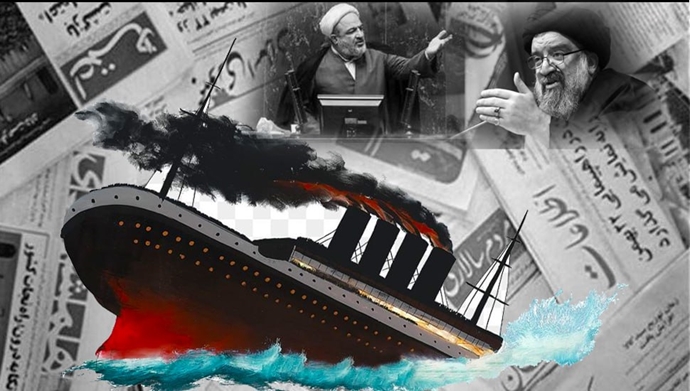
MP Mohammad Reza Sabaghian admitted to the “severe economic conditions, runaway inflation, energy imbalance, the emigration of elites, unchecked printing of money, gasoline imports, and continuous embezzlements” and warned the leaders of the regime and his peers, saying, “Let’s stop with the pleasantries; this ship is sinking, and when it sinks, we’ll realize it.”
He emphasized that it is no longer possible to avoid the crises with polite words. He attacked the heads of the three branches of government, asking what this body has done. According to him, the country’s economic crisis, runaway inflation, and systematic corruption all reflect the inefficiency of the decision-makers.
45% inflation and public dissatisfaction
MP Hassan Norouzi also acknowledged the livelihood conditions of workers and employees, stating that a payment of 30 million rials as New Year’s bonuses, in a context of over 45% inflation, in no way meets the people’s needs.
Such figures do not care about the bonuses and wages of workers. They are more concerned about social explosions and the rapid collapse of the regime.
The crisis of legitimacy of the regime
MP Ali Alizadeh referred to the issue of declining voter participation in elections, saying that the model for selecting representatives is such that people no longer have the motivation to participate in elections. He pointed out that only 600,000 people participated in the elections in Tehran, which he saw as a sign of the crisis of legitimacy for the ruling regime. According to him, even if a survey were conducted, only 10% of people in Tehran would know their representatives.
He continued: “Our model for selecting representatives is such that people don’t even want to participate in elections. You saw that in Tehran, only 600,000 people participated. Why? You could conduct a survey right now in Tehran, and if 10% of Tehranis knew their representatives, feel free to tell me anything. Naturally, why would they come to participate? Why would they come to vote? It doesn’t matter. This is the same in our large cities…”
The controversial meeting of the Economic Commission
Amir Hossein Sabeti, one of the members of the Economic Commission of Parliament, criticized Hemmati in a session on February 18, saying: “Two months ago, in a closed-door meeting, you promised that things would improve. At that time, the exchange rate was 770,000 rials [to the US dollar], but now, with your impeachment becoming serious, the exchange rate has risen to 920,500 rials.” He added that the government and the Central Bank have no control over the currency situation, and this incompetence has only exacerbated the crisis.
During his remarks, he unwittingly admitted that the regime’s officials are unaffected by inflation and unaware of the people’s suffering as they come and go in tinted-window cars.
The Majlis, a battleground for power
The regime’s Parliament, which should be the highest legislative body, has now turned into a battleground for factions within the power structure. The economic crisis, public dissatisfaction, and corruption have placed the entire system in a state of uncertainty. Gathering signatures for the impeachment of the Minister of Economy is only one example of internal crises and conflicts within the regime. These struggles indicate that the mullahs’ regime is approaching its breaking point, and the position of Khamenei is in decline. Deeper layers and developments should be expected in the coming days.