

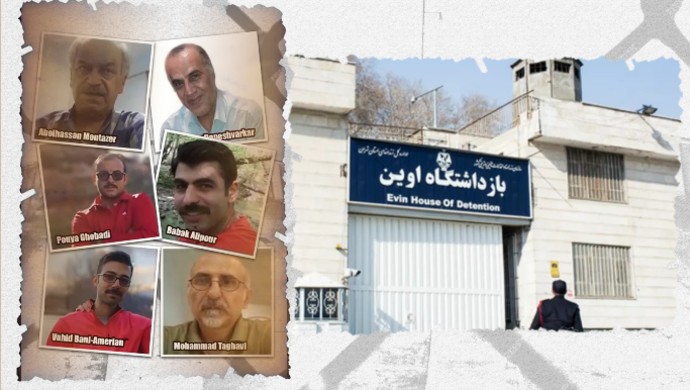

In a chilling escalation of its campaign against dissent, the Iranian regime’s judiciary has sentenced six political prisoners to death on charges of supporting the People’s Mojahedin Organization of Iran. The verdict, delivered by the Tehran’s so-called Revolutionary Court Branch 26, underscores the regime’s increasingly harsh measures against its critics.
The condemned individuals—Abolhassan Montazer, Pouya Ghobadi, Vahid Bani-Amerian, Babak Alipour, Ali Akbar Daneshvarkar, and Mohammad Taghavi—were sentenced to death on charges of “membership in the PMOI,” “armed rebellion against the government,” and “collusion against national security.” Two others, Mojtaba and Ali Taghavi, were sentenced to imprisonment and exile, allegedly for their familial ties to one of the condemned. The sentences follow months of brutal interrogation and torture in Evin Prison, infamous for its treatment of political detainees.
In an open letter, the prisoners wrote, “The nature of the mullahs’ regime is so evident that we find no need to elaborate on the torture, abuse, and numerous violations of our basic human rights from the moment of our arrest until today, nor on the baseless accusations levied against us.”
“Our pursuit of justice is not merely about saving our own lives or limited to this moment when the gallows loom before us. It is a call to oppose the death penalty—in principle and entirely—for all political and non-political prisoners.”
The sentences have sparked outrage inside Iran and across the globe.
In a statement, the “No to Execution Tuesdays” campaign, an organized movement by prisoners across Iran against the death penalty, condemned the death sentence of the political prisoners and warned about its implications.
The prisoners wrote, “Over the years, the ‘judge’s discretion’ has been a tool for the judiciary of the ‘Islamic Republic’ to issue death sentences in numerous cases. This approach, coupled with months of torture, solitary confinement, and interrogations, has exposed the disgraceful nature of such fabrications when death sentences are based solely on this method.”
Several human rights organizations and parliamentary groups condemned the sentence and called on the United Nations and other international organizations to intervene and save the lives of these prisoners.
In a statement, the British Committee for Iran Freedom (BCFIF) wrote “The international community has a moral obligation to stand in solidarity with the people of Iran and demand an end to the regime’s systemic violations of human rights,” the statement reads in part.
In a letter to Mai Sato, the UN Special Rapporteur on the Human Rights situation in Iran, more than 150 international experts, Nobel laureates, and NGOs, underscored the parallels between the current executions and past atrocities of the Iranian regime, particularly the 1988 massacre of political prisoners.
“We urge you to publicly condemn these death sentences, demanding their immediate reversal and the protection of these political prisoners,” the signatories wrote.
Hands off Cain called on the UN High Commissioner for Human Rights and the UN Special Rapporteur on the Human Rights situation in Iran to “take immediate action to save these six prisoners’ lives and secure the release of all political prisoners as well as to renew the appeal for the introduction of a moratorium on all the capital executions in Iran.”
These sentences come as the regime has intensified its campaign against the PMOI and it supporters in a desperate move to prevent Iran’s youth from joining the ranks of Resistance Units and the cause for democratic regime change in the country.
In the past months, the regime has sentenced two other PMOI supporters to death and upheld the death sentence of another PMOI supporter.
However, the regime’s efforts have proven to be in vain. Every day, the ranks of PMOI Resistance Units continue to swell and their activities continue to expand. Following the death sentence for the six political prisoners, the Resistance Units held another round of activities in multiple cities, reiterating their commitment to the struggle for freedom with slogans such as “The executioner’s noose no longer affects the PMOI” and “By the blood of comrades, we stand firm to the end.”