

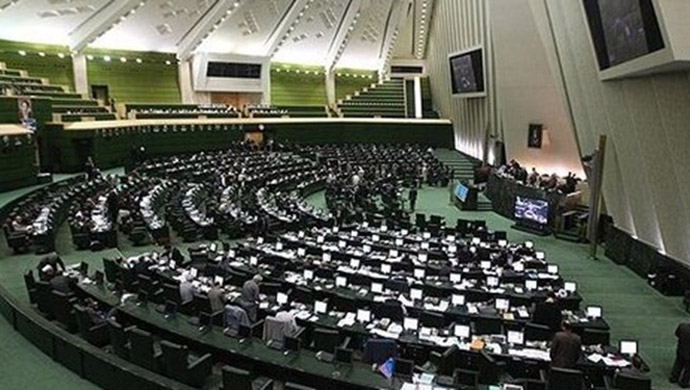

After all the arguments and debates that erupted following the parliamentary election show on March 1, over the position of its chairmanship, with many new regime figures speaking out and criticizing Mohammad Bagher Ghalibaf, the current Majlis (Parliament) Speaker, finally, on May 28, after a sham parliamentary vote, Ghalibaf was declared as the Speaker of the regime’s parliament for another year with 198 votes.
A day earlier, in a message read by his office chief to the new regime members of Majlis, regime supreme leader Ali Khamenei reminded them of an “important point” and said: “Do not waste the short duration of your term with useless media competitions and harmful political disputes in the Majlis, otherwise the valuable capacity of the representatives in this high position will be wasted, and this would be a great loss.”
After emphasizing the danger of a “great loss”, Khamenei warned them that otherwise the oath they take today will “come back to haunt” them tomorrow. Khamenei added: “Another point concerns the oath of representation. This oath is not symbolic or ceremonial; it is a real and responsible oath that will have consequences in both this world and the hereafter.”
Khamenei ended this message by thanking Ghalibaf, which many interpreted as an end to the conflict over the parliamentary chairmanship and a public hint for at least a one-year extension of Ghalibaf’s chairmanship. This occurred even though two days earlier, the parliamentary majority faction opposed to Ghalibaf had declared its formation with 178 votes.
While Ghalibaf was openly opposing Raisi in the eleventh Majlis, calling for a change in governance and “new governance,” the insistence of the Supreme Leader on appointing Ghalibaf to the chairmanship of the twelfth Majlis is nothing but an attempt to temporarily control the crisis out of weakness and navigate the chaotic situation following Raisi’s death.
Khamenei understands the Majlis is an actual and potential center of conflict and crisis. In his first public remarks following the sham elections, in a meeting with the Assembly of Experts, on March 7, he expressed concern that “fighting and enemy-pleasing hostilities” might “destroy the sweetness of the new Majlis.”
With Ghalibaf’s appointment, the crisis has not been eliminated, only temporarily covered in order not to erupt more severely later. A sign of this stored crisis is the 24 invalid votes during the election for the parliamentary chairmanship, indicating serious opposition to Ghalibaf’s appointment. Therefore, in the coming year, the Majlis will be one of the active centers of conflict, which will not be limited to within the Majlis itself.
And this is just related to the sham and subservient Majlis. Raisi’s death, for whom Khamenei had been preparing for years to pursue a path of internal suppression and external aggression, has plunged the entire regime into tension and crisis. Extending Ghalibaf’s speakership for another year, even if it dampens the current tension in the Majlis, will exacerbate the crises at the top and within the body of the regime after Raisi’s death.