

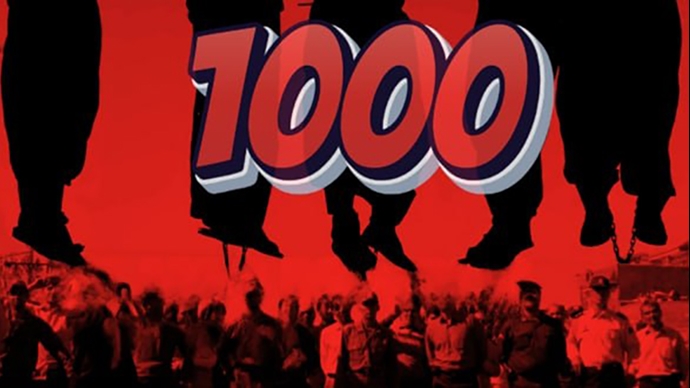

As Iran’s regime inches toward its collapse, it has increasingly resorted to mass executions. This grim strategy reached its peak in 2024, setting an unprecedented record of executions. The statistics from this year clearly indicate that the religious fascism, at its endgame, has resorted to bloody repression in a desperate attempt to delay its inevitable overthrow.
According to official statistics and reports from human rights organizations, 1,000 people were executed in Iran in 2024. This number represents a 16% increase compared to 2023, which saw 864 recorded executions, and is the highest number of executions in the past three decades. It should be noted that these figures only account for recorded executions, and secret or unannounced executions could significantly increase this number.
The clerical regime has also started 2025 with executions. On just the first day of January 2025, 12 executions were recorded in various prisons across the country: five in Ghezel Hesar Prison, five in Bandar Abbas, and two others in Yasuj and Malayer. These executions clearly demonstrate that the Iran’s regime continues its bloody repression despite international condemnations.
The Connection Between Executions and Political and Social Crises
The executions in 2024 are clearly tied to political developments and the regime’s failures both domestically and abroad. According to statistics, 11% of the executions occurred in the first quarter, 17% in the second quarter, 25% in the third quarter, and 47% in the fourth quarter of the year. This sharp rise in the last quarter coincided with significant regime defeats in the region and intensifying economic and social crises.
Notably, approximately 70% of the executions (695 cases), occurred after the inauguration of Masoud Pezeshkian as president. In October 2024, Pezeshkian shamelessly defended the wave of executions, stating: “Those who talk about human rights are asking why we execute murderers.” Such statements expose the regime leaders’ depth of cruelty and indifference toward fundamental human rights.
Repression of Minorities
Executions was carried out in 86 prisons across 31 provinces of the country. Half of these executions were concentrated in eight prisons, including Ghezel Hesar (165 cases), Shiraz (97 cases), and Isfahan (61 cases). Among the victims, marginalized and oppressed minorities, such as the Baluch people, had the largest share. Of the executed, 119 were Baluch individuals, who, despite their province’s small population, represent a disproportionately high percentage of the victims.
Additionally, 34 women and seven individuals who were under 18 years old at the time of the alleged crime were among those executed. These figures highlight that the regime does not hesitate to execute women and minors. Moreover, four of these executions were carried out in a horrifying manner in public.
Blatant Contradictions and Hypocrisy of the Mullahs
More than half of the executions (502 cases) were carried out on charges related to drug offenses. This is even though the Islamic Revolutionary Guard Corps (IRGC) and other mafia networks tied to regime supreme leader Ali Khamenei are themselves the main operators of large-scale drug trafficking networks in the region and globally. This blatant contradiction highlights the regime’s misuse of laws to suppress the weak and impoverished segments of society.
In addition to executions, other inhumane punishments have continued. Examples include the amputation of the fingers of two brothers in Urmia Prison and two other prisoners in Qom. Meanwhile, billion-dollar thefts and embezzlements by the regime’s leaders have become routine, with none of them facing any prosecution.
International Reactions and the Responsibility of the Global Community
Maryam Rajavi, the president-elect of the National Council of Resistance of Iran (NCRI), described the wave of executions as regime’s desperate attempt “to suppress the people’s uprising demanding the regime’s overthrow.” She emphasized “these atrocities only strengthened the determination of Iran’s youth to overthrow the religious dictatorship.” She also warned that silence and inaction in the face of such savage executions not only trample on recognized human rights principles but also embolden the regime to continue its executions, terrorism, war-mongering, and pursuit of nuclear weapons.
She called for the religious fascism ruling Iran to be ostracized by the global community and for any dealings or negotiations with the regime to be conditional on halting executions and torture. Furthermore, the regime’s leaders must face justice for 45 years of crimes against humanity.
A Sinister and Failed Strategy
The regime’s widespread executions and bloody repression is meant to suppress the Iranian people’s uprising and delay its inevitable downfall. However, this sinister strategy will not secure the regime’s survival but will instead intensify public dissatisfaction and strengthen the people’s determination to end this dictatorship. The global community bears a heavy responsibility at this historic moment. Silence in the face of these atrocities is a blatant betrayal of human values and rights. The decrepit religious fascism must be held accountable as soon as possible and consigned to the dustbin of history.