

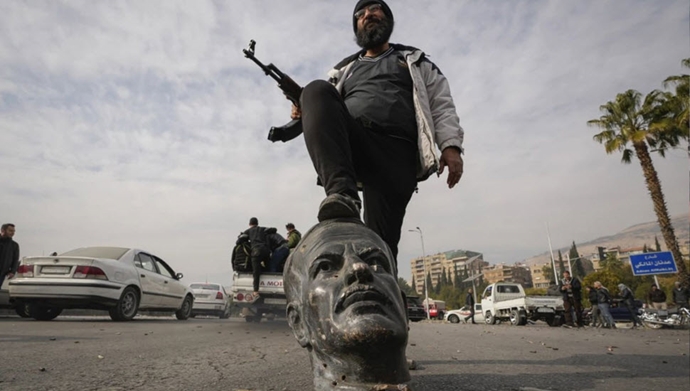

One month after the fall of the Assad regime in Syria, Iran’s regime is still trying to lift the spirits of its demoralized forces, who are seeing the regime on the decline after losing its main ally in the region.
In this context, Abbas Araghchi, the regime’s Deputy Foreign Minister, lamented the media environment, stating, “Today more than ever, we must care for morale and not allow enemies to create despair and uncertainty through the media environment… Preserving the morale of the people and various groups in the current very critical circumstances is more necessary than ever.”
On January 7, the state-run media outlet Rouydad24 quoted Araghchi’s remarks in an article titled “The Defeat of the Syrian Army is a Wake-Up Call for Us.” This alarm has indeed echoed in many other media outlets.
In its December 30, 2024, issue, the New Arab wrote about a collection of analyses and interpretations by Arab experts on the subject:
“All analyses agree that Iran is the biggest loser from the fall of the Assad regime and the weakening of Hezbollah. Iran had created and gradually strengthened an axis that extended from Tehran to the Mediterranean Sea; this axis passed through Iraq and Syria and reached Lebanon, where Hezbollah, built and armed by Iran, held control. According to the same analyses, this axis has now been destroyed, and Iran’s dream of establishing a Shia axis connecting it to the Mediterranean Sea has been obliterated.”
On December 25, 2024, Al-Arab wrote, “The historical change in Syria will alter the regional balance and has brought a major defeat for Iran… The Iranian regime’s investment in Syria can only be analyzed through the lens of an expansionist project whose primary goal was to export Iran’s internal problems beyond its borders and preserve the regime under the guise of exporting the revolution. Iran will soon have to bear all the costs of its adventurism in Syria.”
The same newspaper, on December 30, 2024, wrote, “The year 2024 was the year of the failure of Iran’s expansionist project in the region. The question is, how will the ‘Islamic Republic’ deal with this defeat, which it is clearly incapable of accepting? The root of this failure lies in swallowing a morsel too big for Iran to digest.”
Al-Arab further elaborated on the significance of the regime’s historical defeat in Syria, stating: “Accepting this defeat must start with ending the ‘resistance’ business, whether in Syria, Lebanon, Palestine, Iraq, or Yemen. Lebanon is no longer a ‘battlefield.’ Syria is no longer a ‘battlefield.’ Iran’s game in Lebanon and Syria is over. Now the game is elsewhere: inside Iran.”
The shift of the battleground from Syria to inside Iran echoes the famous statement of regime Supreme Leader Ali Khamenei, who once said that if the regime does not fight in Syria, it will have to fight in Kermanshah, Hamadan, and other Iranian cities. In other words, with the removal of the barrier established to suppress uprisings, the battleground has now moved inside Iran.
With the backbone of the Iranian regime in the region broken, the curtains have been lifted, revealing more clearly than ever that the expenditure of tens of billions of dollars from the pockets of the Iranian people, under the ridiculous pretext of defending the shrine, was actually aimed at preserving the regime and suppressing uprisings. Now, the decaying regime and its embattled leader face the imminent threat of uprisings.