

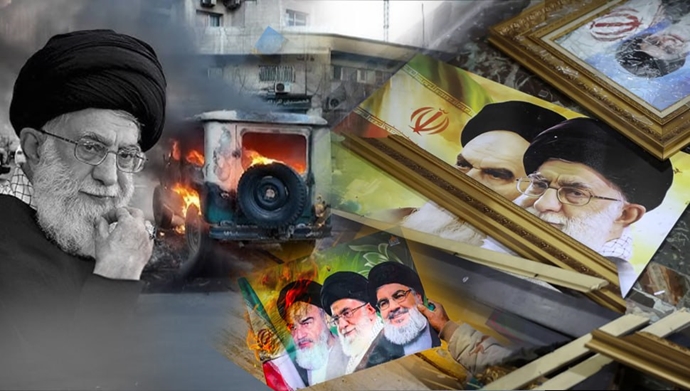

Since Iran’s regime lost one of its most coveted investments with the fall of the Assad regime in Syria, Supreme Leader Ali Khamenei has made four speeches offering empty promises to his audience. Without presenting a clear position or directive, he makes promises to IRGC Basij forces, asserting that Syria will improve, Lebanon and Yemen remain part of the “Axis of Resistance,” and the “Resistance Front” is still intact.
In all four speeches, Khamenei tried to convince his audience that Syria remains unaffected and that the expenses were for ensuring security. To dress the shaky foundation of the regime in the guise of “security,” he symbolically offers Lebanon’s and Syria’s loss to Iraq’s holy sites, trying to console his followers that the holy shrines in Karbala and Najaf still exist.
Islamic Revolutionary Guard Corps (IRGC) commanders are traveling to various cities, creating empty hype and loudly boasting about what they will allegedly achieve.
The hypocritical Friday prayer leaders, briefed weekly by Khamenei’s office, reassure the demoralized regime supporters, emphasizing that nothing has happened while warning against overreacting.
The regime’s think tank is striving to create artificial crises in a “new Syria” to instill fear, suggesting that without the clerical regime’s grip, Iran will descend into chaos like Syria. Meanwhile, most Iranians enthusiastically welcomed the fall of the Syrian dictator, hoping for a similar fate for the mullahs ruling Iran.
During this time, Iranians inside and outside the country have focused on the regime’s strategic defeat in the region and its direct impact on the regime’s governance and fate.
No matter how much Khamenei tries to regroup the regime’s demoralized forces, three interconnected factors undermine his authority and the regime’s propaganda machine, even among loyalists:
1- Khamenei cannot escape the reality of the collapse of his regime’s “strategic depth” and the end of a 30-year era of regional hegemony.
2- After the failure of the regime’s regional strategy, Iranian society has become a significantly stronger opposing force against the regime.
3- The shared atrocities of Khamenei and Assad have turned even some within the regime against the lavish spending in Syria at the Supreme Leader’s behest.
The traces of the clerical regime’s involvement in horrific crimes in Syria remain undeniable. On January 2, Agence France-Presse reported that the Syrian Observatory for Human Rights announced that over 528,500 people have been killed in the Syrian civil war. The deaths of more than 14,000 individuals from torture in Bashar al-Assad’s prisons have been confirmed through official documents discovered in these facilities following their liberation.
Khamenei’s maneuvers, the Friday prayer leaders, and the IRGC commanders’ efforts to whitewash the strategic defeat in Syria, Lebanon, and Palestine hold no political or strategic value. This is because the profound and transformative effects of this defeat are propelling both the internal dynamics of the regime and social protests toward a fate like Assad’s for Khamenei.
The political and social developments of the past year have recently culminated in a decisive delineation against the clerical dictatorship and demands for both domestic and international accountability. We witness professional groups chanting slogans such as “Our silence is betrayal” in the streets, calling for national unity and solidarity.
It is an inevitable reality that the regime’s strategic defeat accelerates the momentum of the movement for its overthrow. This is the pressing and active issue between the regime and most of the Iranian people.