

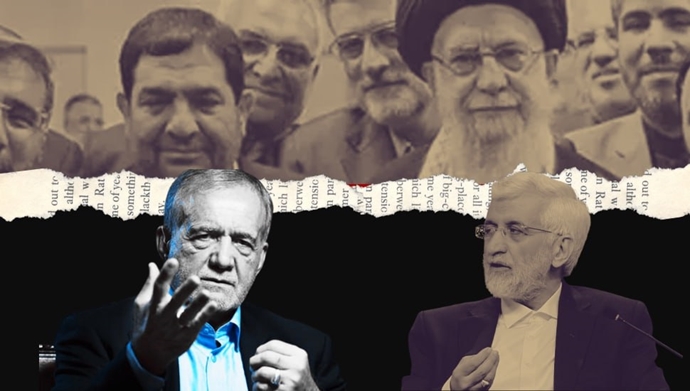

On September 23, 2024, in an unprecedented and unexpected move, Iranian regime Supreme Leader Ali Khamenei appointed Mohammad Mokhber, Vice President under Ebrahim Raisi, as the “Advisor and Assistant to the Supreme Leader and Leader of the Nation.” The decree for his appointment stated:
“Considering your committed and impactful services in management and economic fields, especially in the government of Martyr Raisi, and your correct and prudent policy of employing elites and motivated young individuals in the execution of various projects, I appoint you as the Advisor and Assistant to the Leadership. It is expected that, in line with this policy, you will continue identifying young talents and collaborating with them through logical planning and employing them in assisting government and other entities.” (ILNA, September 24, 2024).
This appointment was made while Massoud Pezeshkian, the official President, was on a trip to New York to address the UN General Assembly.
The terms “Advisor” and “Assistant” in Khamenei’s office evoke a familiar meaning. Those working under this title in Khamenei’s office are, in fact, agents of the Ministry of Intelligence. They play a major role in suppressing dissent, causing corruption, fabricating cases against rival factions, and advancing Khamenei’s repressive policies. These individuals define the regime’s grand security strategies and exert control over intelligence and security organizations.
Khamenei understands that if he does not have his own independent and exclusive government and does not embed it in every aspect of the regime, he will not be able to maintain his rule.
Khamenei has his own independent cabinet. At critical and decisive moments of the regime, this reality becomes apparent. Hassan Rouhani, the former President, referred to this supra-government during power struggles among regime factions as the “Government with Guns” in contrast to the “Government without Guns.”
The showcase of the regime continuously changes, and different products are placed behind it, but the main structure of power behind the scenes, consisting of close associates, advisors, and intermediaries, always remains the same. They decide the composition of the visible cabinet—who stays and who leaves.
Whenever the Supreme Leader wants to boast about elections, he sends forth some of his pawns as the President, cabinet members, and members of parliament. They serve as the regime’s façade for foreign interactions. In this system, according to Khamenei’s recent decree, the real government is Mohammad Mokhber, while the showcase government is Massoud Pezeshkian. In other words, what is wrapped in the guise of a “Republic,” “President,” and “Elections” is merely a decoration to enhance Khamenei’s absolute rule.
Let’s carefully reconsider Khamenei’s decree for the appointment of the supra-government:
He praises Mokhber for his contributions “in management and economic fields, especially in the Raisi government,” and directs him to “continue the prudent policy of employing motivated and hardworking youth in various projects.” We are familiar with the term “Young Hezbollah Government” from the time when Ebrahim Raisi was elevated to the presidency. In Khamenei’s lexicon, “youth!” and “motivated and hardworking youth!” are code words for loyal and pre-screened individuals to be employed in government positions. The sudden emergence of Mojtaba Khamenei as the Deputy to the Leader completes this puzzle, hinting at the scenario being pursued. If we look closely, Khamenei’s current policy is a continuation of the same one he used when selecting and positioning Raisi.
Interestingly, in addition to the official government (Pezeshkian with the slogan of “National Unity”) and the supra-government (Mohammad Mokhber), there is also a “Shadow Government” led by Saeed Jalili. Jalili describes the Shadow Government as a “discourse and ideology” and says:
“This discourse states that everyone in society, within their ability, has a duty to follow the developments step by step. If the actions are appropriate, they should be supported, and if they require correction, solutions should be provided… We believe that the success of the elected government will strengthen the country, and we must help the government. If any shortcomings are observed, the issue should be pointed out, mistakes should be noted, and solutions should be offered. The student movement can be effective in this regard by following developments in various fields according to its capacity and capability, and taking necessary actions to strengthen efforts and resolve issues.” (Donya-e-Eqtesad, August 8, 2024).
He reiterated similar remarks in his meeting with Pezeshkian. The essence of his statements is that he sees himself as a rival to the official government and is not satisfied with anything less.