

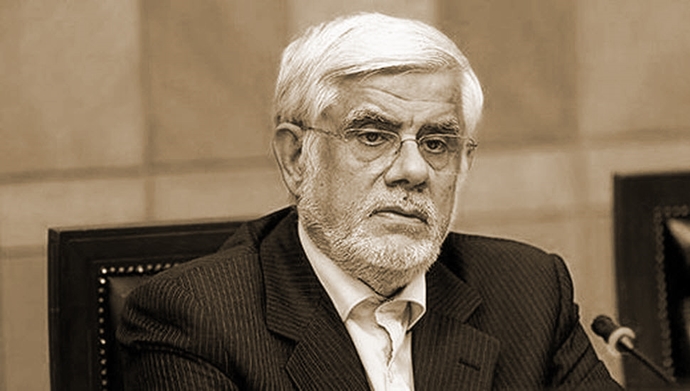

After declaring the reinstatement of the maximum pressure policy on the Iranian regime, U.S. President Donald Trump followed up with an offer for negotiating a new nuclear deal with Tehran. In response, regime Vice President Mohammad Reza Aref, announced that at present, no meeting or negotiation is on its agenda.
On February 5, responding to questions from the media, Aref said, “One cannot say that a meeting between two individuals is impossible, but today, meetings and negotiations are not on the Islamic Republic’s agenda.”
Earlier, Deputy Intelligence Minister Hossein Safdari had warned reformist factions within the regime, who were increasingly advocating for negotiations, that talks with the U.S. were “the greatest poison” for the system and would have “no political or security benefit.”
On the night of February 2, during a gathering of seminary teachers in Qom, Hossein Safdari elaborated on why negotiations were toxic for the regime. He urged those pushing for talks to learn from the fate of the Syrian regime and its now-ousted leader Bashar al-Assad.
Safdari described the collapse and elimination of Assad’s rule in Syria as the key development in the region and said, “The Americans want to use negotiations to tell Iran that it must either retreat, be overthrown, or face the same fate as Assad.”
The deputy minister of intelligence emphasized that “when negotiations are used as a threat, they are the greatest poison.” He added, “The lesson we learn from Syria is that if we do not resist, they will ravage our country. Today, Syrians do not even have the capacity to fire a few mortars in their own defense. Therefore, within the framework of the country’s approved strategies, no one intends to negotiate. Those who think they can achieve results at the negotiating table with the Americans either do not understand politics or are unfamiliar with the language of diplomacy. Today, negotiations with the U.S. offer no political or security benefit to the Islamic Republic.” (Tasnim News Agency, February 3).
Two days before Safdari’s speech, representatives of Supreme Leader Ali Khamenei used Friday prayer sermons across various cities to lash out at those advocating for negotiations.
In Karaj, Mohammad Mehdi Hosseini Hamedani said, “Some people are distorting the Leader’s remarks. He has not granted any permission for negotiations. He said we must be mindful of whom we are dealing with.”
In Ilam, cleric Allah Nour Karimi Tabar warned, “Today, the enemy’s strategy is to change the course of the revolution through diplomatic smiles at the negotiating table. We once trusted their smiles, signatures, and commitments. A believer should not be bitten twice from the same hole.”
In Mashhad, Ahmad Alamolhoda, said, “It has reached the point where they are begging for negotiations. They go groveling at the enemy’s door just to gain power in this country.”
Following this barrage of threats and denunciations, Setareh Sobh, a newspaper tied to the so-called “reformist” faction, wrote on February 1, “No solution remains other than negotiation. If a new agreement is not reached by this date, the country will face a crisis and the risk of military conflict, as the activation of the snapback mechanism would mean the return of six UN Security Council resolutions under Chapter VII.”