

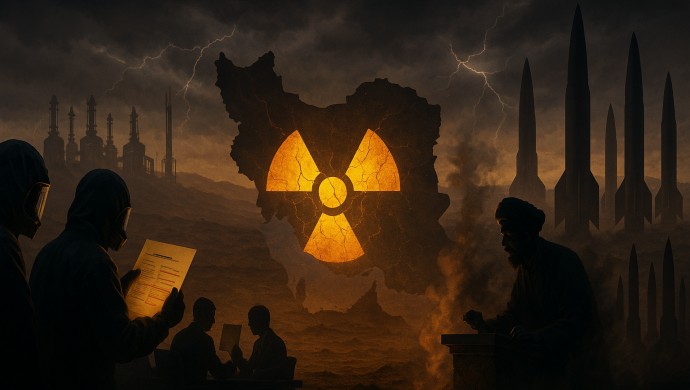

The Iranian regime is teetering on the edge of an unprecedented crisis as recent damning reports from the International Atomic Energy Agency (IAEA) have laid bare its clandestine nuclear activities and blatant deceptions. The international community, long wary of Tehran’s nuclear ambitions, now possesses irrefutable evidence of the mullahs’ relentless pursuit of atomic weapons, pushing the regime into a corner with dwindling options and potentially catastrophic consequences. The findings, presented ahead of a crucial IAEA Board of Governors meeting around June 9, 2025, paint a grim picture of a regime flouting international obligations while desperately trying to conceal the true extent of its illicit program.
The damning evidence of a rogue nuclear program
The latest IAEA confidential report, dated May 31, 2025, and a separate report sent to member states, deliver a devastating blow to the regime’s facade of a peaceful nuclear program. According to these reports, Iran’s stockpile of uranium enriched to 60% purity—a level perilously close to the 90% weapons-grade threshold—has surged to a staggering 408.6 kilograms. This quantity, if enriched further, is sufficient for nine nuclear weapons, based on the IAEA’s own metrics. Alarmingly, this represents an almost 50% increase (133.8 kg) in just a few months since the previous IAEA report in February 2025, an expansion that brazenly occurred during five rounds of negotiations with the United States, underscoring the regime’s contempt for diplomatic engagement and international commitments.
The IAEA’s comprehensive investigation also definitively uncovered secret nuclear activities involving undeclared nuclear material at three long-scrutinized locations: Lavisan-Shian, Varamin, and Turquzabad. The report concludes that “these three locations, and other possible related locations, were part of an undeclared structured nuclear programme carried out by Iran until the early 2000s and that some activities used undeclared nuclear material.”
Specifically, at Lavisan-Shian in Tehran, a disc made of uranium metal was “used in the production of explosively-driven neutron sources” on at least two occasions in 2003. This process is directly designed to initiate the explosion in a nuclear weapon, exposing the military dimensions of the program.
The agency stated that Iran “did not declare nuclear material and nuclear-related activities at three undeclared locations.” Furthermore, nuclear material or heavily contaminated equipment from this program was stored at a fourth site, Turquzabad, between 2009 and 2018. The IAEA deemed Iran’s enrichment to such high levels as being “of serious concern,” noting it is the only country to do so without currently producing nuclear weapons.
Deception, defiance, and growing panic
Faced with this irrefutable evidence, the Iranian regime has resorted to its usual tactics of denial and deflection. Iran’s foreign ministry and its nuclear agency jointly rejected the IAEA report, predictably branding it “politically motivated” and threatening “appropriate measures” in response to any action at the Board of Governors meeting. This defiance, however, belies a deep-seated panic within the ruling clique. Regime foreign minister Abbas Araqchi frantically contacted IAEA Director General Rafael Grossi, warning that Iran “will respond to any inappropriate action by European parties,” and subsequently rushed to Egypt for a meeting with Grossi. Nournews, affiliated with the regime’s Supreme National Security Council, lamented that the “biased IAEA report recalls a return to costly games.”
The regime’s anxiety is further compounded by the relentless exposés by the Iranian Resistance, which, since 2001, first unveiled the regime’s clandestine nuclear program and has continued to reveal its hidden aspects. Regime figures like IRGC member Abdollah Ganji expressed concern on X (formerly Twitter), questioning the timing of an Austrian security service report on Iran’s nuclear activities, the IAEA’s “extraordinary growth” statement on enrichment, and a simultaneous revelation by the Iranian Resistance about a nuclear site in Semnan. Mohammad Eslami, head of the regime’s Atomic Energy Organization, also complained that “the [PMOI] names a location or site every time and starts to create hype and agitation regarding our atomic program.” These admissions highlight the crucial role of the Iranian Resistance in unmasking the regime’s dangerous ambitions.
International condemnation mounts as patience wears thin
The IAEA’s stark findings, confirming a “gross violation” of the Non-Proliferation Treaty (NPT), have triggered alarm bells globally. The United States, Britain, France, and Germany are reportedly preparing a “heavy resolution” for the upcoming IAEA Board of Governors meeting. Diplomats indicate this resolution could formally declare Iran in “non-compliance” with its obligations, a significant step not taken since 2006.
Such a declaration would pave the way for Iran’s referral to the UN Security Council. This, in turn, could activate the “snapback” mechanism, leading to the automatic reinstatement of all UN sanctions and placing the regime under Chapter VII of the UN Charter. This legally designates the regime as an “international threat” and could even open the door to military action against its nuclear program.
The deadly impasse for Khamenei
The escalating nuclear crisis has pushed Supreme Leader Ali Khamenei into a deadly predicament. The regime faces a stark choice: either capitulate completely, effectively “drinking the nuclear poison” by abandoning its decades-long pursuit of atomic weapons, or continue its current defiant path, which risks even more crippling sanctions and the looming threat of military intervention.
The US has reportedly urged the regime to stop all enrichment and join a regional consortium with Saudi Arabia and others, a proposal flatly rejected by regime officials who insisted they could not relinquish domestic enrichment. This intransigence highlights the regime’s commitment to its nuclear ambitions, despite the severe costs.
This external pressure converges with an increasingly volatile internal situation. Iran is a tinderbox, with continuous strikes and protests across the country signaling a society on the verge of an explosion. The specter of a nationwide uprising is the ultimate fear for Khamenei, a danger he perceives as more threatening than any external crisis. The regime’s desperate gamble on nuclear weapons is not only a threat to global peace but also an attempt to project strength amidst profound domestic weakness and fear of its own population.
The international community can no longer afford to be deceived by the Iranian regime’s machinations. The latest IAEA reports provide clear and compelling evidence of a systematic, covert nuclear weapons program. It is time for decisive action to dismantle this threat, hold the regime accountable for its egregious violations, and support the Iranian people’s aspirations for a democratic, peaceful, and non-nuclear Iran, free from the tyranny of the mullahs.