

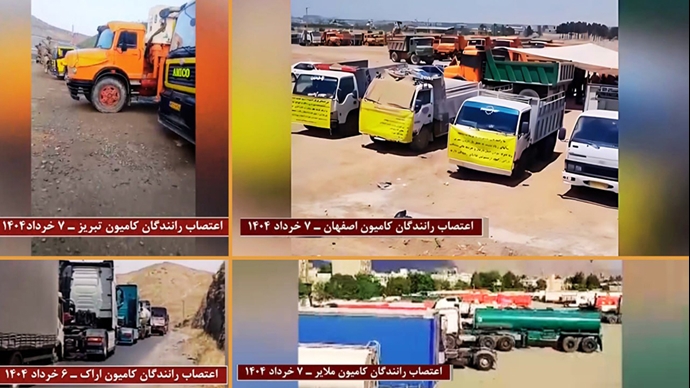

A potent wave of defiance is sweeping across Iran, with the nationwide strike by truck drivers, which marked its eleventh day on June 1, 2025, emerging as a formidable challenge to the clerical regime. This is a powerful manifestation of a nation’s deep-seated frustration, crippling key transportation arteries and galvanizing support from various struggling sectors of Iranian society.
The strike, spanning at least 155 cities across all 31 provinces, serves as a lit fuse, igniting broader solidarity and exposing the regime’s pervasive corruption and incompetence, signaling a populace increasingly ready for fundamental change.
June 1—Tehran, Iran
Tehran's cargo terminal parking lot is empty as truckers continue their nationwide strike, which has spread to at least 155 cities in its 11th day.#IranProtestspic.twitter.com/ZH1RWUY0EQ— People's Mojahedin Organization of Iran (PMOI/MEK) (@Mojahedineng) June 1, 2025
The strike’s unprecedented scope and drivers’ unwavering resolve
The sheer scale of the truck drivers’ action is unprecedented. On May 31, 2025, the strike had already reached 152 cities, and by June 1, it extended to 155. The impact has been palpable: Tehran’s cargo terminal parking lot remained conspicuously empty. Reports and images from freight terminals and major routes in cities including Arak (specifically the Arak to Tehran road), Bandar Imam, Khorramabad, Isfahan, Sanandaj, Shiraz, Yasuj, and Bandar Abbas depicted a near-total standstill of truck activity.
In Chermahin Lanjan, all trucks were reported parked in the city’s four parking lots. The usually bustling road to Bandar Abbas was notably empty of trucks, and drivers in Shiraz noted the Sadatshahr police checkpoint, typically congested, was devoid of heavy vehicles.
May 31—Isfahan, central Iran
Minibus in Isfahan join the nationwide strike by truck drivers, protesting high insurance costs, rising prices of parts and fuel, and inadequate freight rate adjustments.#IranProtestspic.twitter.com/QWFZFCyhPB— People's Mojahedin Organization of Iran (PMOI/MEK) (@Mojahedineng) May 31, 2025
Their grievances are rooted in severe economic pressures: exorbitant insurance costs, the relentlessly rising prices of essential spare parts and fuel, and freight rate adjustments that fail to keep pace with rampant inflation.
These critical issues, they state, have been consistently ignored by government authorities. Despite regime attempts at suppression, including the arrest of nine colleagues in Bijar and others in Hamedan, the drivers’ resolve has only strengthened. The Union of Truck Drivers and Transporters of Iran powerfully declared: “Our response is one word: resistance until we achieve our basic human and legal rights! These threats only prove that our voice has reached a point where it has shaken the foundations of injustice… We stand firm until our rightful demands are met.” Their primary demand following the arrests has been the immediate and unconditional release of all detained colleagues.
May 31—Iran
10th day of strikes by truck drivers, protesting high insurance costs, rising prices of parts and fuel, and inadequate freight rate adjustments, all unaddressed by government authorities.#IranProtestspic.twitter.com/xHREfJmY8w— People's Mojahedin Organization of Iran (PMOI/MEK) (@Mojahedineng) May 31, 2025
Solidarity across sectors
This powerful display of unity by the truck drivers has resonated deeply, igniting a contagion of courage across various other sectors of Iranian society. Taxi drivers in cities such as Sabzevar and Arak, and minibus drivers in Isfahan, have joined the striking truck drivers, broadening the transportation community’s united front. The Syndicate of Workers of the Tehran and Suburbs Bus Company issued a statement backing the strike and condemning the arrests and threats against the drivers.
Beyond the transport sector, a significant development noted as early as May 28 and 29, 2025, was the widespread support from diverse professional and social groups. Workers, nurses, teachers, intercity drivers, and bakers have supported the truck drivers’ call to continue the strike until their demands are met and have declared their solidarity with them.
This burgeoning solidarity is crucial, as the regime’s strategy for years has been to impose hardship and keep various social and professional groups isolated from one another, without unions or unified representation, to prevent the threat of their combined power. Now, this very strategy is backfiring, as these groups recognize their shared plight and the necessity of mutual support against an oppressive dictatorship.
More footage of 10th day of truckers' strikes in Iran, which has now spread to 152 cities across the country.#IranProtestspic.twitter.com/GE1UegA99x
— People's Mojahedin Organization of Iran (PMOI/MEK) (@Mojahedineng) May 31, 2025
The regime panics
Faced with this escalating crisis, the regime’s response has been a predictable, yet failing, mix of intimidation and hollow promises, betraying a palpable sense of anxiety. Reports from Thursday, May 30, 2025, indicated that at freight terminals in Mobarakeh and Shahpur in Isfahan, drivers refusing to load cargo were threatened with the invalidation of “all their documents,” service cut-offs, and the direct opening of judicial cases against them. Arrests in cities like Bijar and Hamedan were carried out under the pretext of drivers being “security disruptors.”
Simultaneously, regime officials have offered placatory statements. Reza Rostami, head of the Transportation Commission of Iran’s Chamber of Commerce, vaguely promised that drivers’ concerns about social security insurance would be “re-evaluated within a week.” Abbas Soufi, a member of the regime’s Parliament Urban Development Commission, admitted that “freight tariffs haven’t been updated for years” and that “current insurance premiums are unaffordable,” while reporting the drafting of a double-urgency plan. Fatemeh Mohajerani, the government spokesperson, claimed on May 30, 2025, that the government feels “obliged to respond to the demands of the truck drivers.”
May 30—Sorkheh, northern Iran
Cargo terminal remain empty as truckers continue their strikes for 9th day.#IranProtests pic.twitter.com/S5dqciYGcO— People's Mojahedin Organization of Iran (PMOI/MEK) (@Mojahedineng) May 30, 2025
However, these assurances ring hollow against the backdrop of continued repression and the regime’s well-documented history of ignoring the people’s plight. The regime’s fear was openly voiced by Reza Nouri, Khamenei’s representative and the Friday prayer leader of Bojnourd, who stated on May 30, 2025: “There is talk of the truck drivers, talk of the bakeries… our enemies are trying to turn a small dispute into a riot.” He added, “We know our enemies are in ambush, looking to create a big issue, a big chaos out of a small dispute or difference that might arise within the system.” Such statements reveal not a willingness to address legitimate grievances, but a deep-seated fear of popular uprising and a desperate attempt to deflect blame onto external “enemies.”
The strike as a microcosm of national crisis
The truck drivers’ strike is far from an isolated incident; it is a microcosm of the profound and systemic economic crisis engendered by the clerical regime’s decades of corruption, incompetence, and prioritization of its oppressive agenda over national welfare. The grievances of the truckers resonated across numerous other sectors. On June 1, 2025, retirees from the Social Security Organization held rallies in Shush, Ahvaz, and Tehran, protesting their meager pensions and the skyrocketing cost of living. In Ahvaz, the retirees showed powerful solidarity, chanting, “The imprisoned truck driver must be freed” and “The imprisoned protester must be freed.”
More footage of protests by retirees of the Social Security Organization in Ahvaz.
Protesters chant "The imprisoned truck driver must be freed" and "The imprisoned protester must be freed" in support of other protesting communities.#IranProtestspic.twitter.com/yx2hRkOB0z— People's Mojahedin Organization of Iran (PMOI/MEK) (@Mojahedineng) June 1, 2025
Similarly, retirees from the steel and mining industry resumed their weekly protests in Isfahan and Kerman. Demonstrators in Isfahan voiced a particularly pointed accusation, chanting, “Reduce one [government] embezzlement, solve our problem.”
Workers also voiced their deep frustrations. In Gachsaran, contract workers from the Gachsaran Oil and Gas Company protested demanding direct employment contracts. In Tabriz, workers at CNG fueling stations went on strike over unpaid wages. On May 31, in Ilam, workers from the Puya Nakh factory protested outside the provincial governor’s office demanding overdue wages and an end to threatened layoffs.
In Yazd, parents protested an exorbitant tuition hike, and in Lordegan, residents decried the halt of a crucial water supply project. These are direct consequences of policies that have led to rampant inflation, widespread unemployment, and the decay of public services, while regime-affiliated entities continue to plunder the nation’s wealth.
Despite this brutal wave of arrests and executions, Iran’s cities continue to erupt daily with protests and strikes—from oil, gas, and petrochemical workers, to farmers, nurses, teachers, miners, bakers, truck drivers, and retirees. Since approximately 10 days ago, courageous… pic.twitter.com/x84WT41glL
— Maryam Rajavi (@Maryam_Rajavi) May 31, 2025
During the Free Iran conference on May 31, 2025, Mrs. Maryam Rajavi, the President-elect of the National Council of Resistance of Iran (NCRI), addressed the situation: “For the past ten days, hardworking truck drivers have gone on strike. Their outcry against injustice is loud. They are the voice of millions of laborers who this regime has plundered.” She called for broad public support for the striking drivers and demanded the immediate release of those arrested.
The regime’s crumbling foundations and the people’s unstoppable will
The sustained and expanding truck drivers’ strike, coupled with the burgeoning solidarity from diverse segments of Iranian society, serves as a clear and undeniable testament to the people’s escalating frustration and their courageous rejection of the ruling religious dictatorship. The regime’s fearful responses, characterized by a desperate blend of repression and empty rhetoric, only highlight its increasing weakness, isolation, and its abject failure to address the fundamental grievances of its citizens: the right to a dignified livelihood and an end to systemic corruption.
This collective outcry, echoing from the highways to city squares, is more than just a series of economic protests; it is a profound demand for fundamental change. As Mrs. Maryam Rajavi powerfully stated, “The day is not far when the smoldering anger of the Iranian people ignites into a well-organized uprising, led by resistance units, and turns the dynasty of this oppressive regime into ashes.” The resilience and unity displayed by the Iranian people signal an unyielding determination to reclaim their rights and their nation’s future, paving the way for a democratic and accountable government in Iran.