

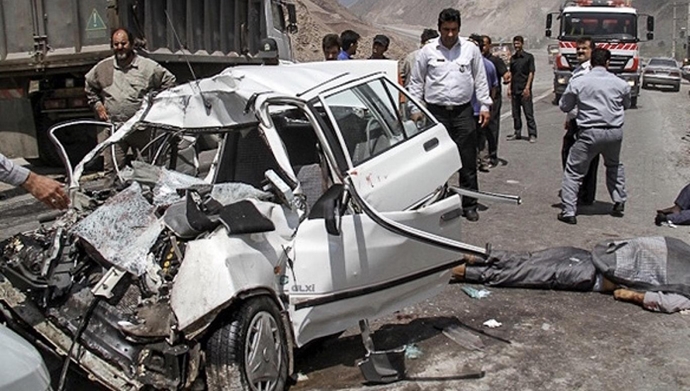

Under the mullahs’ regime, Iran’s automotive industry has been constantly falling to new lows. To date, it has only focused on importing used cars, assembly, producing counterfeit parts, and monopolizing lucrative revenues. The poor quality of vehicles produced by ruling mafias results in the annual death of over 20,000 Iranians on the roads, with many more injured. Additionally, it exacerbates air pollution and imposes heavy financial burdens on the public.
In May, a university professor stated, “Most of our road fatalities are victims of low-quality cars. The two major automakers, at best, employ 100,000 people; that means we pay 100,000 people to kill 20,000 annually!” (Source: Fararu news website, May 31, 2024).
The deputy of the Traffic Police also announced, “Out of approximately 27.5 million registered vehicles in the country, over 9 million lack a technical inspection certificate” (Source: the official IRNA news agency, November 20).
The enormous sums of money and immense profits from car imports, assembly, parts manufacturing, and the sale of low-quality vehicles cannot exist without the intervention and approval of the regime Supreme Leader Ali Khamenei’s office and the Islamic Revolutionary Guard Corps (IRGC). After the oil industry, the automotive sector is Iran’s second-largest industry, and its high financial turnover has long attracted the IRGC’s attention.
The IRGC’s entry into the automotive industry began long ago with slogans like “Entrust car manufacturing to strategic drone producers” in state-affiliated media. According to a 2017 WikiLeaks report, the IRGC owns 17% of SAIPA’s shares, comprising $1 billion in assets and $2 billion in company capital. Additionally, $240 million of Bahman Investment Company’s assets are linked to the IRGC.
However, in 2020, IRGC publicly announced an accelerated initiative to enter the automotive industry with the approval of Supreme Leader. Amir Ali Hajizadeh, the commander of the IRGC Aerospace Force, stated, “The formation of a joint committee between the IRGC and the Ministry of Industry to enable the military entity’s entry into the automotive sector is in line with the directive and obligation placed on them by the Leader of the Revolution” (Source: ISNA news agency, June 9, 2020). Khamenei had remarked that “the same mindset and intellect capable of producing satellites” could also produce “a car that consumes five liters of fuel per 100 kilometers.”
In addition to the state-owned car manufacturers Iran Khodro and Saipa, other companies have also been involved in exploiting the Iranian population. For instance, during the 2010s, it was revealed that the company Crouse misrepresented customs fees, siphoning approximately $220 million from the public between 2016 and 2019 (Source: Bitrun news website, February 5, 2022).
Price hikes and astronomical deficits
For years, sudden hikes in car prices have not only enriched officials but also served to cover the government’s massive budget deficits.
On November 19, Ensaf news website wrote, “An industry dependent on favoritism, currency exploitation, overpricing, and inefficient management will eventually collapse. The path Iranian automakers are on will only lead to the further destruction of this already dying industry.”
Iran Khodro and SAIPA, after much effort, obtained permission to raise prices. The products of these two automakers increased by 30%, and some models in the open market saw price hikes of over 500 million rials in a single day.
On November 20, the state-run Setareh Sobh newspaper quoted a car market analyst as saying, “The secretary of the Automakers Association said that the prices of some Iran Khodro vehicles need to increase by 70–80% to match their production costs.” This statement was publicized two days before the price hike, reinforcing the suspicion that automakers had reached an agreement with the government for the price increase and that these figures were deliberately leaked through the media to prepare the public.
The analyst further added: “When an industry faces numerous issues despite extensive support and presents itself as bankrupt, we must conclude that continuing its activities offers no benefit to us. Sooner or later, we will need to meet domestic demand through imports. State-owned automakers are bankrupt and survive off the public’s money.”
Interestingly, the secretary of the Automakers Association stated that the two major automakers incur at least 2 trillion rials in losses monthly, and their debts to parts manufacturers have exceeded 1 quadrillion rials.
Meanwhile, on November 18, Deutsche Welle reported that in Toyota’s 2023 financial report, an average profit of $2,500 was recorded per car, while Iranian automakers make $10,000 on vehicles sold to consumers.
The sudden and overnight increase in the prices of essential goods and services for the oppressed people of Iran occurs while even small wage raises for workers, teachers, nurses, and retirees require months or years of fruitless meetings.
On November 21, the state-run Alef news website wrote, “This results in a massive and dangerous imbalance between workers’ and employees’ wages and the prices of goods and services in the country, adding to the many existing imbalances in the country.”
However, these imbalances will ultimately lead to greater pressure on the regime. With unrest in the country, the balance of power will tilt in favor of the Iranian people against the nation’s enemies.