

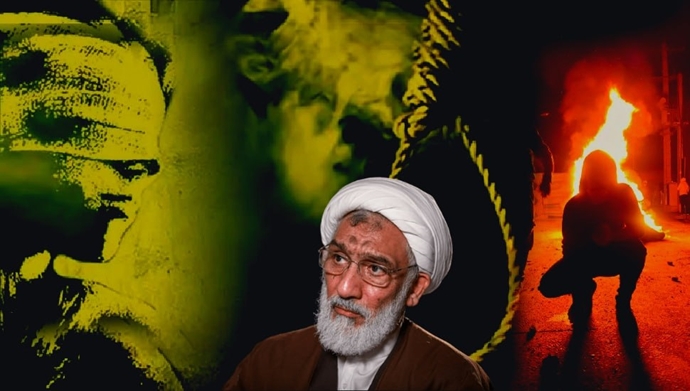

Mostafa Pourmohammadi, a notorious figure in the Iranian regime’s judiciary and intelligence apparatus and a key member of the “Death Committees” responsible for the 1988 massacre of political prisoners, has recently made a series of statements that, far from absolving him or the regime, further expose the deep-seated brutality and current panic within Iran’s ruling clerical establishment.
These remarks offer a chilling glimpse into the mindset that orchestrated one of modern history’s most heinous crimes against humanity, while also highlighting the regime’s increasing desperation in the face of domestic and international pressure.
The 1988 massacre saw the summary execution of an estimated 30,000 political prisoners across Iran. The vast majority of victims were members and supporters of the People’s Mojahedin Organization of Iran (PMOI/MEK). The killings were carried out based on a fatwa (religious decree) issued by then-Supreme Leader Ruhollah Khomeini, who ordered the annihilation of all PMOI prisoners who remained steadfast in their opposition to the regime. Pourmohammadi, who has held various high-ranking positions including Minister of Interior under Mahmoud Ahmadinejad and Minister of Justice under Hassan Rouhani, was a central figure in implementing this decree, serving on “Death Committees” that sent thousands to their deaths after mock trials lasting mere minutes. His recent utterances are not acts of contrition but rather as “inevitable confessions” forced by a regime teetering under the weight of its crimes and growing calls for accountability.
The “confessions” old and new: a consistent pattern of justifying mass murder
In his recent remarks, Pourmohammadi explicitly identified the PMOI as the primary and persistent target of the regime’s repressive machinery. “The most important group that has always made noise in the country and is still supported by Iran’s enemies to this day is these same Mojahedin,” he stated, attempting to frame the massacre as a response to an ongoing threat. He further described the terrifying atmosphere deliberately cultivated by the regime during the 1980s, admitting, “Many individuals were severely influenced by the general atmosphere… They would say: Sir, execute like so-and-so, execute! … They would say everyone must be executed.”
This chilling admission from his recent statements resonates with justifications he offered in a previous interview about a year ago. In that earlier exchange, Pourmohammadi laid bare the regime’s cold-blooded legal and religious rationale for the killings, stating, “The legal, judicial, and religious ruling for those who are steadfast in their positions is that they must be executed.” This directly echoes Khomeini’s fatwa, confirming that steadfast support for the PMOI was, in itself, a death sentence. In that same prior interview, Pourmohammadi inadvertently highlighted the unwavering courage of the PMOI prisoners. He recounted interrogations where, even after being told their stance meant execution, prisoners defiantly affirmed their commitment to the PMOI and its leader, Masoud Rajavi. “We begged them, saying… ‘If Masoud Rajavi were in Tehran now and opened the prison door, would you fight?’ They would say, ‘Yes, I would fight!’ What should I (Pourmohammadi) do?!” This reveals not only the prisoners’ heroism but also Pourmohammadi’s consistent, albeit self-serving, narrative.
Distortion and deflection: the regime’s failing narrative in recent remarks
Despite these partial admissions, Pourmohammadi’s recent statements are rife with attempts to distort history and deflect blame. He outrageously tried to minimize the scale of the atrocities by suggesting, “We ourselves accept that perhaps five mistakes were also made… We accept that in a few cases in the 1980s we did not act correctly.” This trivialization of a systematic, pre-planned massacre targeting thousands, recognized by international bodies like the UN Special Rapporteur Prof. Javaid Rehman as constituting genocide and atrocity crimes, is a profound insult to the victims and their families.
Furthermore, Pourmohammadi continues the regime’s desperate attempts to absolve its founder, Khomeini, from direct responsibility. His recent claim that “Imam [Khomeini] never resorted to violent behavior!” is a blatant falsehood, directly contradicted by Khomeini’s own explicit fatwa which ordered the execution of PMOI prisoners without due process, trial, or defense.
Underlying reasons: a regime cornered – past arrogance vs. current fear
The shift in Pourmohammadi’s tone, when compared to his past pronouncements, is telling. On July 25, 2019, he arrogantly stated on state TV, “We have not yet settled accounts with the [PMOI]. We must settle accounts with each and every one of them… We suffered many casualties because of the [PMOI], we were defeated… Should I come and give a legal answer?!” This belligerence contrasts sharply with his recent “frightened defense.” This change is indicative of a regime increasingly cornered by the relentless efforts of the justice movement for the 1988 victims, growing international scrutiny, and profound domestic discontent, particularly among a younger generation that rejects the regime’s falsified historical narratives.
His awareness of the public’s revulsion was already evident in the previous interview, where he lamented the perception of security officials, saying, “You interpret a security person as if he is a dirty rag that should be discarded.” This admission of being viewed as a “dirty rag” by society underscores the deep-seated hatred for perpetrators of such crimes, a sentiment that has only intensified as the truth of the regime’s atrocities becomes more widely known.
The unraveling truth and the inevitability of justice
Mostafa Pourmohammadi’s recent statements, much like his previous attempts to justify the unjustifiable, serve only to further incriminate himself and the Iranian regime. They are stark reminders of the systematic nature of the 1988 massacre, a crime against humanity specifically targeting the PMOI and all who yearned for a free Iran. These “confessions,” extracted under the pressure of a crumbling narrative and growing global condemnation, highlight the regime’s profound moral bankruptcy and its desperate, failing attempt to evade historical truth. The blood of the martyrs of 1988 continues to cry out for justice, and the People’s Mojahedin Organization of Iran remains steadfast in its commitment to ensuring that all perpetrators of these horrific crimes are held accountable before the Iranian people and the world. The day of reckoning, as Pourmohammadi’s own fearful words suggest, is drawing nearer.