

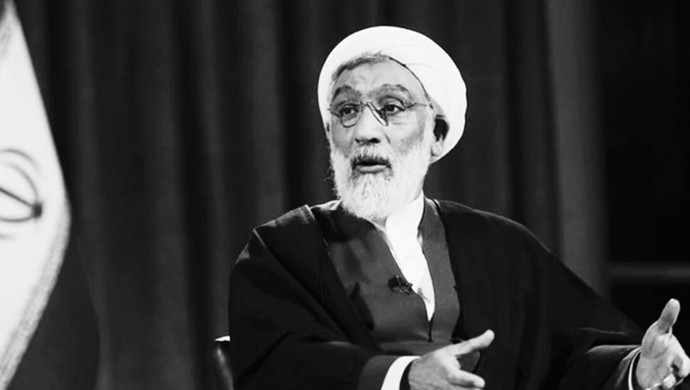

Mostafa Pourmohammadi, the executioner of political prisoners in 1988 and one of the candidates in the Iranian regime’s upcoming elections, was forced to make three significant confessions in a recent television interview:
In the first and most important confession about the 1988 massacre of political prisoners, Pourmohammadi said, “The legal, judicial, and religious ruling for those who are steadfast in their positions is that they must be executed.”
This is the same principle of Khomeini’s decree for the massacre of all steadfast members of the People’s Mojahedin Organization of Iran (PMOI/MEK). It means that anyone who holds the ideals and political stance of the PMOI, which is based on overthrowing the religious dictatorship of the mullahs, was condemned to execution and included in the massacre. This explicit reality was clearly written in Ruhollah Khomeini’s decree.
Khomeini’s decree, on the basis of which more than 30,000 political prisoners were executed in the summer of 1988, unequivocally indicated the order to execute any steadfast PMOI member and supporter. In this decree, Khomeini himself wrote, “Those who insist on their [support for the PMOI] in prisons across the country are considered as waging war against God and are condemned to execution.”
Another important confession by Pourmohammadi was his acknowledgment that the executed PMOI members were steadfast in their fight against the mullahs’ dictatorship and liberate the people of Iran. These heroes stood up in a completely unequal confrontation within the prisons and dungeons of the regime, enduring years of imprisonment and brutal torture, and under the most crushing pressures, they said “no” to Khomeini and his executioners. With their heroic resistance, they brought Khomeini and the regime to their knees. Here is how Pourmohammadi described the steadfastness of PMOI members in prison:
“We were very insistent in many instances… We told them two or three times, ‘Sir! Ma’am! What you are saying means that your previous sentence must be carried out.’ We begged them, saying, ‘You don’t have to accept us, you don’t have to accept the Islamic Republic at all. We don’t want you to say a single word in favor of [Khomeini] and the system… Do you support armed struggle against the Islamic Republic or oppose it? If Masoud Rajavi were in Tehran now and opened the prison door, would you fight?’ They would say, ‘Yes, I would fight!’ What should I (Pourmohammadi) do?!”
Pourmohammadi’s third confession is his acknowledgment of the intense social hatred towards the regime of executions and massacres. In response to the host’s question about his role in executions and massacres, he said, “You interpret a security person as if he is a dirty rag that should be discarded.”
This “dirty rag” of Khomeini and Khamenei, in another instance, to justify his job as an executioner, in response to the question that his name in society is “tied to the concept of execution,” said with despair, “Well, what should I do? I was a judge at one point; I had to either prosecute or write indictments. Some were fined, some were imprisoned, some were executed.”
Pourmohammadi, who now tries to portray himself as having been forced to issue execution orders, is the same executioner who, five years ago, when questioned about the executions of the 1980s and the 1988 massacre, arrogantly said, “We have not yet settled accounts with the [PMOI]. We must settle accounts with each and every one of them. Unfortunately, due to the psychological atmosphere or the ignorance and stupidity of some, we have become indebted. We suffered many casualties because of the [PMOI], we were defeated… Should I come and give a legal answer?!”
He then added, “No destruction has happened in the past 40 years unless the [PMOI] were the main perpetrators.” (State TV, July 25, 2019).
The fact that Pourmohammadi, whose crimes are well-documented, is backtracking on his previous comments and trying to distance himself from his role in the executions, shows how far the justice movement has come to hold the Iranian regime to account for their crimes.
Confessions by regime officials like Pourmohammadi indicate the undeniable truth that the executioners of the PMOI and the usurpers of the Iranian people’s right to sovereignty have no escape from answering to the people and history. The blood of the victims and martyrs is alive, and the day of reckoning is ahead.